
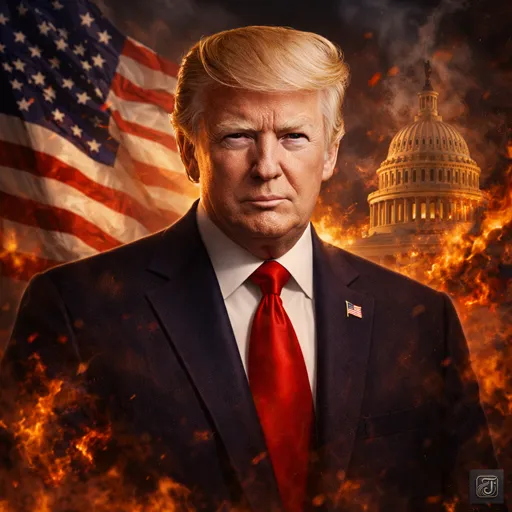
Donald J. Trump: A Mirror Reflecting America’s Emotions
The images used in this article are not journalistic photographs depicting real individuals or events.
They are generated as narrative, critical, and symbolic representations,
and are not intended to assert or confirm any specific facts or actions.
- Prologue
- Chapter 1: The Boy from Queens
- Chapter 2: The Manhattan Declaration
- Chapter 3: The Miracle of the Grand Hyatt
- Chapter 4: The Golden Tower and the Casino Empire (1983–1989)
- Chapter 5: Envy of the World’s Best (The Japanese Miracle)
- Chapter 6: Fame and Ruin — The Plaza Hotel (1988–1995)
- Chapter 7: The Collapse of the Empire (1990–1994) — The Fall of the Golden Empire
- Chapter 8: Into the Dark of Politics — The Reform Party Primaries (2000)
- Chapter 9: Transformation into a Television King (The Apprentice)
- Chapter 10: The Dark Shadow of SoHo (2007–2010)
- Chapter 11: The Anti-Elite Banner (The Obama Birthplace Controversy)
- Chapter 12: 2016 — The Year the Crown Was Taken
- Chapter 13: The Global Trade War (2018)
- Chapter 14: 2025 — Echoes of Fire (A Symbolic Literary Interpretation)
- Author’s Afterword
- Author: Fuji
Prologue
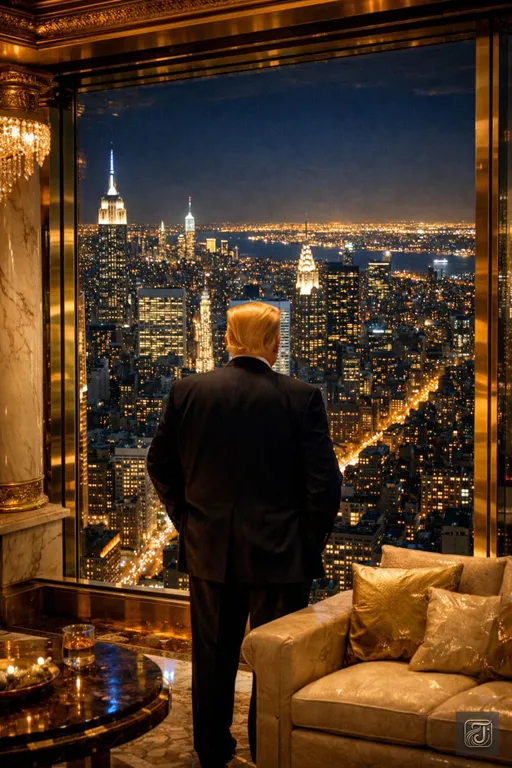
At the Summit of the Golden Tower
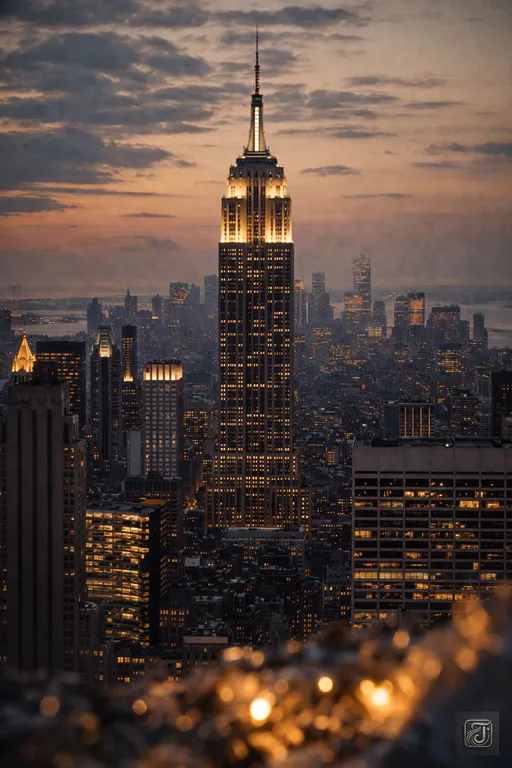
The Manhattan nightscape looked like a vast circuit board.
Millions upon millions of lights ran like a mesh of veins, making the city itself appear to pulse with intention.
At its center, a single tower pierced the sky along Fifth Avenue.
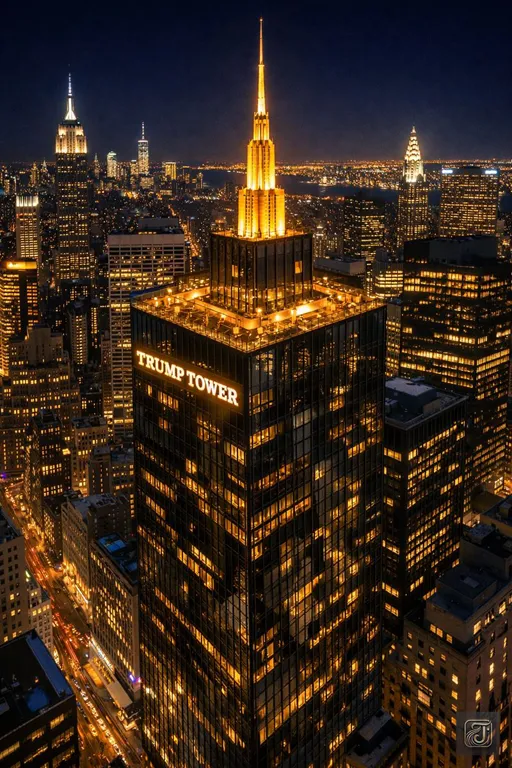
At the Summit of the Golden Tower
The Manhattan nightscape looked like a vast circuit board.
Millions upon millions of lights ran like a mesh of veins, making the city itself appear to pulse with intention.
At its center, a single tower pierced the sky along Fifth Avenue.
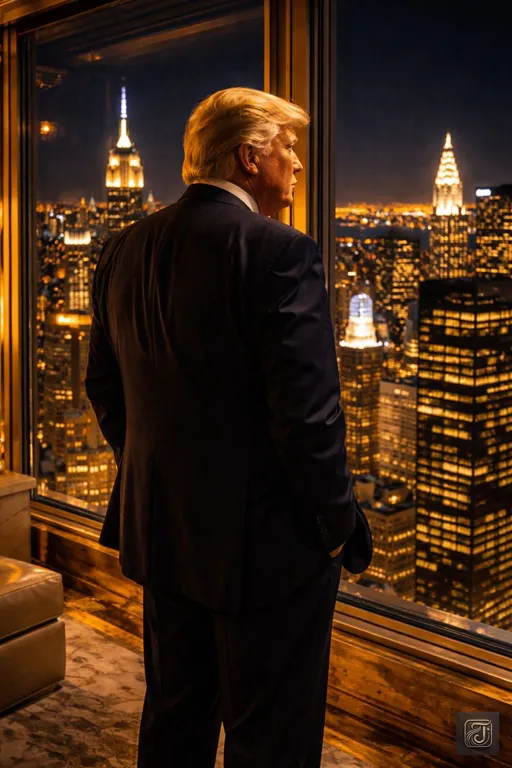
“I’ve come a long way.”
Donald John Trump.
A man who shook America twice.
Loved, hated, feared, mocked—and even returned to power.
Whatever judgment one makes, it cannot be denied that he has walked at the very center of history.
Yet what he came to possess was not solely the product of effort alone.
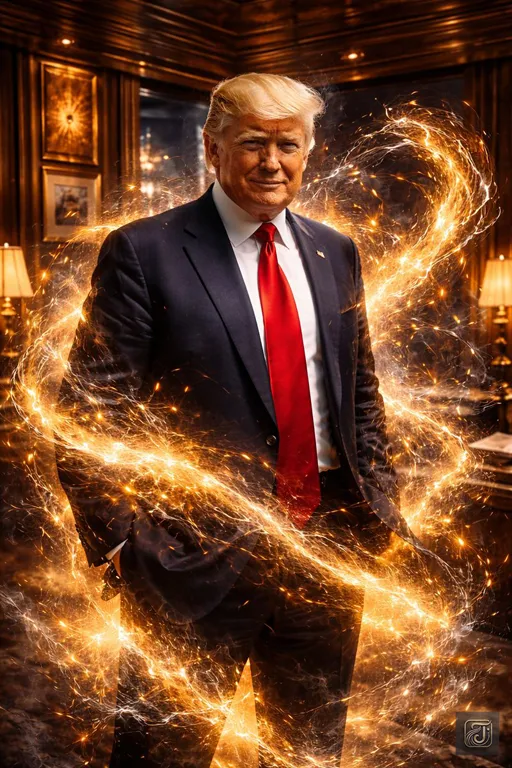
Aggression, bravado, negotiation, deception, branding, and obsession.
All of it fused together to create the strange, volatile energy known as “Trump.”
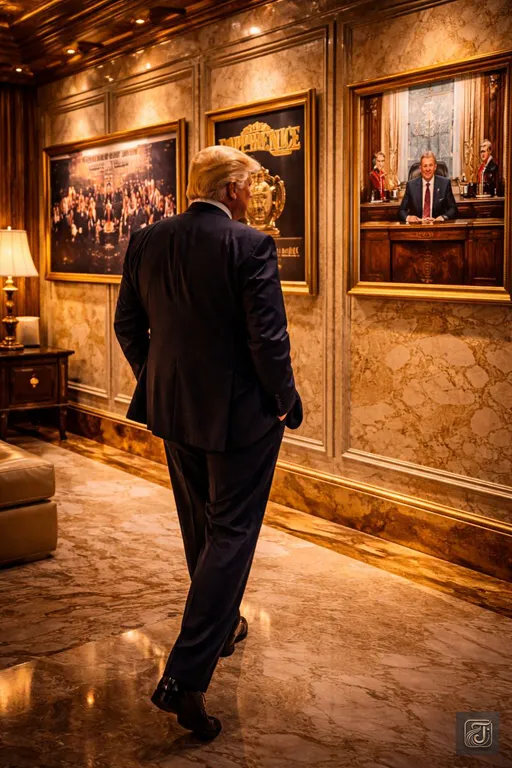
He turned his gaze away from the window and walked slowly across the marble floor.
Along the walls of the room hung symbols of his own success.
Photographs from the opening ceremony of the Grand Hyatt Hotel.
The opening night of the Taj Mahal.
A commemorative plaque marking The Apprentice reaching number one in national ratings.
And himself, leaning back confidently in a chair inside the Oval Office.
All of them preserved as “moments of victory”—
Yet how many failures had it taken to reach each one?
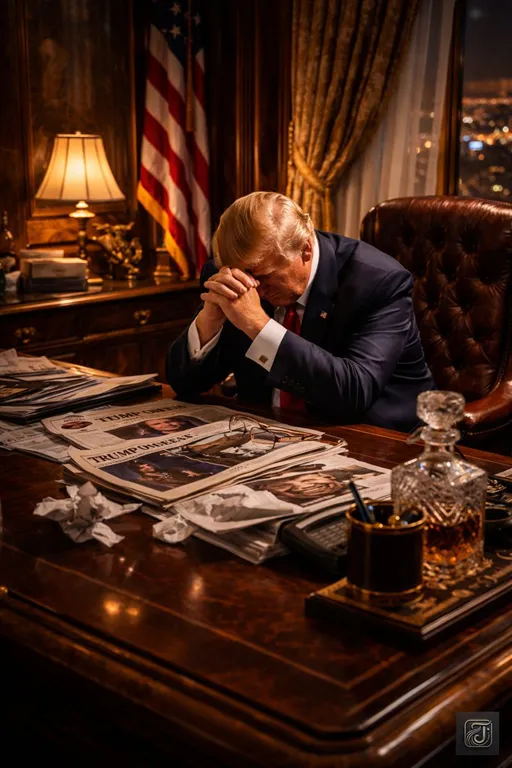
Nights on the brink of bankruptcy.
The humiliation of bowing his head to bankers.
The days he was mocked in newspapers.
The period when the Plaza Hotel’s losses drove him into a corner.
His younger years, seething with jealousy over Japan’s economic rise.
The chaos of the Reform Party in 2000.
The political swamp, surrounded by enemies.
And then—
defeat in 2020.
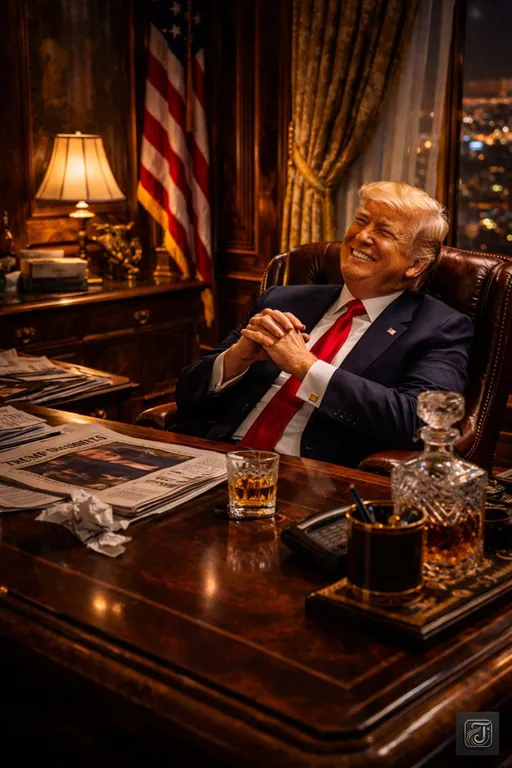
“I hate admitting defeat.”
The moment he said it aloud, he let out a faint laugh.
No matter how many times he fell, he would never say that he had fallen.
That was the man called Trump.
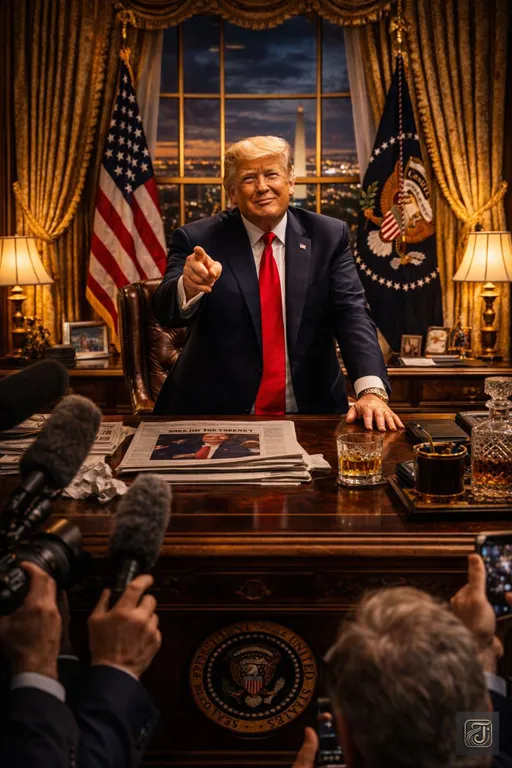
Now, in 2025, as his second term as president begins, the world once again finds itself tossed about by his every move.
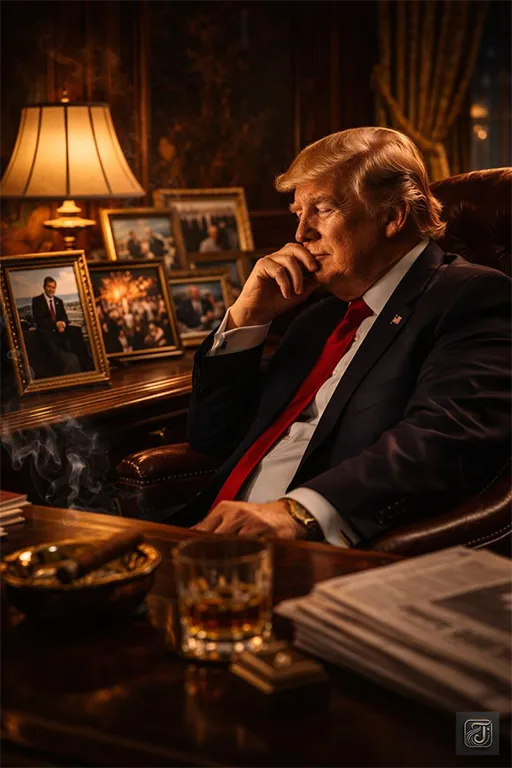
He sat down in the chair and slowly closed his eyes.
Memories from his boyhood began to surface.
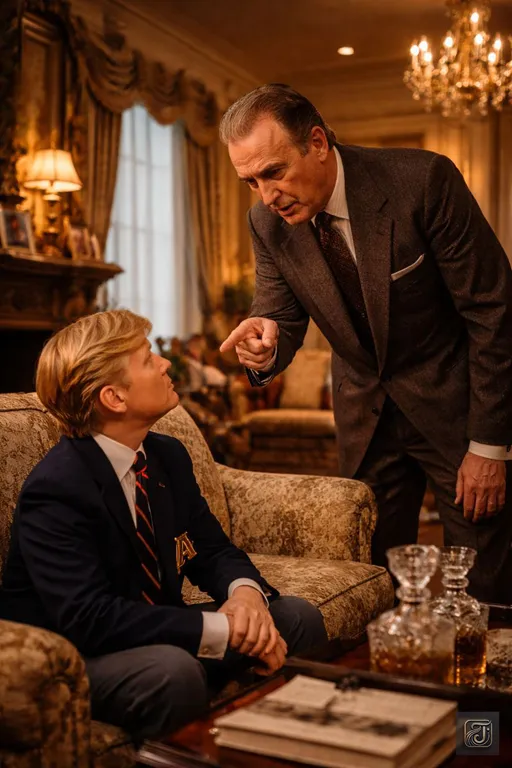
The spacious house in Queens.
His father Fred’s stern voice.
“Be a winner in everything you do, Donald.”
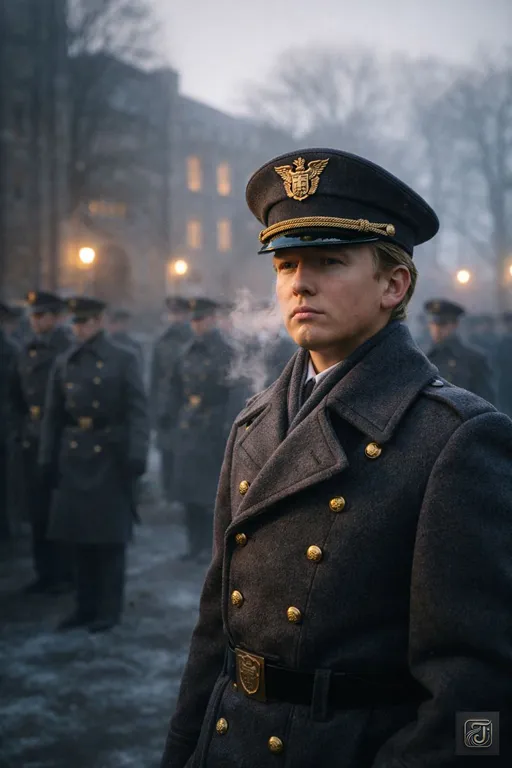
The cold mornings at military school.
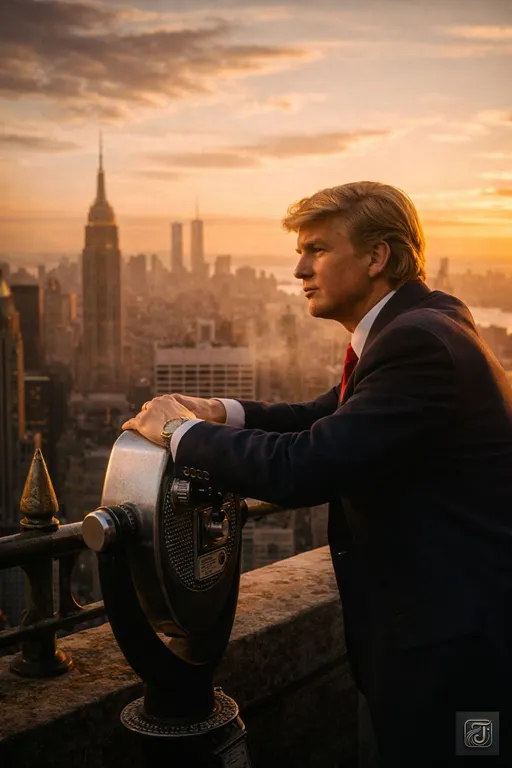
The Manhattan skyline he saw for the first time at Wharton.
The day he swore, “I’ll carve my name into that place.”
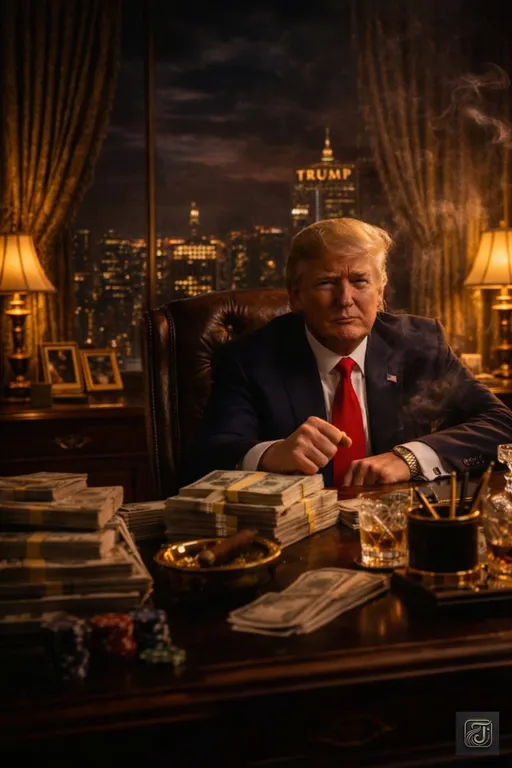
And he truly did carve it there.
But behind it all, money, power, desire, vanity, jealousy, betrayal, calculation—and collapse—came crashing in like a vortex.
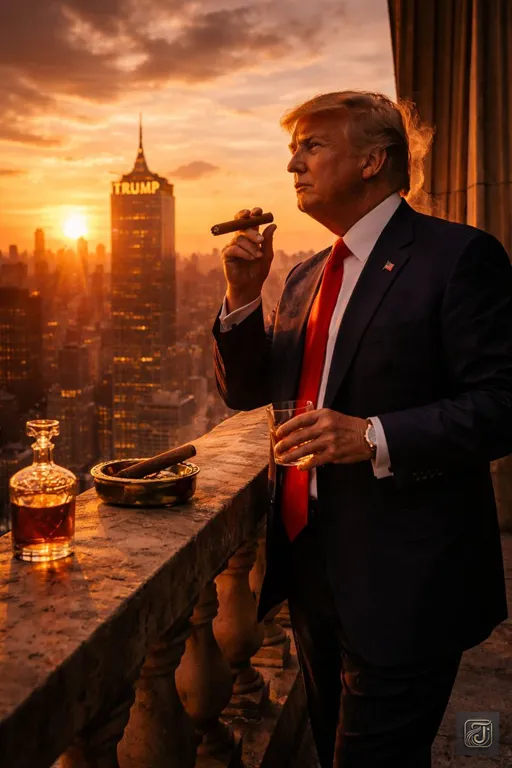
Donald Trump’s life is like an eternally burning flame.
Come too close, and you are scorched by its heat; observe it from afar, and it shines so brightly you must squint.
How much that flame illuminated the world—and how much it burned it—
The story begins here.
Chapter 1: The Boy from Queens
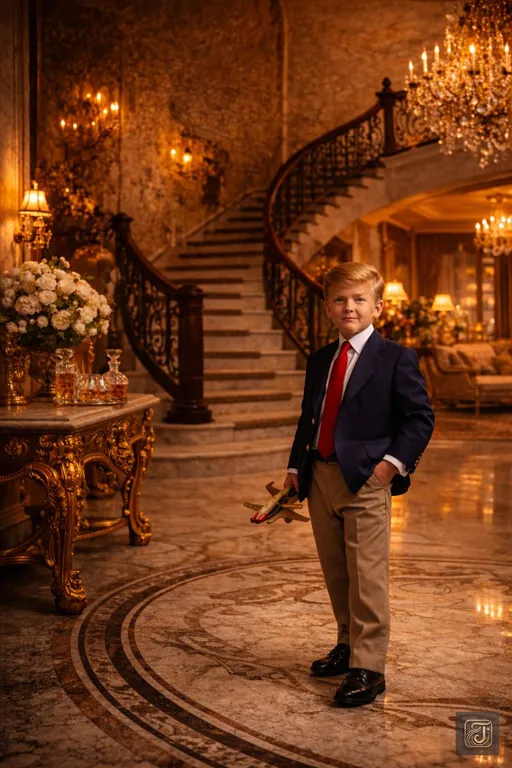
In 1946, in Queens, New York, a boy named Donald John Trump was born—and from the moment of his birth, he was treated as someone special.
His father, Fred, was a successful real estate developer, and there was no trace of economic hardship in the Trump household.
A marble entrance hall, meticulously polished floors, and no fewer than three separate rooms reserved solely for receiving guests.
Growing up in such a home, the boy learned from birth what it meant to belong to “the winning side” of the world.
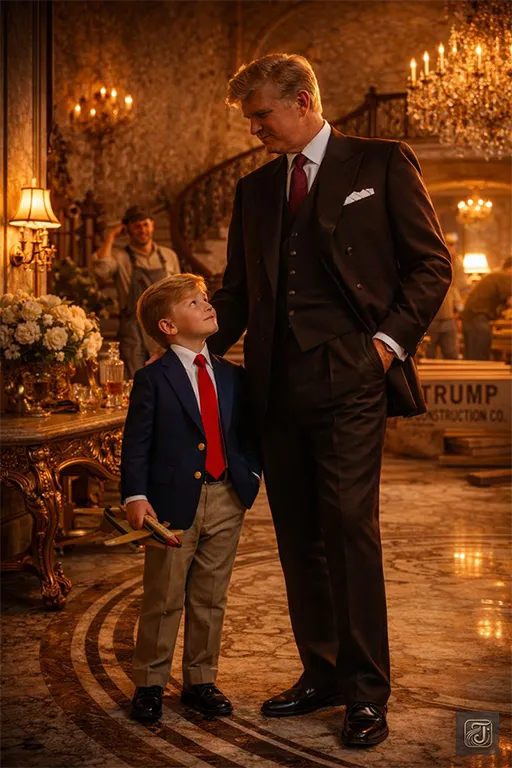
To the young Donald, his father, Fred, was an emperor.
Tall, commanding, and above all, a man who ruled with absolute authority.
When he walked through the residential developments, workers at the sites would call out,
“Mr. Trump, the building materials have arrived!”
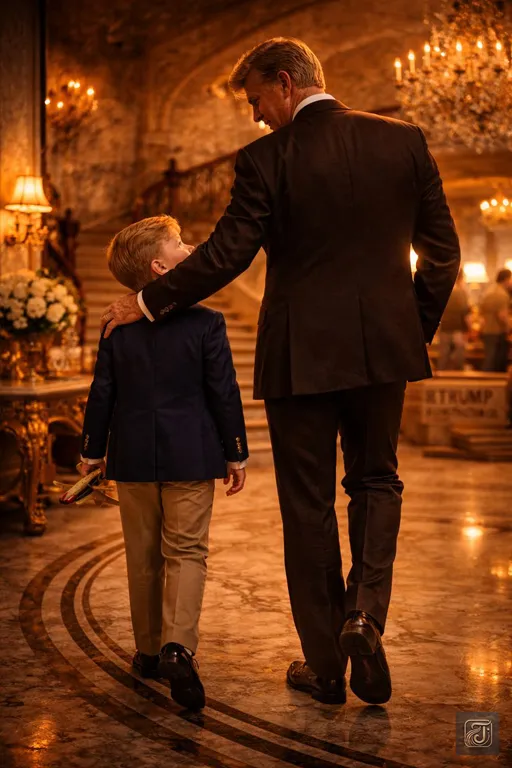
The boy walked beside him, looking up at his father’s broad back, and his father would always say,
“Donald, remember this. Be a winner. The world follows only winners.”
Those words burned themselves into the boy’s chest,
almost like a spell.
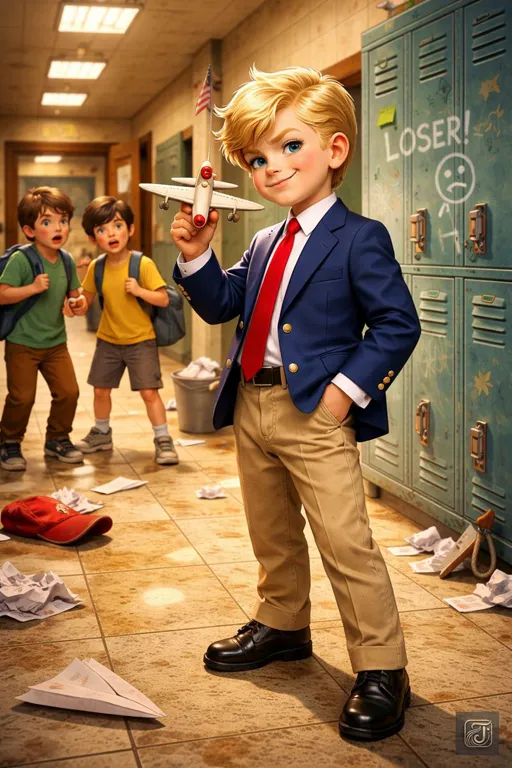
But a boy who was constantly told to be a winner gradually became uncontrollable at school.
He defied teachers he disliked, barked at timid classmates, and always took whatever toy caught his eye.
He accepted the words “be a winner” in their simplest, most literal form.
By the time he was thirteen, his mother, Mary, finally let out a sigh.
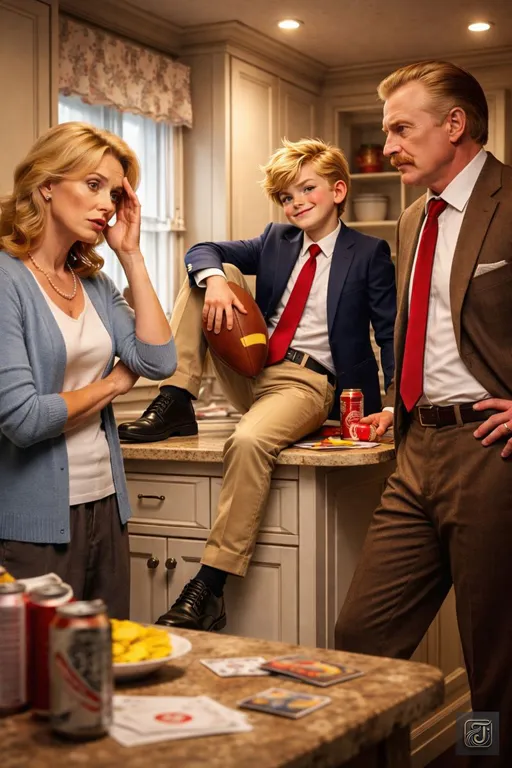
“This boy is out of control… Fred, can’t something be done?”
His father did not hesitate.
Gathering the family around the dining table of the Trump home, Fred spoke quietly to Donald.
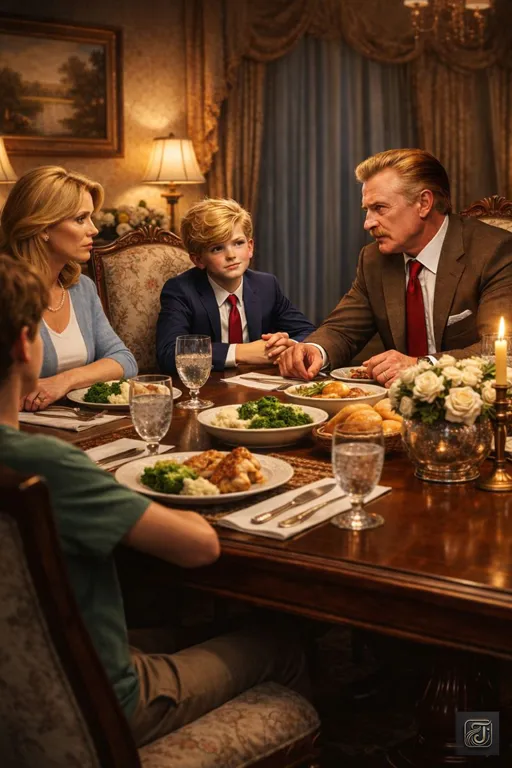
“You need a place that will forge you.”
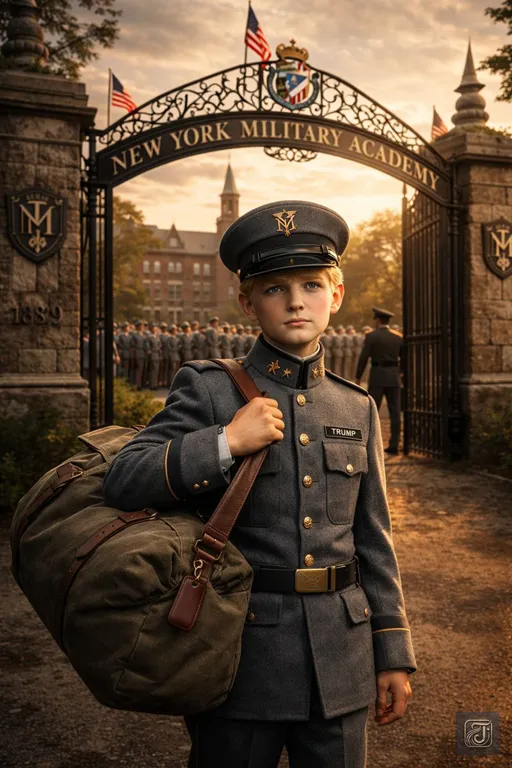
The following week, young Donald stood before the gates of the New York Military Academy.
Iron gates, rows of students in uniform, shouts echoing across the drill field—
It was a world that had no tolerance for a spoiled, willful rich boy.
On his first day, an instructor hurled his belongings onto the floor and shouted:
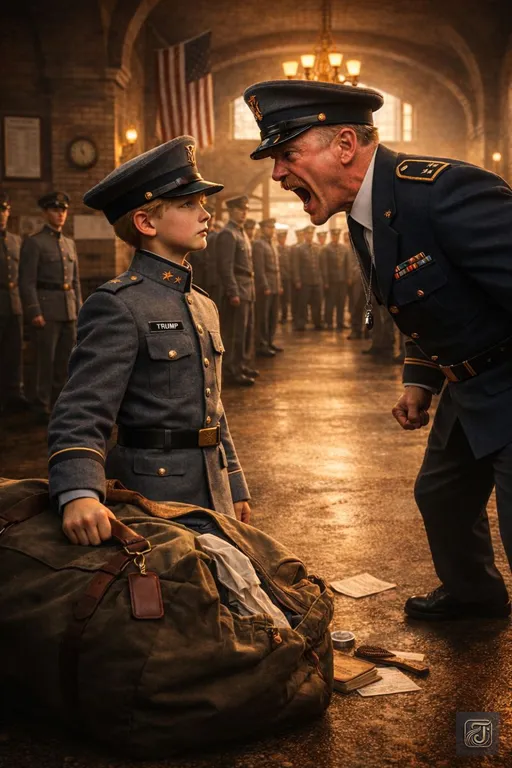
“Here, your father’s money and name mean nothing!
From here on, you will prove who you are—by yourself!”
The boy stood stunned for a moment.
But in that instant, a strange flame was lit within his chest.
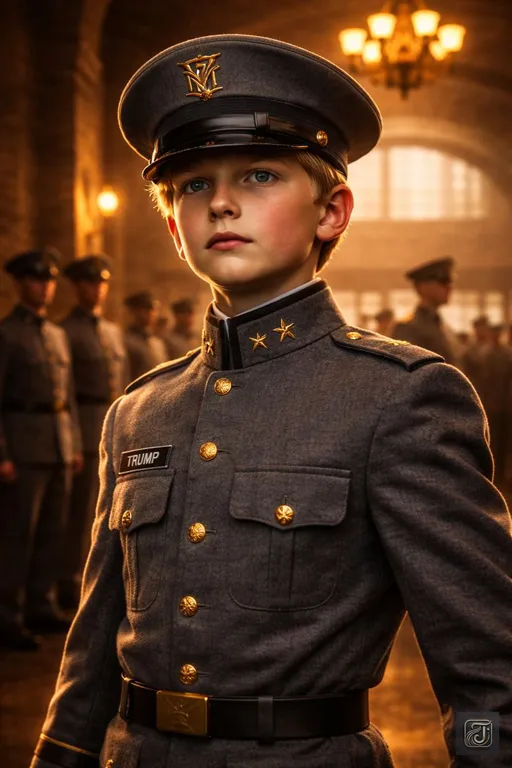
“Prove it? The world follows winners? Then all I have to do is become a winner here, too.”
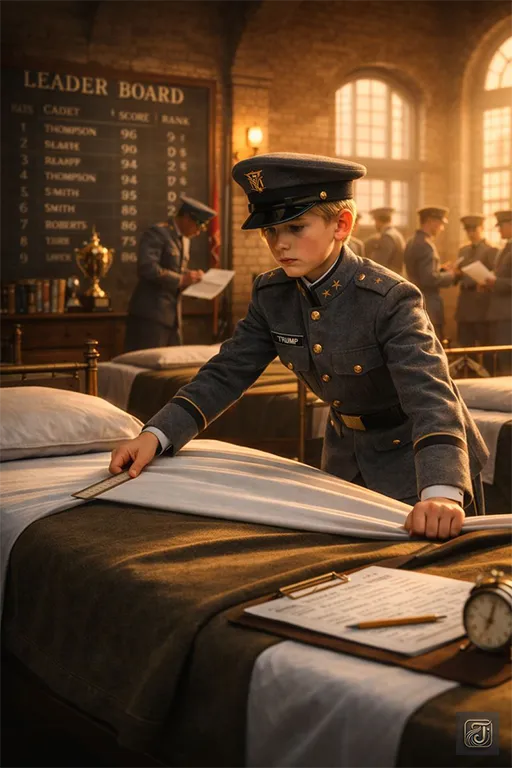
Life at the military academy was brutal.
Reveille at five in the morning, beds inspected down to the angle of their corners, one hundred push-ups for a single mistake.
Hierarchy was absolute, and any defiance was met with swift punishment.
Yet here, Donald learned the true meaning of “competition” for the first time.
Scores, grades, leadership—
Everything was measured by rank, and who stood above and who below was unmistakably clear.
For him, it was a world of perfect clarity.
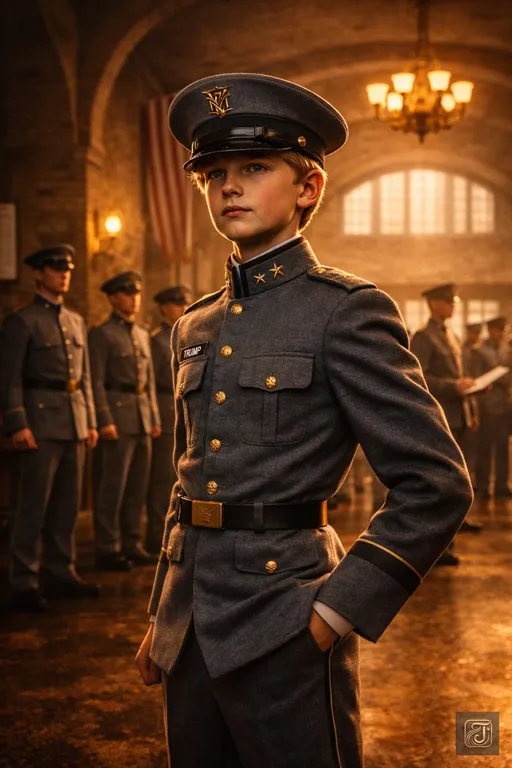
In time, he changed from a defiant boy into a young man who understood how to behave in order to win.
A former dorm mate later recalled:
“Donald absolutely hated losing.
When he won at something, he genuinely believed he was the best in the world.”
Life at the military academy sharpened the boy’s ambition even further.
The spell his father had cast—“be a winner”—
took on a concrete form here, becoming “learn how to win.”
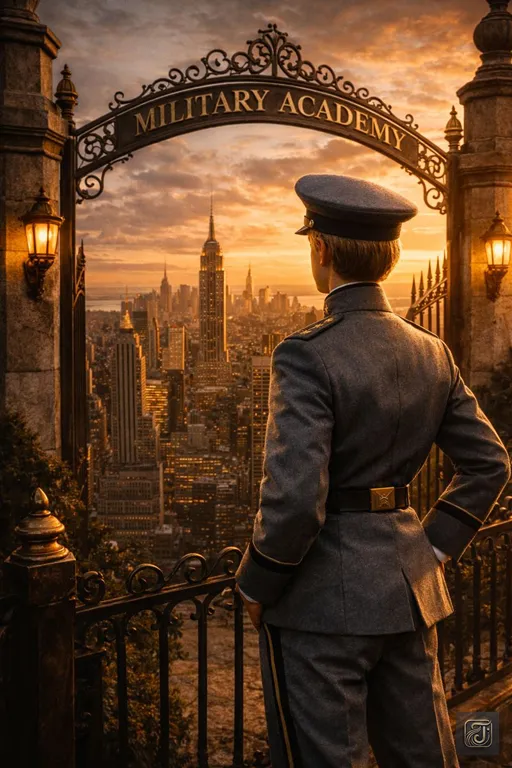
At last, beyond the gates of the military academy, the wider world began to call to him—
And above all, one city rose higher than anywhere else, radiating an overwhelming presence in the boy’s heart.
Manhattan.
A forest of towers piercing the sky, gold glinting everywhere—the beating heart of America.
The boy did not yet know it.
That those skyscrapers would one day become the stage upon which he would raise his own name.
But the seed was planted here, unmistakably, at this moment.
And the boy murmured quietly toward the unseen towers:
“I’m not just a man of Queens.”
His story begins here.
Chapter 2: The Manhattan Declaration
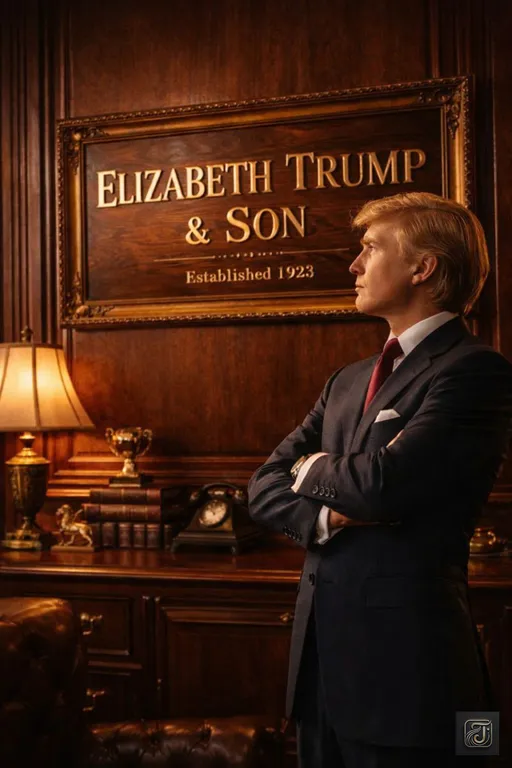
1971.
In a quiet residential neighborhood of Queens, a small revolution was about to begin.
The Trump family’s sitting room.
On the wall hung the heavy wooden sign of Fred Trump’s real estate company—Elizabeth Trump & Son.
Standing before it, twenty-four-year-old Donald Trump folded his arms and stared at it in silence.
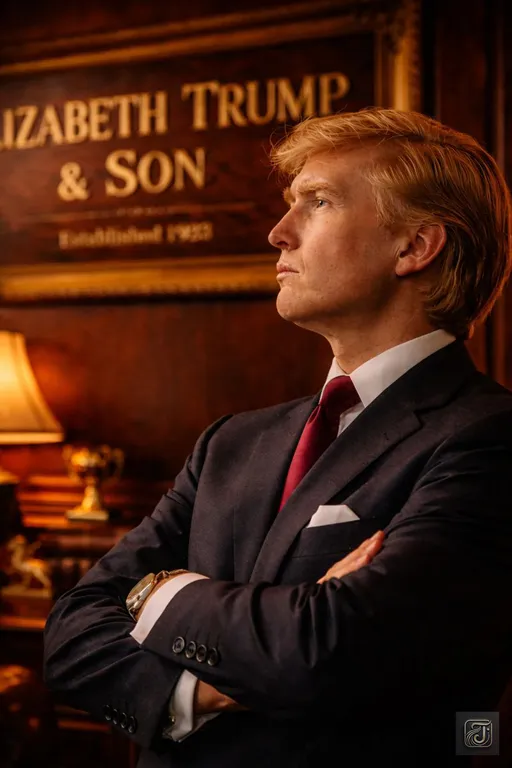
“‘& Son’…? Don’t be ridiculous.”
The words were neither a sigh nor a complaint.
They were the quiet crackle of a fire igniting deep in his chest, just before a decisive contest.
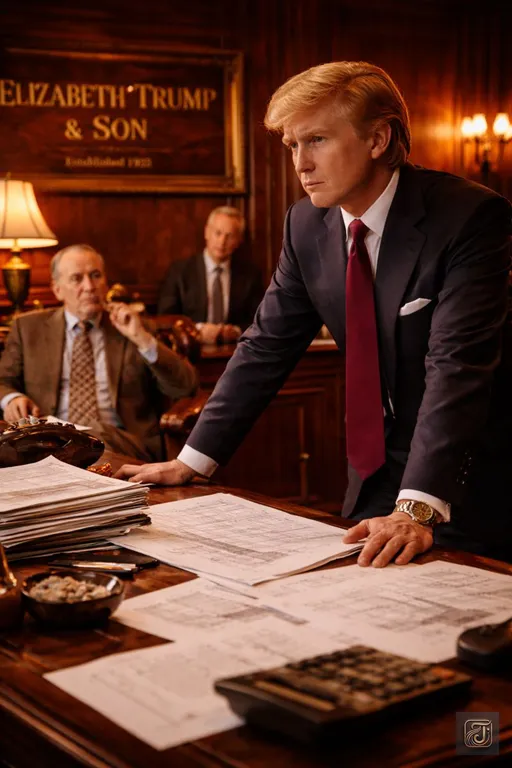
■ The Moment He Set Out to Break “His Father’s Company.”
Fred Trump fully intended to hand the business over to his son.
With Donald’s return, the numbers improved, tenants increased, and contractors felt reassured.
In Queens, young Donald’s reputation had already taken shape—as a capable operator, very much his father’s heir.
But Donald himself was tired of that evaluation.
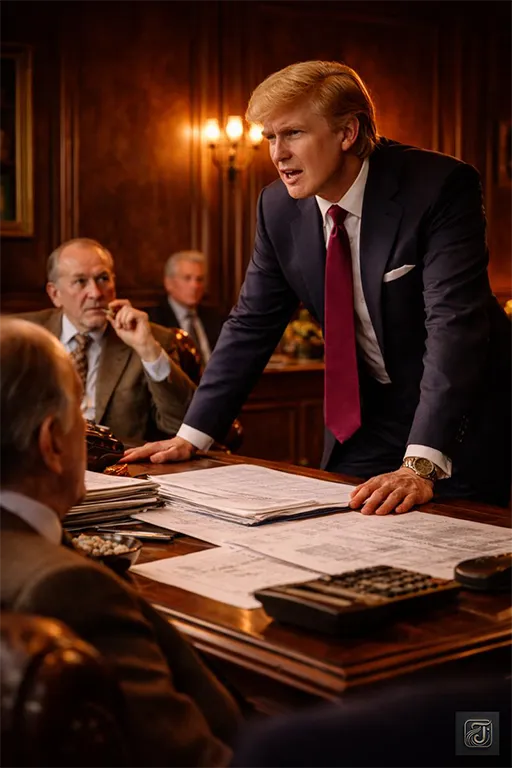
“I’m not ‘Fred’s son.’ I’m Donald Trump. My empire begins with my name.”
When he sat across from his father in the meeting room, Donald did not hesitate.
“We’re changing the company name. Not Elizabeth Trump & Son—”
He paused for a breath, then declared it in the voice of a winner.
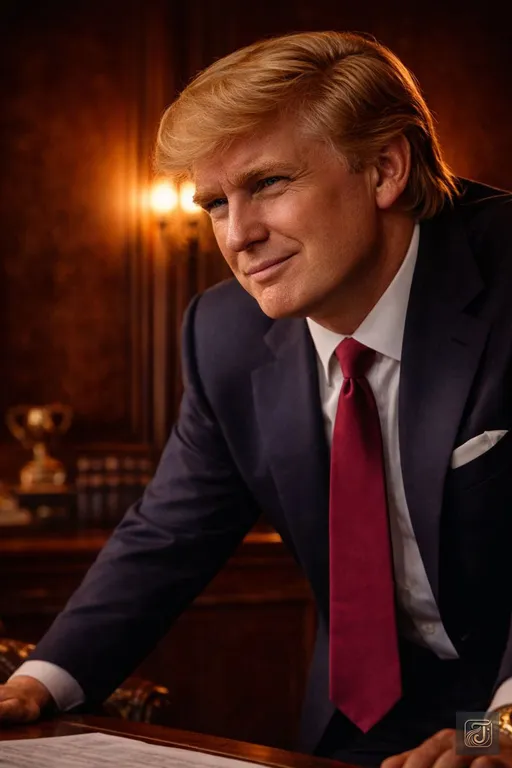
“The Trump Organization.”
Fred narrowed his eyes.
Whether it was a smile of pride or one of disbelief, even his son could not tell.
But he did not object.
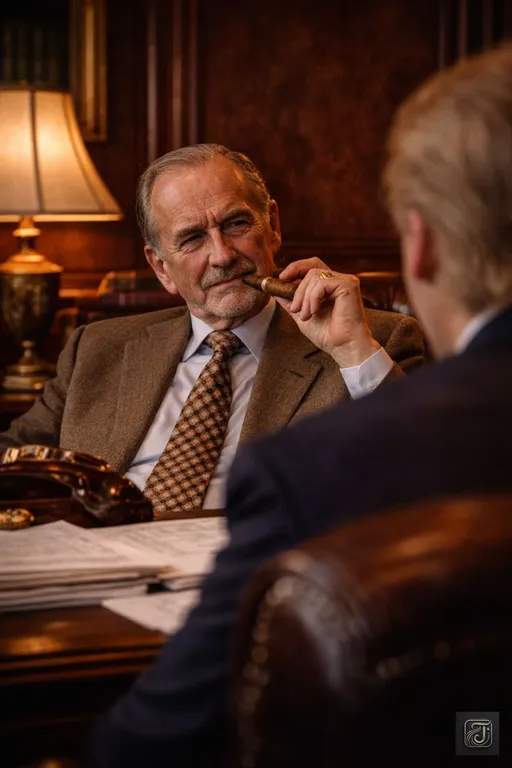
“…Do as you like. But you’ll bear all the responsibility.”
Donald smiled.
He was not a man made to wear the face of a loser.
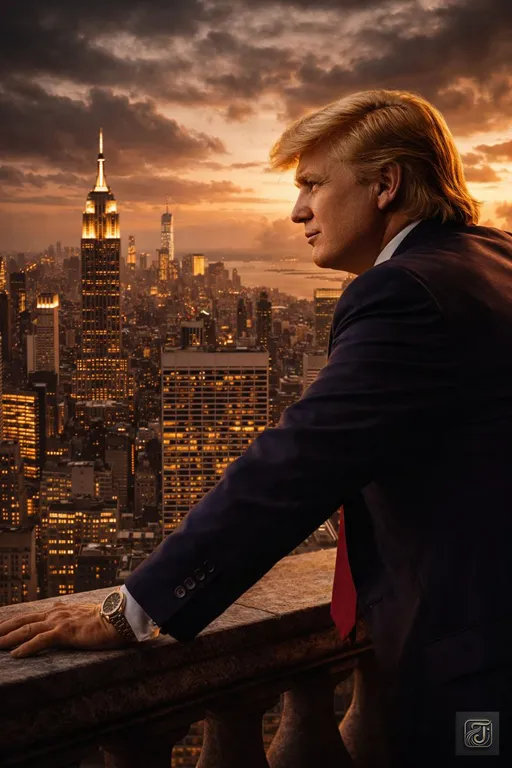
■ From King of Queens to Emperor of Manhattan
Changing the company name was not a simple matter of replacing a sign.
It was a declaration of war to the world.
Queens was his father’s kingdom.
The son had no intention of merely inheriting that castle.
What he wanted was—
Skyscrapers.
A battlefield of real estate on the grandest scale, where gold and marble rose toward the sky.
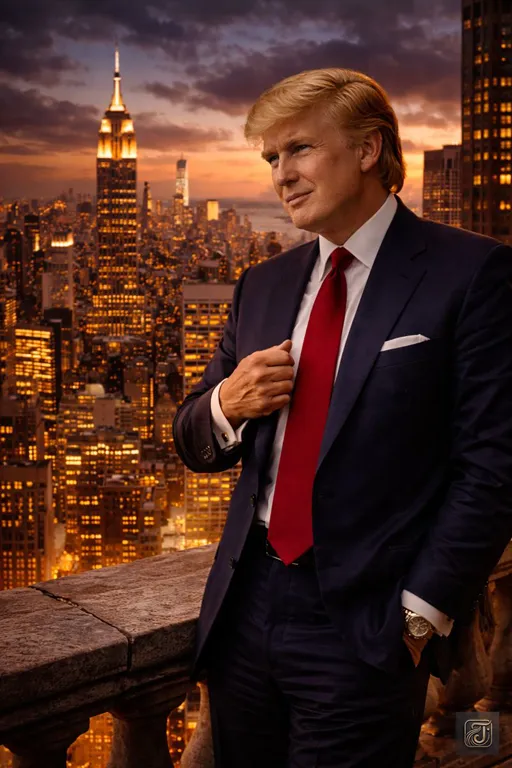
Manhattan.
But in Manhattan at the time,
No banker was willing to take a young upstart from Queens seriously.
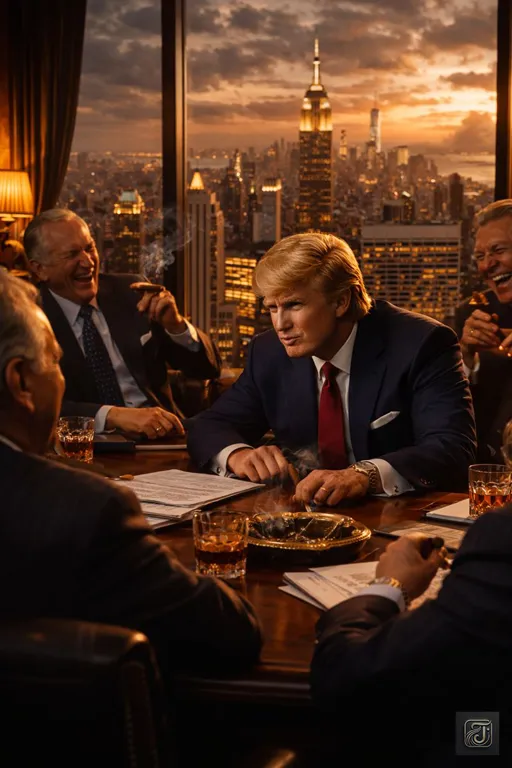
“You’re just the son of a landlord from Queens, aren’t you?
Manhattan is where the real men fight.”
In room after room, from suit after suit, he was met with the same smirk.
And the more they laughed at him, the more fiercely Donald burned.
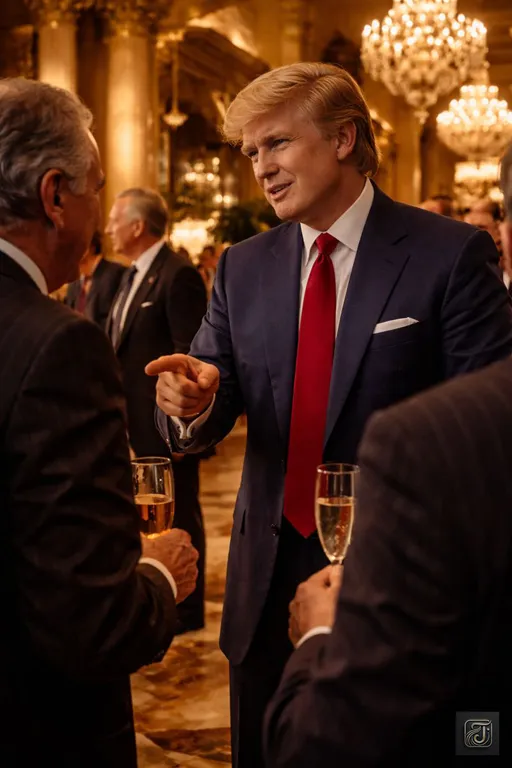
“Real men? Then I’ll prove it to you.”
The young Trump courted bankers, ingratiated himself with politicians,
and kept talking—endlessly—about a gilded future in Manhattan lobbies.
The first doors opened with his father’s money and his own bravado.
And there are few weapons more powerful than bravado.
■ From an “Ordinary Real Estate Developer” to a Man Who Branded Himself
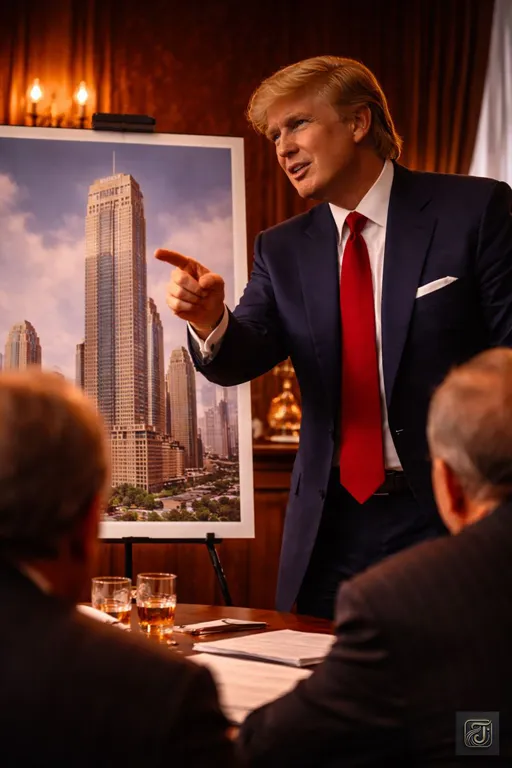
By this time, Trump had already glimpsed a future in which a name itself carried value.
“If you put ‘TRUMP’ on top of a building, the price goes up.
Make people believe that—and it becomes reality.”
He was one of the very few in New York who understood the magic of branding.
That was precisely why even the words of a young upstart carried weight.
■ The Challenger’s Declaration That Echoed Through Manhattan
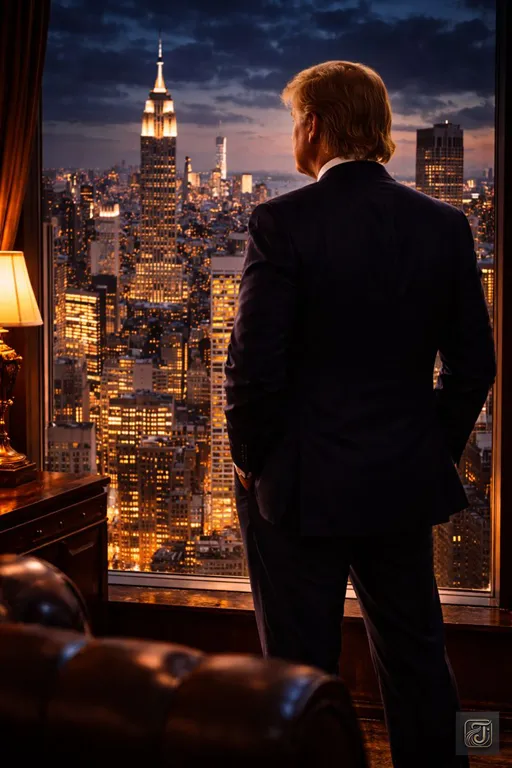
On the day he transformed his father’s company into his own empire, Donald stood at the window and gazed at Manhattan’s skyscrapers.
The massive buildings floating against the night sky felt, to him, like a direct provocation.
“Just wait. I’m not a man who will end in Queens.
I will become the emperor of Manhattan.
I’ll drive my name into the very summit of the world.”
The arrogance and confidence of youth—
It was still only the beginning of what would later be called a miracle.
Before long, the story would begin to move toward the project that would shake all of New York:
The Grand Hyatt plan.
Chapter 3: The Miracle of the Grand Hyatt
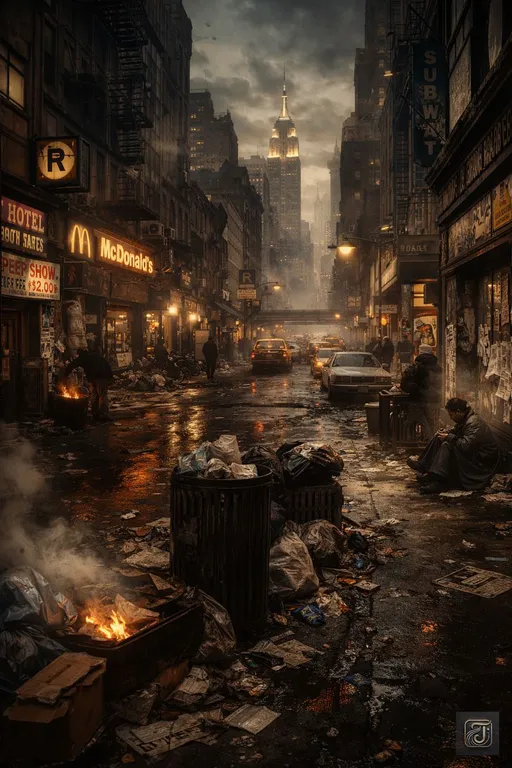
New York was on the verge of death.
By the late 1970s, Manhattan had sunk into crime, unemployment, and fiscal collapse,
and the city was derided as the “Rotten Apple.”
Grand Central Station was dim and grim,
overrun with the homeless, its windows shattered,
trains delayed, and public safety at rock bottom.
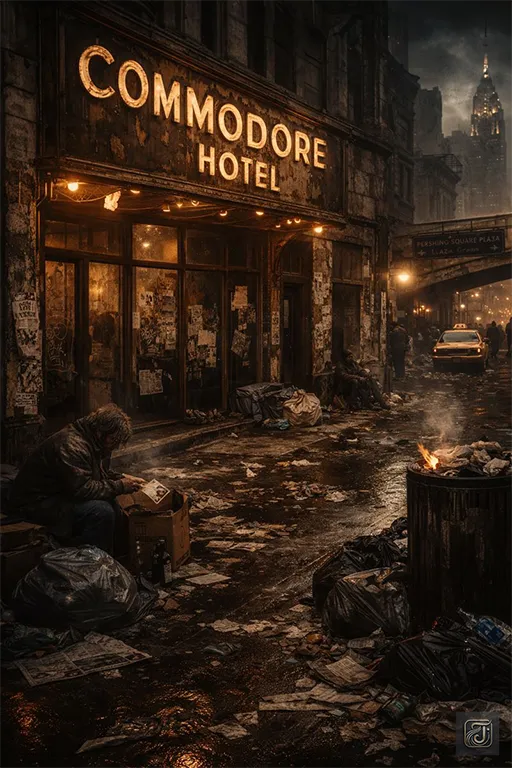
The aging Commodore Hotel, adjoining the station, was following the same path.
On the brink of bankruptcy, buried under debt, abandoned by everyone.
A massive negative legacy forsaken by both banks and city officials.
And yet—
There stood one young real estate developer.
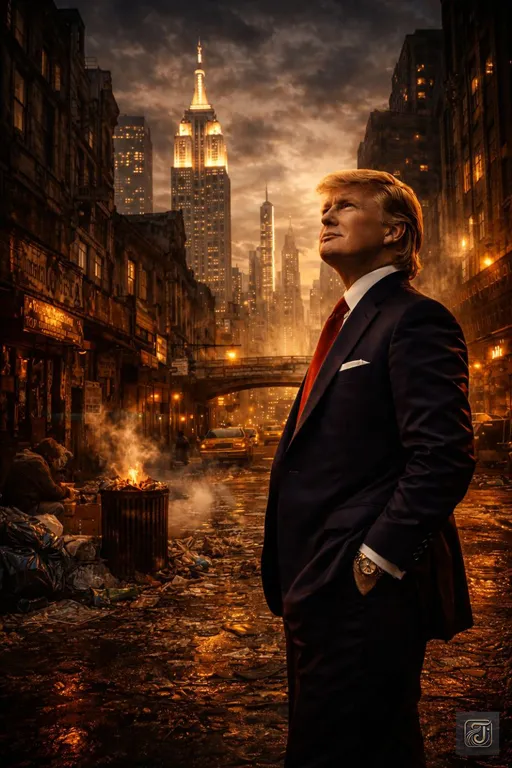
Donald J. Trump. Thirty-four years old.
As he looked up at Manhattan’s skyscrapers,
He murmured to himself.
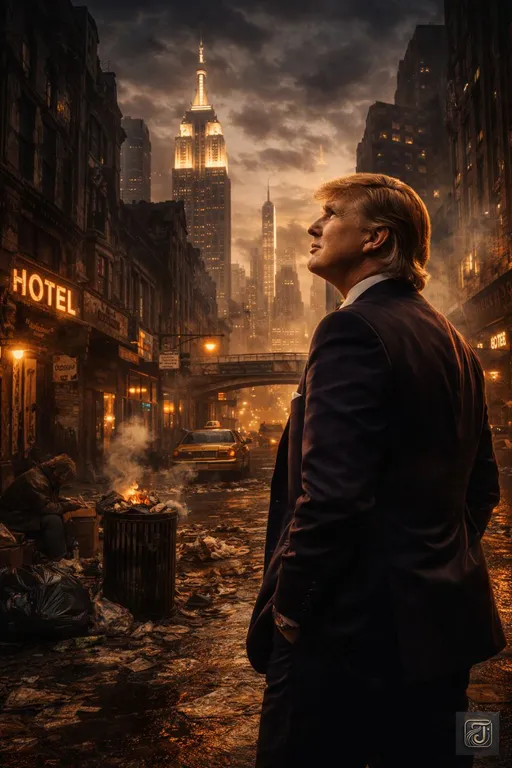
“This will be my castle. The very heart of Manhattan…
I’ll turn this rotten city into gold.”
No one believed his romantic vow.
Because to anyone looking at it, it was clearly impossible.
But Trump was a man who burned all the brighter the more he was told it couldn’t be done.
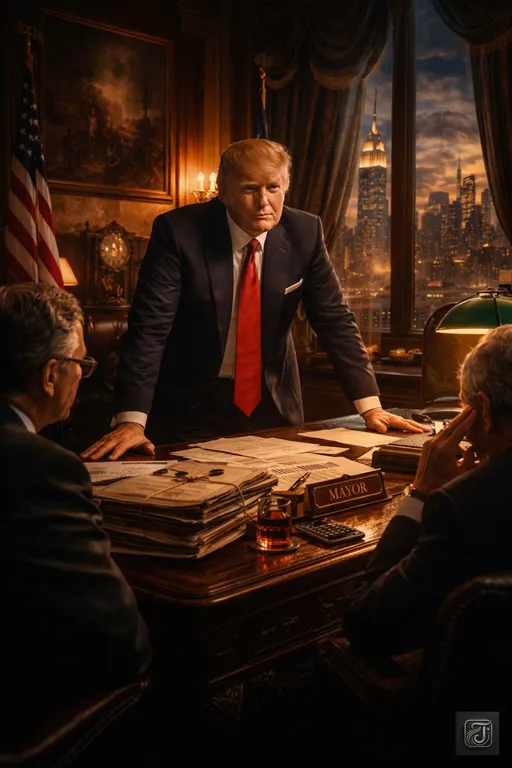
■ The Deal-Making Genius Sets His Plan in Motion
Trump marched straight into City Hall.
New York City was on the brink of bankruptcy and out of money.
Tax revenues were thin, and the mayor was at his wit’s end.
Trump opened without yielding an inch, his voice unwavering.
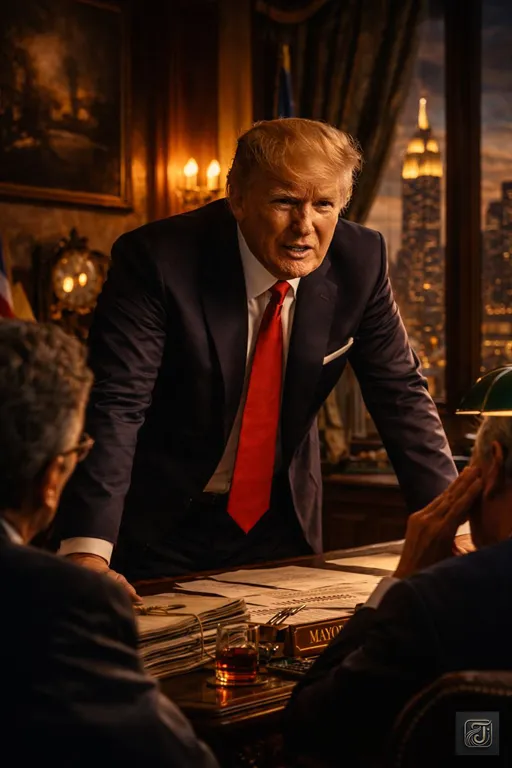
“I want to save New York.
Revive the Commodore Hotel and make it the catalyst for restoring this city into something the world can be proud of.
So—I’m asking for tax abatements.”
City officials were stunned.
What was this young upstart talking about?
The hotel was practically worthless. Tax breaks? There was no precedent.
But Trump pressed on.
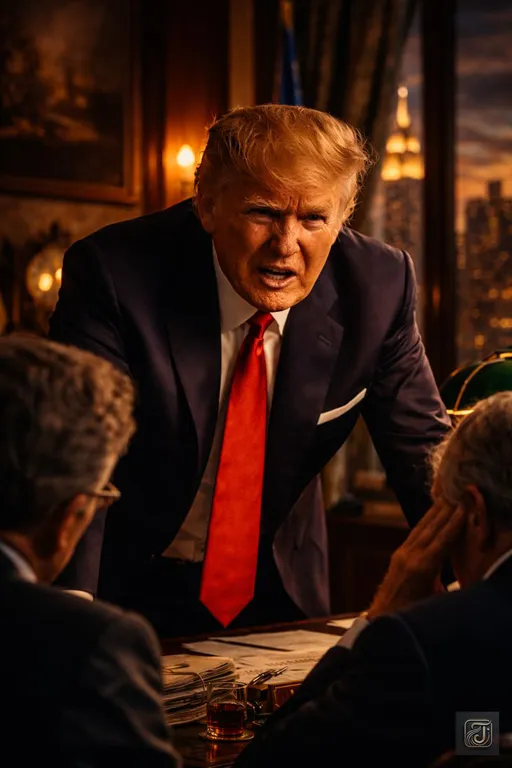
“I have my father’s capital. I have the trust of the banks.
If this succeeds, New York will gain jobs, tax revenue will rise, and the city will be saved.”
Youth, arrogance, and a strange, compelling force of persuasion.
After much deliberation, the city chose to gamble.
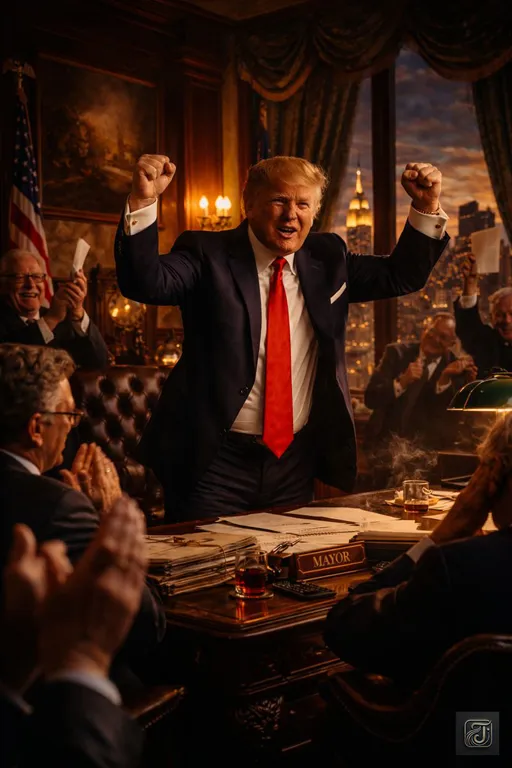
The first massive tax abatement in Manhattan’s history—
won by a man who would later be called a “monster of negotiation.”
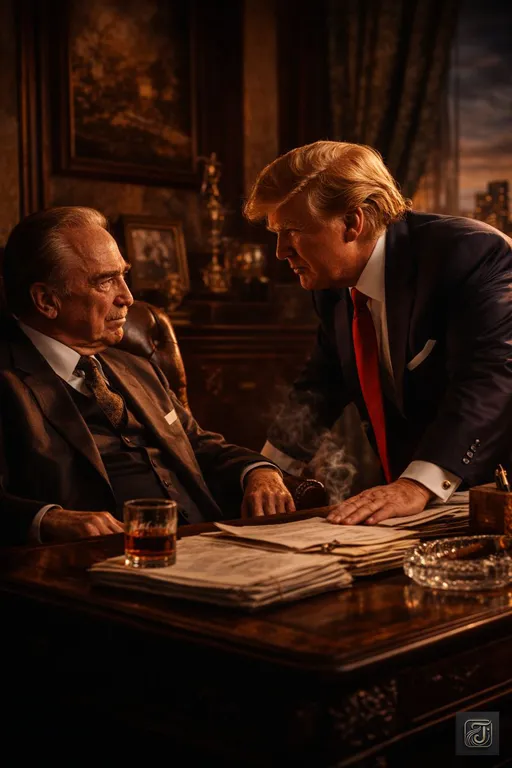
■ The Shadow and Light of His Father, Fred
At first, his father, Fred, frowned at his son’s near-mad dream.
“Manhattan is dangerous.
It’s a mountain of bad debt.
You can make steady money safely if you stay in Queens.”
But Donald shot back at his father.
“I don’t want safety. I want the crown.
And this hotel is the key to that crown.”
Fred fell silent.
Then he looked into his son’s eyes.
What he saw there was the same unchanging obsession with victory that had been there since boyhood.
Fred made his decision.
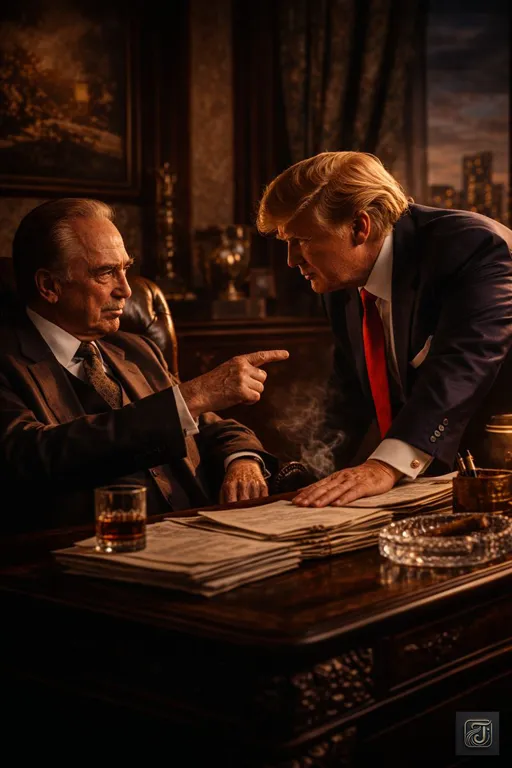
“All right. I’ll invest.
But if this fails—the company is finished.”
The moment he heard those words,
Donald’s chest burned.
The immense weight pressing down on his back only drove him higher.
■ The Birth of the Golden Miracle
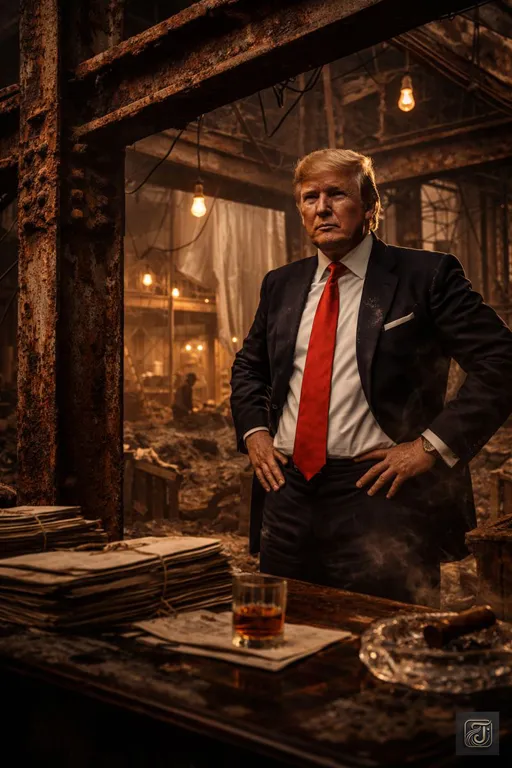
The renovation was hell.
- Rusted steel beams
- Mountains of trash
- Leaking water
- Mud-caked corridors
- And a constant lack of funds
At construction sites deep into the night, Trump kept shouting orders, wearing his hard hat.
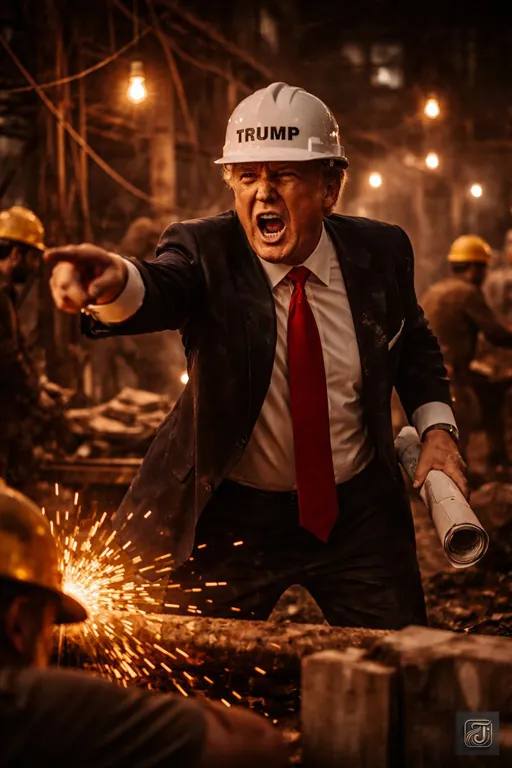
“Faster!
This place is going to be the greatest hotel in the world!”
The craftsmen, bewildered as they were,
found themselves drawn in by the young man’s abnormal intensity.
And then—1980.
At last, the “miracle” was complete.
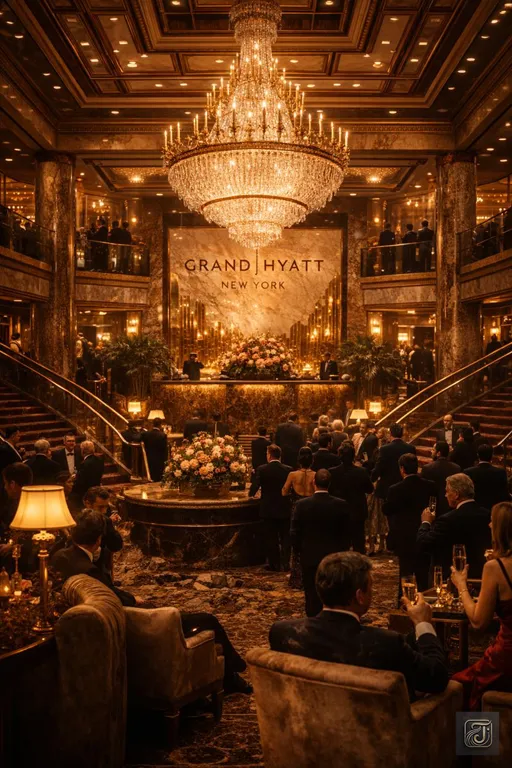
The Grand Hyatt New York.
Glass and marble, chandeliers, a gleaming lobby.
The hotel that had once symbolized decay became, overnight, an icon of New York’s revival.
On opening day, the newspaper headlines blazed in bold letters.
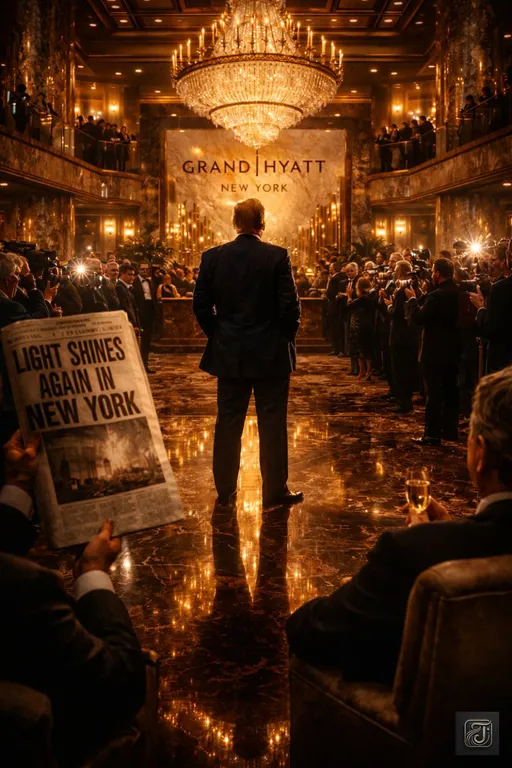
“New York Has Found Its Light Again”
Trump stood at the center of the lobby, looking down at his own reflection mirrored in the marble floor.
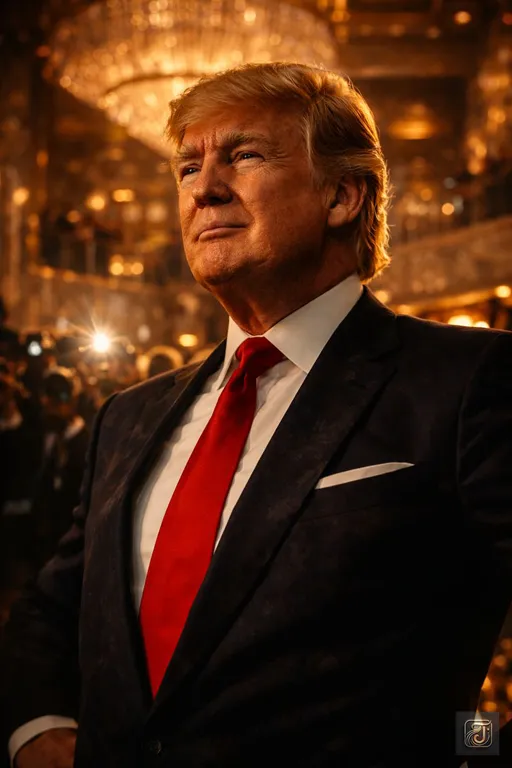
“This is only the beginning.
The first step toward carving my name into Manhattan.”
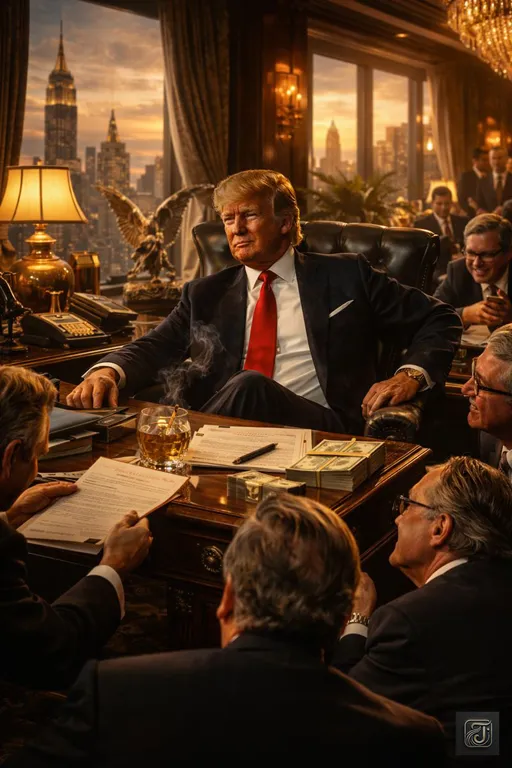
■ Manhattan’s Banks Bow Down
The success of the Grand Hyatt completely transformed the attitude of the banks.
Bankers who had sneered at the young upstart just yesterday now straightened their suit collars and spoke with polite smiles.
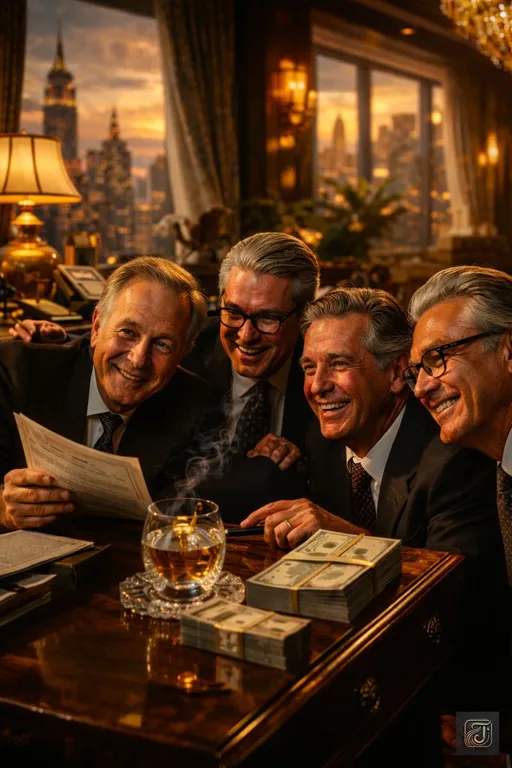
“What kind of project are you considering next, Mr. Trump?”
Trump merely smiled.
It was less a smile of confidence than one of certainty.
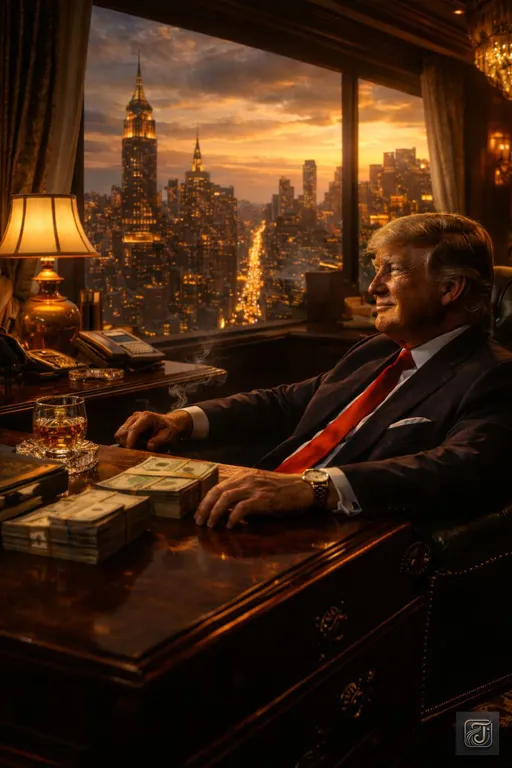
“Next comes a tower. One bearing my name… a golden tower no one has ever seen.”
His gaze was already fixed on Fifth Avenue.
From here on,
The fate of Manhattan would begin to change—dramatically.
Chapter 4: The Golden Tower and the Casino Empire (1983–1989)
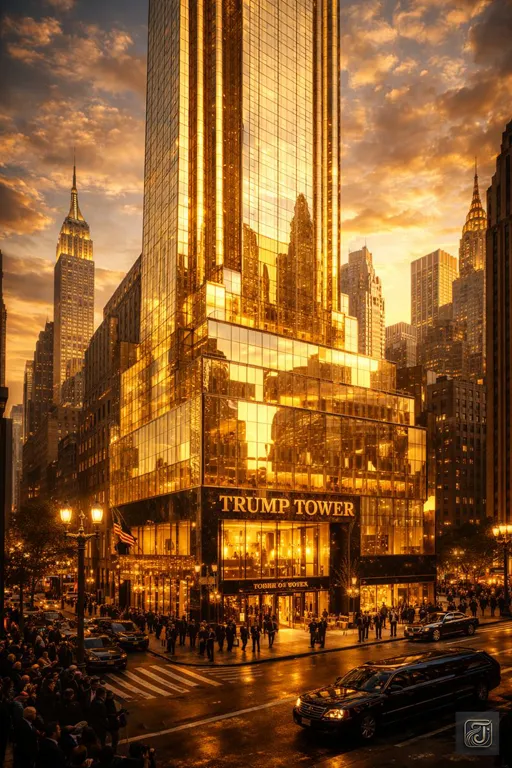
On Fifth Avenue in Manhattan, a building rose that radiated an unmistakably alien presence.
Trump Tower.
Clad entirely in gold, glass, and marble, it was less a “building” than confidence itself, made solid.
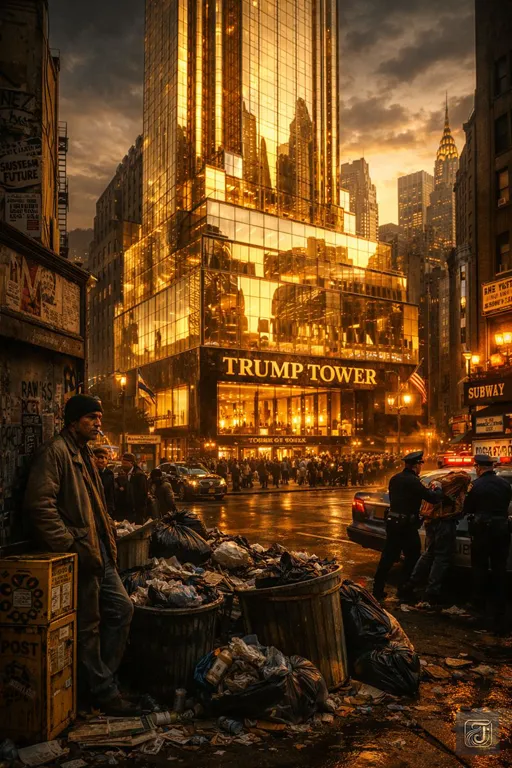
New York in 1983 was still rough around the edges.
Unemployment and crime were high, and behind Manhattan’s glamorous façade, the city was exhausted.
But Trump scoffed at that atmosphere.
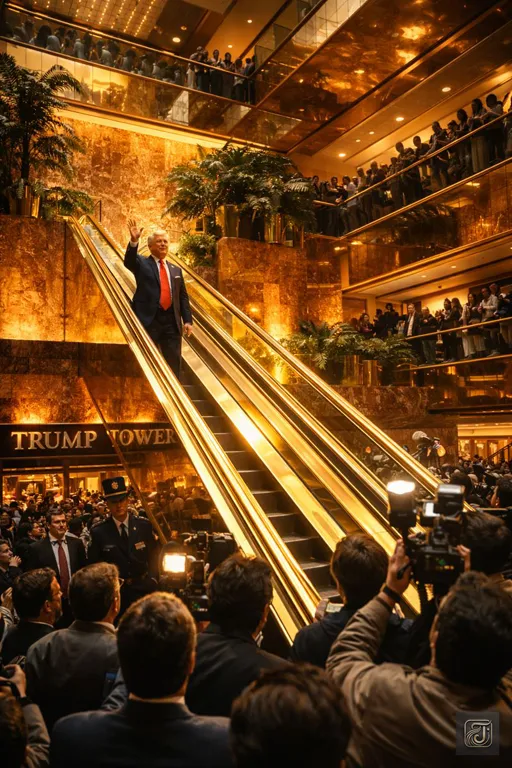
“Who cares about the city. I’m going to carve my name into history.”
The tower he created after declaring that was filled with extravagance beyond the comprehension of New Yorkers at the time:
a golden escalator, a marble atrium, a massive waterfall.
But the more incomprehensibly flashy something is, the more people feel compelled to see it at least once.
Trump understood that.
Of course, there was criticism during construction as well.
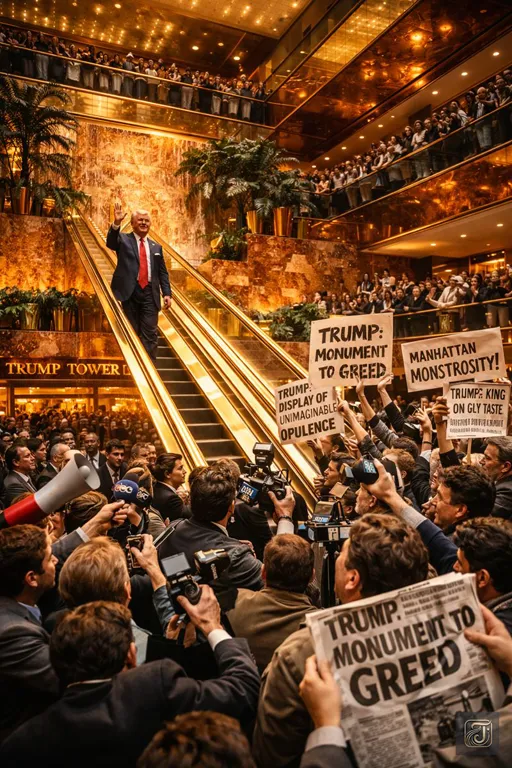
“It’s the height of excess.”
“Gaudy.”
“Tasteless, gold-plated nouveau riche.”
He was criticized without restraint, but Trump didn’t care at all.
If anything, he said this instead.
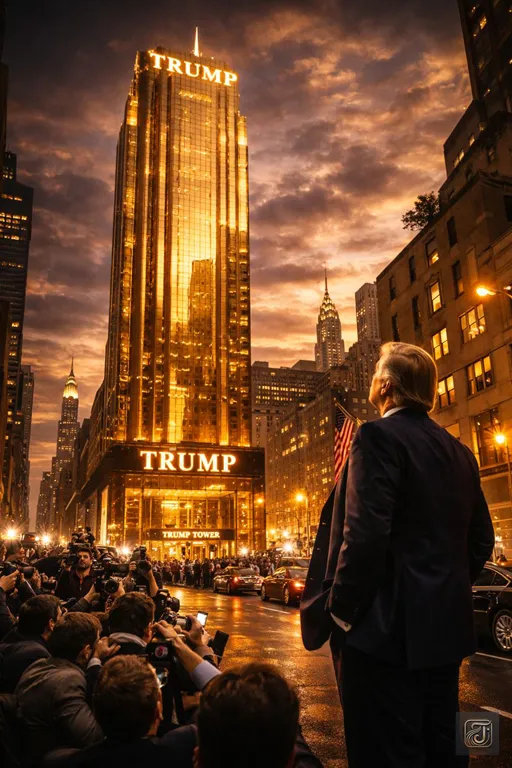
“The more people hate it, the brighter my name shines.”
The moment the name “TRUMP” was carved into the very heart of Fifth Avenue, he knew it for certain—no one would ever call him “the kid from Queens” again.
◆ To the Castle — “Playing King” Becomes Serious
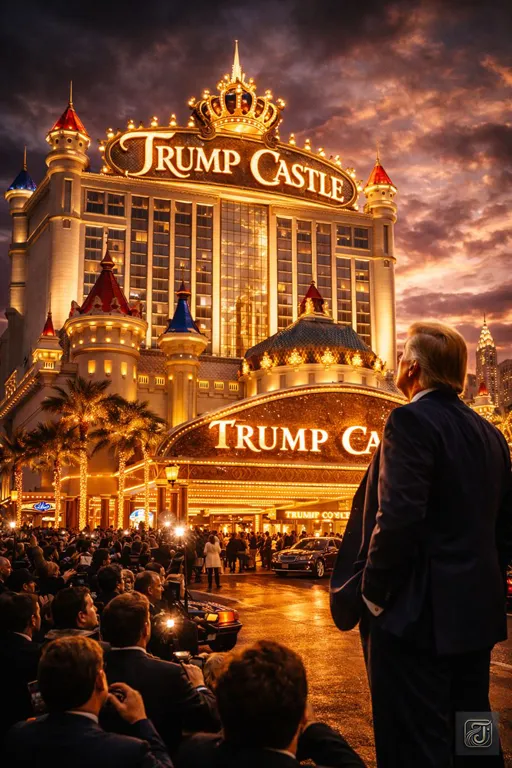
1985.
Trump turned his gaze toward Atlantic City, New Jersey.
A city of gambling. A city where money moved. A city where winners wore crowns.
What he acquired was “Trump Castle.”
Even the name radiated a sense of unchecked ambition.
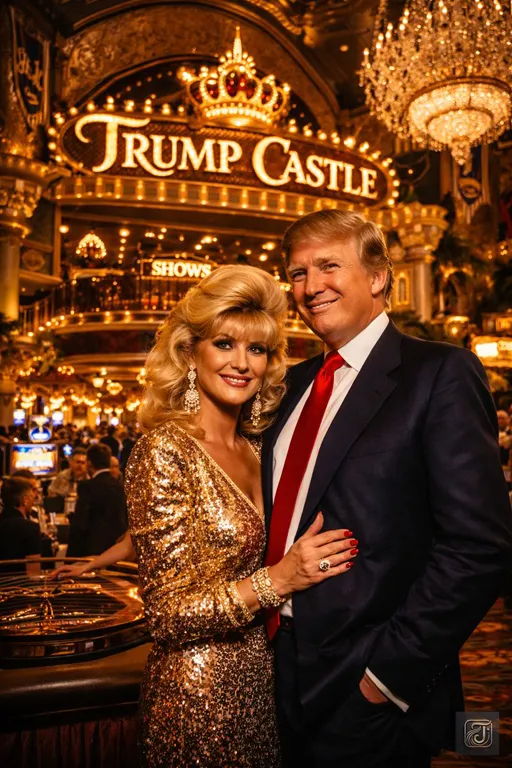
“I’m not a real estate mogul. This is a castle. And I am its king.”
Trump boasted as much and appointed his then-wife, Ivana, as the manager.
But behind the glittering palace, the couple fought almost every day.
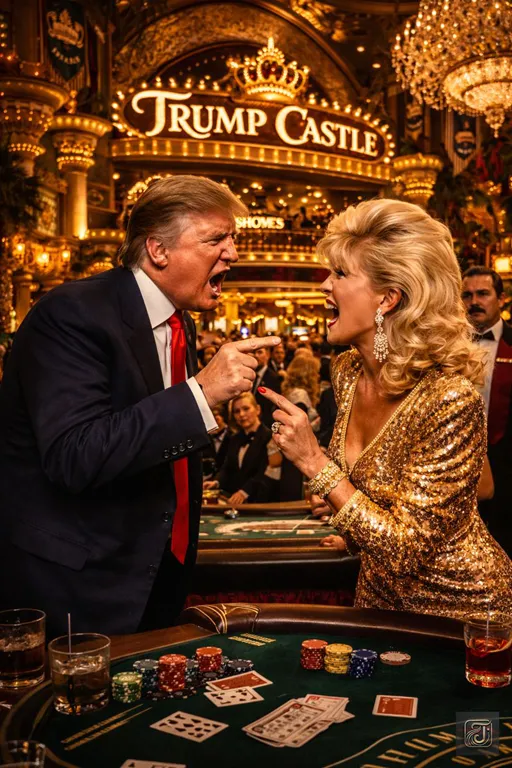
They shouted at each other in front of employees,
fought over interior colors,
Trump changed specifications on a whim, and Ivana exploded in anger,
And their yelling sometimes echoed all the way to the back of the casino.
One staff member later recalled:
“It wasn’t a castle. It was a battlefield.”
Even so, the extravagance and chaos drew people in.
The Castle became one of the defining symbols of the “Trump Empire.”
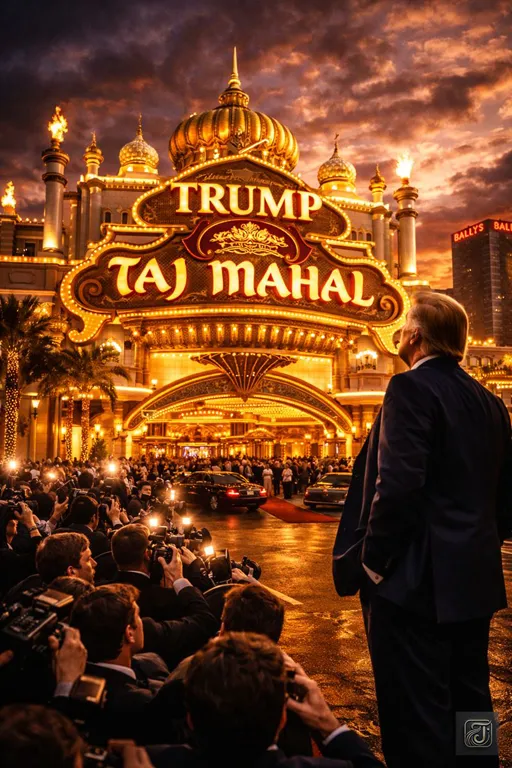
◆ The Taj Mahal — Glory and Nightmare Gilded in Gold
A man who succeeds always wants a bigger stage next.
Trump’s next target was the Trump Taj Mahal.
“The Eighth Wonder of the World.”
“The largest casino in American history.”
Flashy slogans filled the newspapers, and Trump declared proudly:
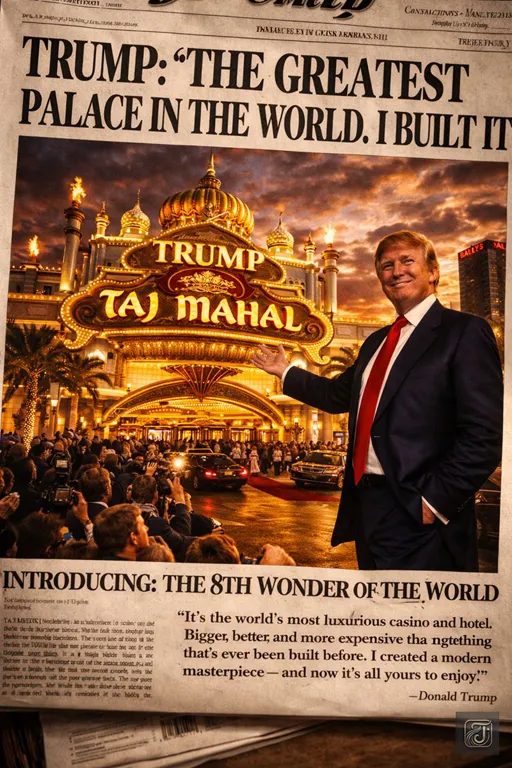
“This is the greatest palace in the world. I built it.”
But reality was ruthless.
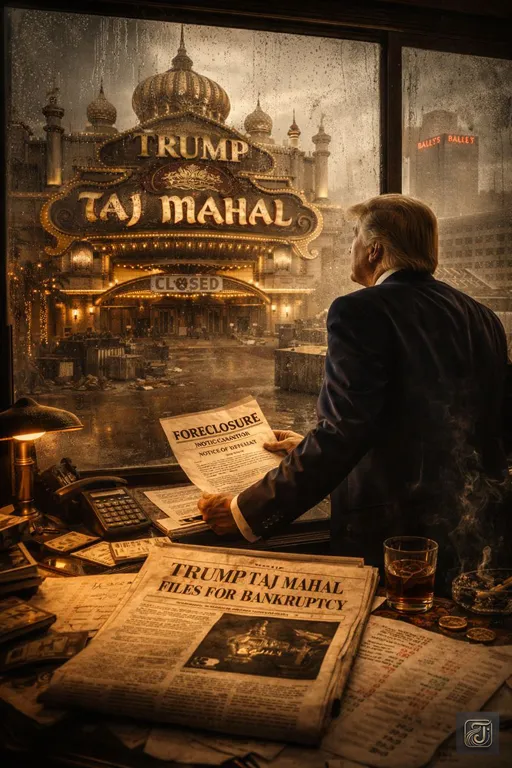
Construction costs spiraled out of control, and the project relied on junk bonds with interest rates as high as 14 percent—so heavy that interest payments alone threatened to sink the company.
In its opening year, the Taj Mahal dazzled in all its luxury, and tourists poured in.
But money flowed out faster than it flowed in.
The result—
bankruptcy in just one year.
The newspapers mocked him.
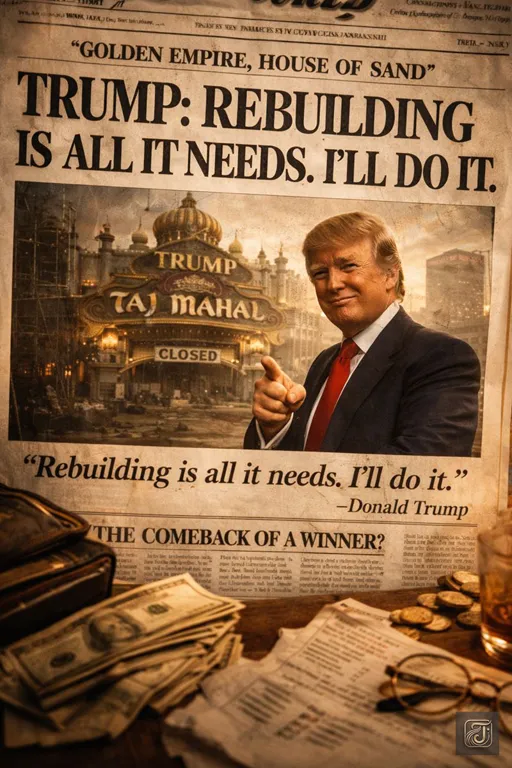
“The gold-plated empire was nothing more than a castle of sand.
But Trump remained unfazed.
‘It just needs rebuilding. I’ll do it.’
It was the familiar language of a winner.”
◆ And Yet, the Age of “TRUMP” Continued to Expand
Towers, castles, the Taj Mahal.
Each was criticized, mocked, and often felt as though it had stumbled forward by accident.
And yet—
Every building bore the name “TRUMP.”
In this era, Trump turned his own name into a brand,
multiplying golden signboards not only across Manhattan but throughout the United States.
Success or failure?
That didn’t matter.
What mattered was this:
that his name was spreading across the world.
That became the very core of the Trump empire.
The golden tower was his pride.
The casino empire was his desire.
And with every failure, his myth only grew larger.
The more a man falls, the more he becomes a story.
Trump understood that instinctively.
Chapter 5: Envy of the World’s Best (The Japanese Miracle)
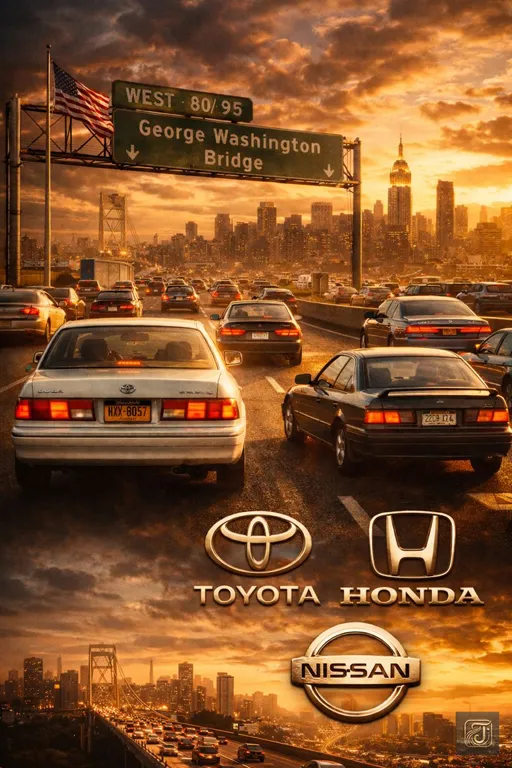
In the late 1980s, amid the streams of cars racing along America’s highways, there was a presence that stood out—quiet, restrained, and unmistakably confident.
Japanese cars.
Toyota. Honda. Nissan.
Their names were tantamount to a death sentence for factories across the American Midwest,
And for one man in New York, they were nothing less than a direct challenge.
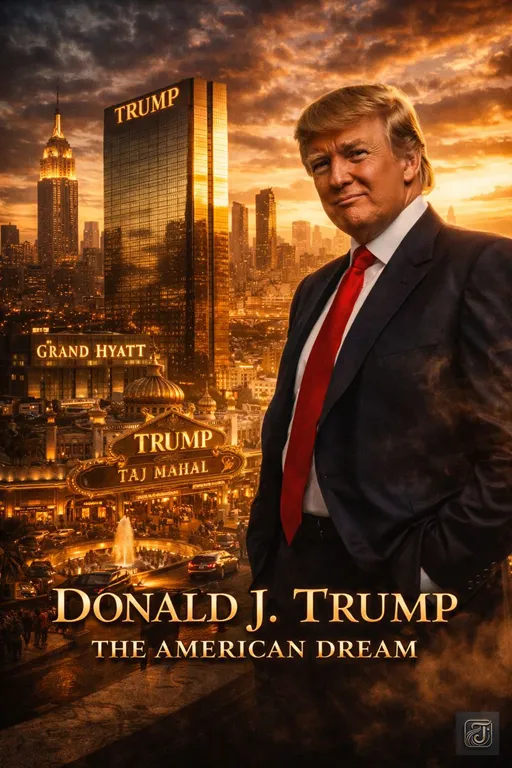
Donald J. Trump.
Having turned the Grand Hyatt into a success, stunned the world with Trump Tower, and dominated the media as the king of a casino empire,
he should have been the very embodiment of the American Dream.
— And yet.
American television delivered the same message day after day.
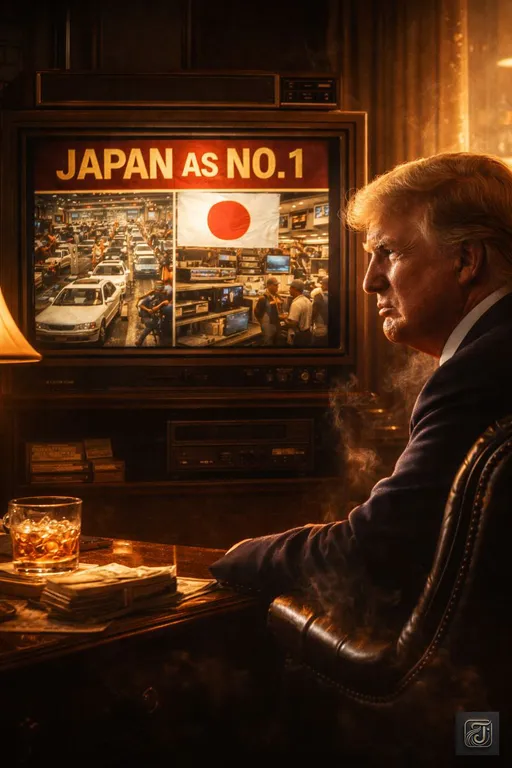
“Japan as No. 1.”
Japan was being hailed as the victor of the global economy.
American-made cars stopped selling, consumer electronics were defeated, and even semiconductors fell behind.
America’s pride was quietly eroded, and whispers began to spread on Wall Street.
“The emperor of the economy is no longer America.”
Those whispers reached Donald Trump’s ears as well.
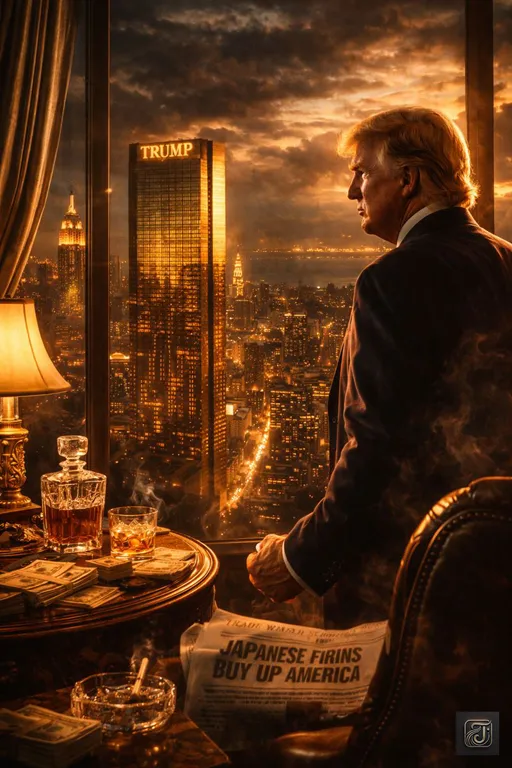
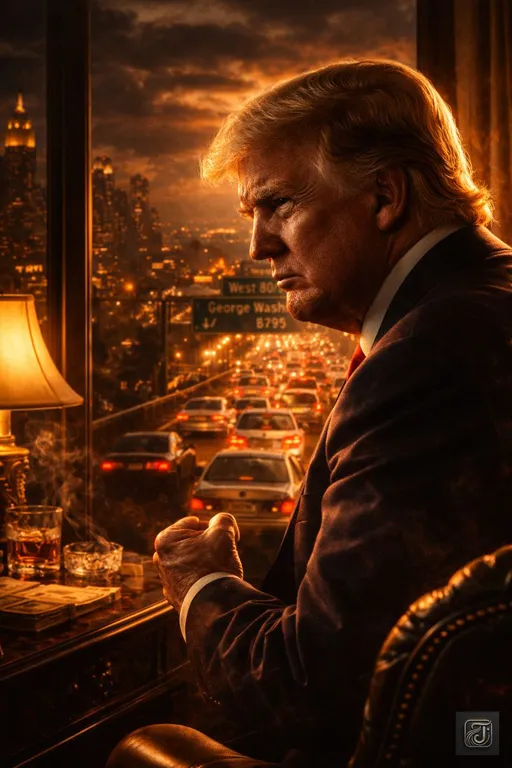
In a penthouse overlooking all of Manhattan, Trump could no longer contain his irritation.
Outside the window, the “golden tower” he himself had built gleamed in the night.
But his gaze was fixed much farther away—across the Pacific, toward Japan.
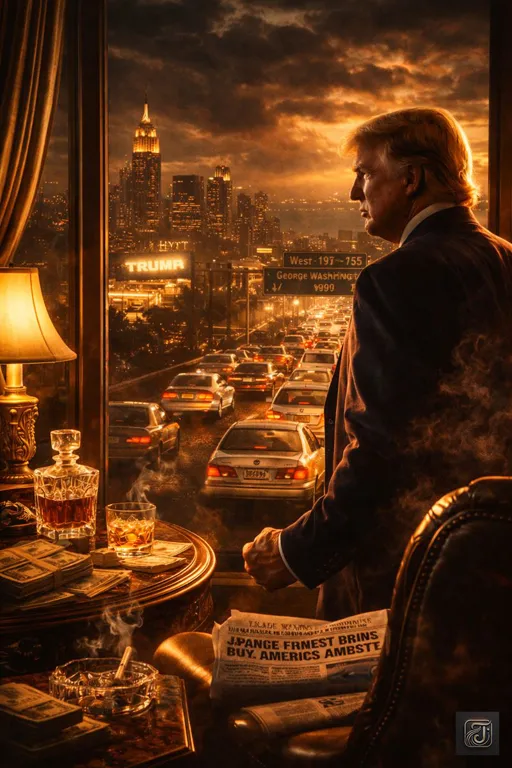
“America is being exploited. We’re nothing more than a cash cow.”
He clenched his fist.
Every time Japanese cars raced across American roads, it felt as though they were flaunting America’s defeat.
And then, one night, he made a decision.
The enemy to fight was not another real estate tycoon, nor a casino corporation.
It was a nation itself.
◆ “The Bomb Called a Full-Page Ad.”
October 1987.
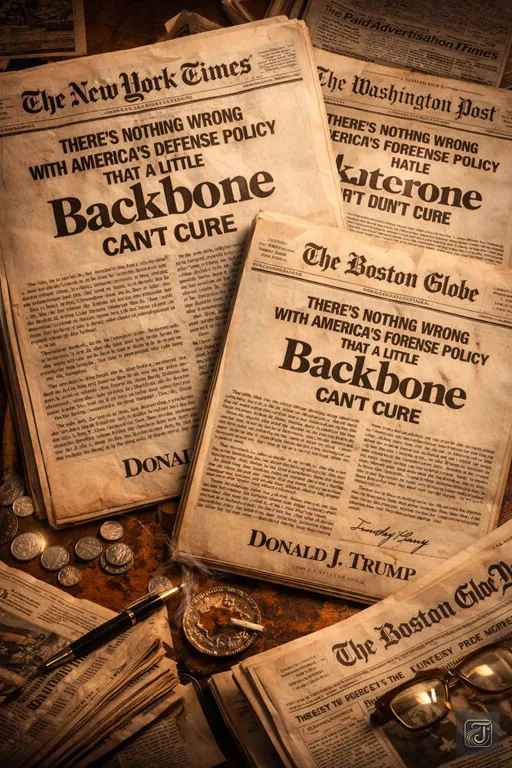
Three of America’s major newspapers—
The New York Times, The Washington Post, and The Boston Globe.
Across their pages suddenly appeared a massive opinion advertisement,
and the entire nation froze.
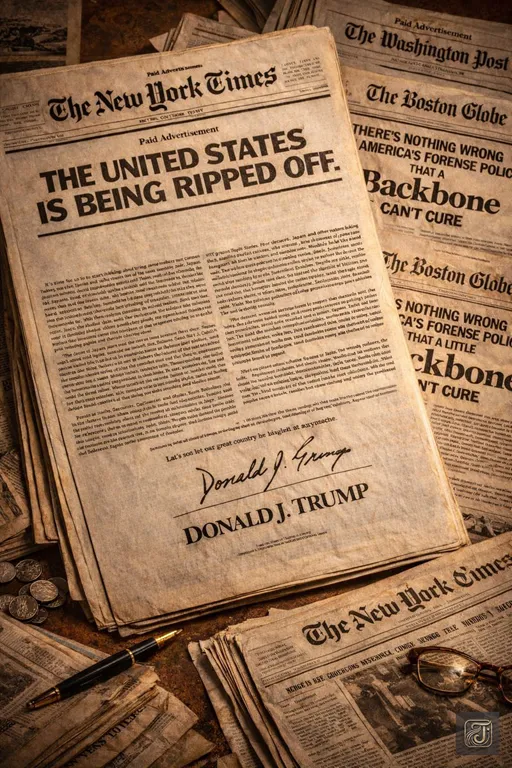
“THE UNITED STATES IS BEING RIPPED OFF.”
America is being taken advantage of by the world.
There was only one signature.
DONALD J. TRUMP
The message was explosive.
- Japan is not paying for its own defense
- Japan keeps its market closed and shuts out American products
- The U.S. government is weak and spineless
- If this continues, America will be swallowed by Japan
Trump gave voice, on the printed page, to the deep-seated frustration and sense of defeat that had been building inside the American psyche.
Not a politician.
Not a scholar.
A real estate tycoon declaring war between nations.
The media erupted all at once.
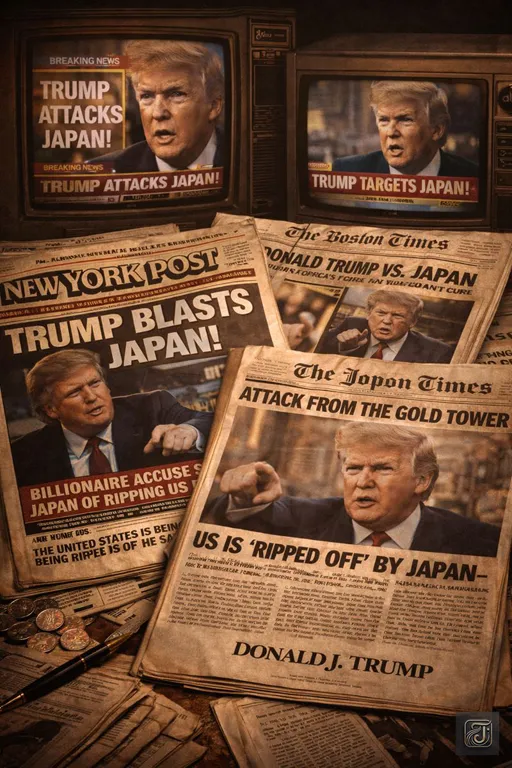
“Trump attacks Japan!”
“Has a new political protagonist emerged?”
“From New York’s golden tower, an arrow of anger was shot across the Pacific.”
Meanwhile, Trump was already thinking about his next move.
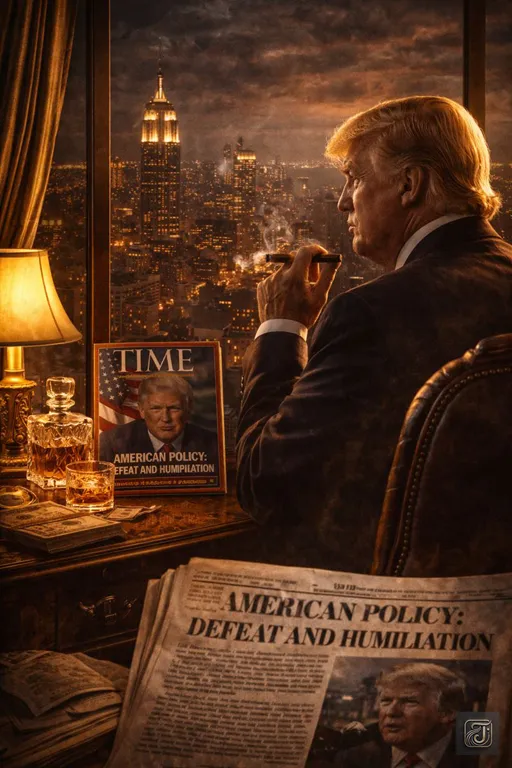
“Politics? I don’t really get it—but I know I could do it better.”
The more he thought that way, the more America’s policies felt to him like a frustrating defeat.
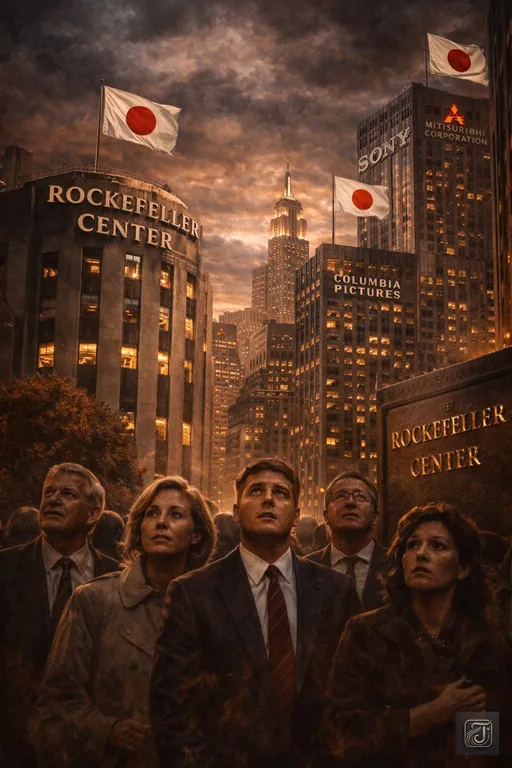
◆ The Shadow of the Empire: The “No.1 Ghost”
Japanese companies bought Rockefeller Center.
Sony acquired Hollywood’s Columbia Pictures.
Mitsubishi Estate carved its name into the symbols of Manhattan.
Americans trembled.
And Trump became convinced.
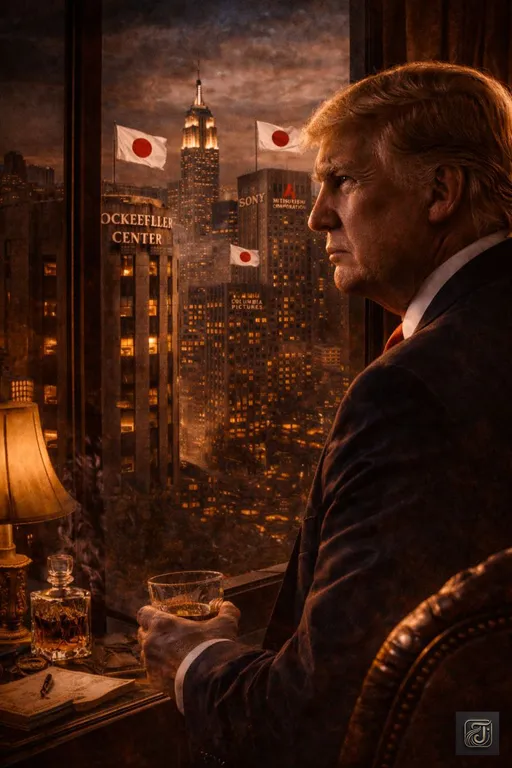
“Japan has surpassed America. But there’s no reason we have to allow it.”
At that moment, his political ego fully awakened.
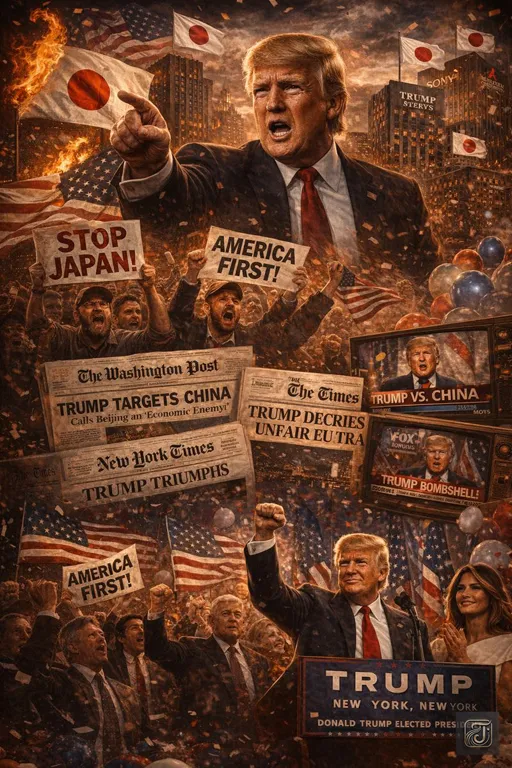
The prototype of what would later be called “Trump-style populism.”
was already complete at this point.
- Create an enemy
- Speak on behalf of the people’s anger
- Seize attention with spectacle
- And keep winning
His anger toward Japan was, in truth, anger at America’s defeat.
That emotion would later be redirected toward
China, Mexico, and the EU,
and would ultimately lead to his victory in the 2016 presidential election.
At the end of this chapter, he mutters to himself:
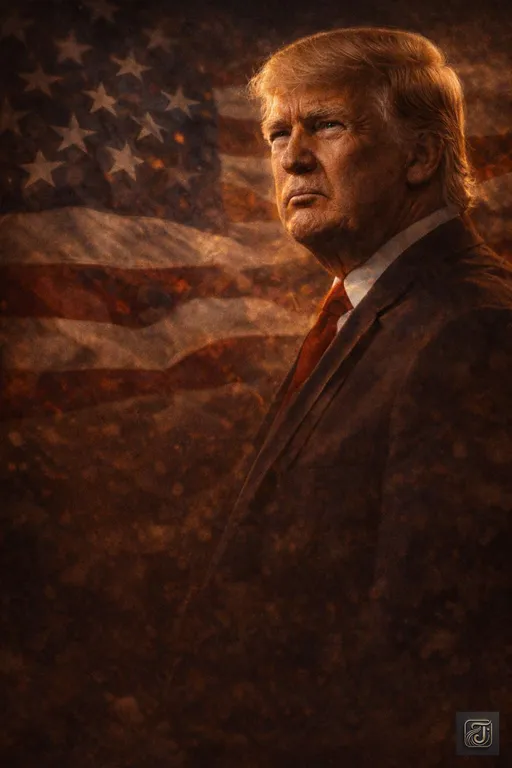
“Be a winner. That’s everything. And America, too, must win again.”
Chapter 6: Fame and Ruin — The Plaza Hotel (1988–1995)
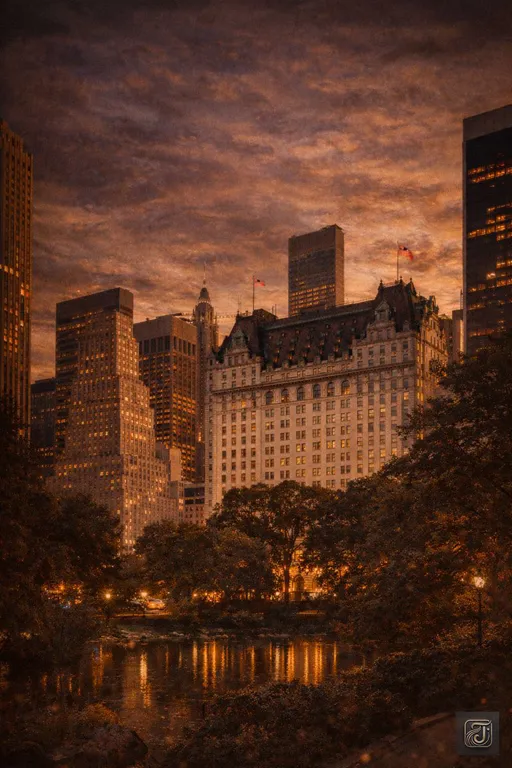
At the heart of Manhattan, on the southern edge of Central Park,
stands a massive white palace.
The Plaza Hotel.
A legend known to anyone who lives in New York.
Only those at the very top of the successful—those who already wear a crown—are allowed to reach for it.
And in 1988, Donald J. Trump pushed open that door.
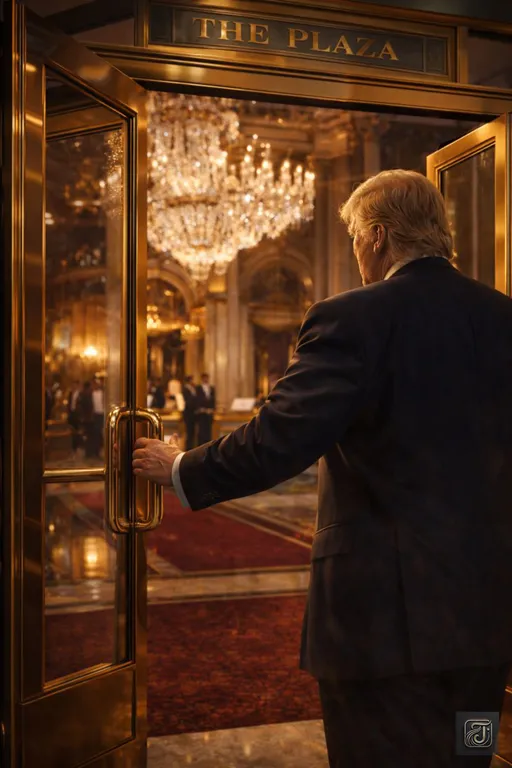
“I fell in love with the Plaza.”
The moment he stepped inside, he caught his breath.
The scent of plaster and marble.
Golden light spilling from massive chandeliers.
Standing in the grand hall, it felt as if he had wandered into nineteenth-century Europe.
He murmured to himself, almost unconsciously.
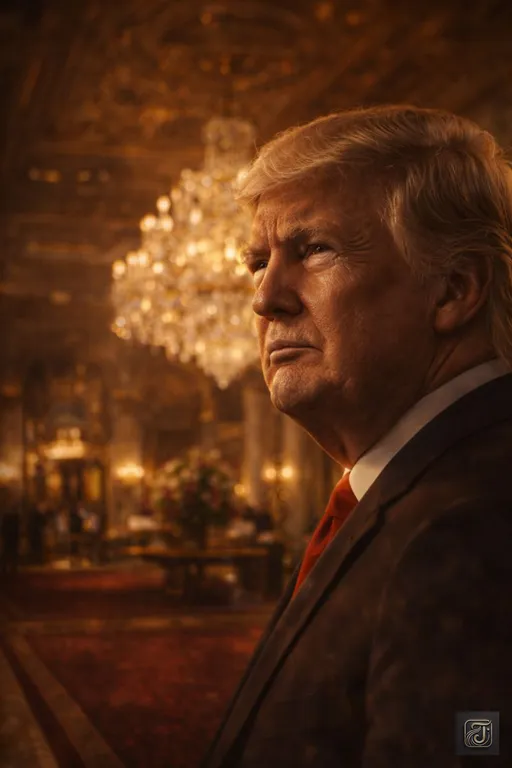
“This is something I have to buy.”
It wasn’t the judgment of an investor.
It wasn’t about numbers or returns—
It was an impulse closer to infatuation.
A few weeks later, at a press conference, he declared:
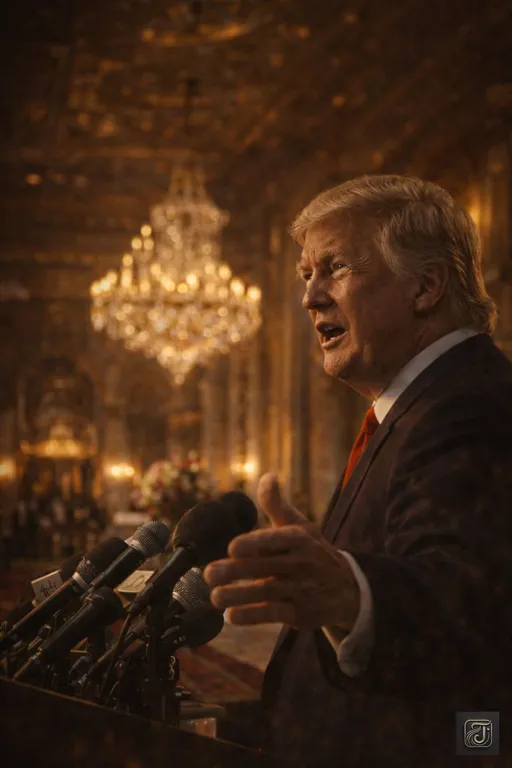
“I fell in love with the Plaza Hotel. This isn’t a business. It’s art.”
The bankers around him buried their heads in their hands.
They had never seen a man justify a $470 million acquisition with the word “love.”
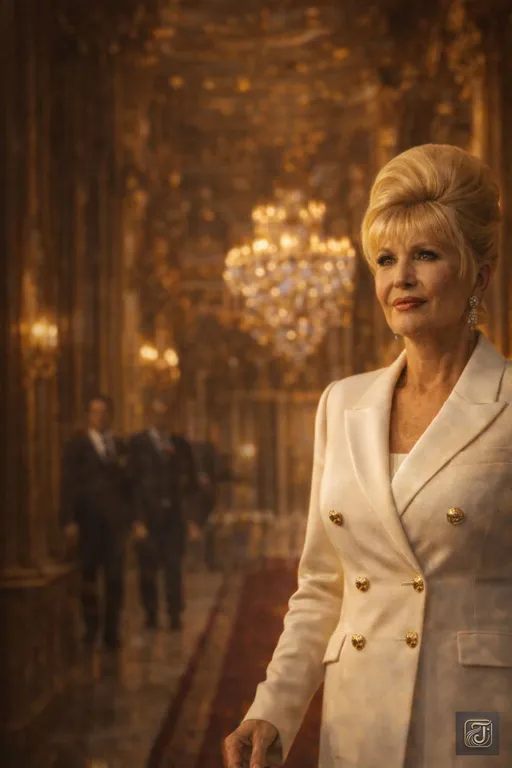
Ivana, Queen of the Plaza
Trump appointed his wife, Ivana, as the hotel’s general manager.
She was strong, beautiful, and capable.
She set out to restore the Plaza to its former brilliance.
• Rigorous staff training
• Introduction of European-style service
• A magnificent revival of the ballroom
• Event planning to bring back VIPs from around the world
When the sound of her heels echoed through the corridors, the staff straightened their backs,
and the hotel regained the tense elegance of a former royal residence.
But there was a small crack forming beneath the surface.
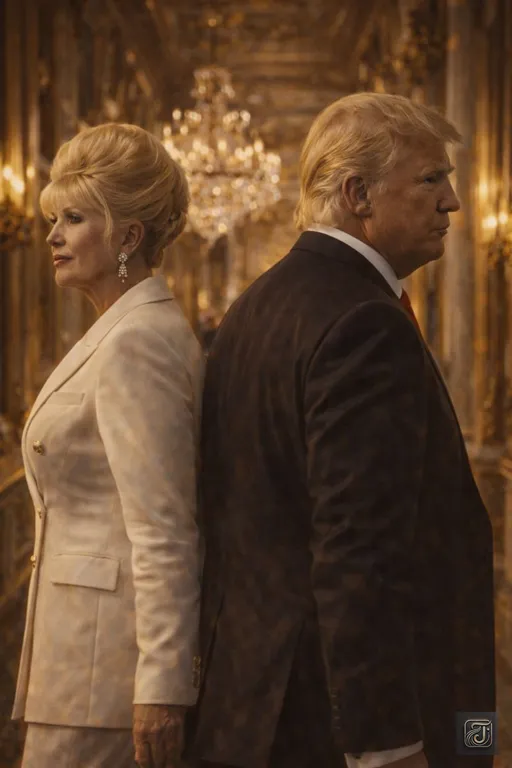
Each time Ivana took command,
Trump found himself unconsciously feeling as though his own empire was being ruled by someone else.
Deep in his heart, there was a curse planted by his father.
“Never be ruled. Be the winner.”
A cold wind slowly began to blow between husband and wife.
Marital quarrels became “the Plaza’s traditional music.”
One night, raised voices echoed through the conference room.
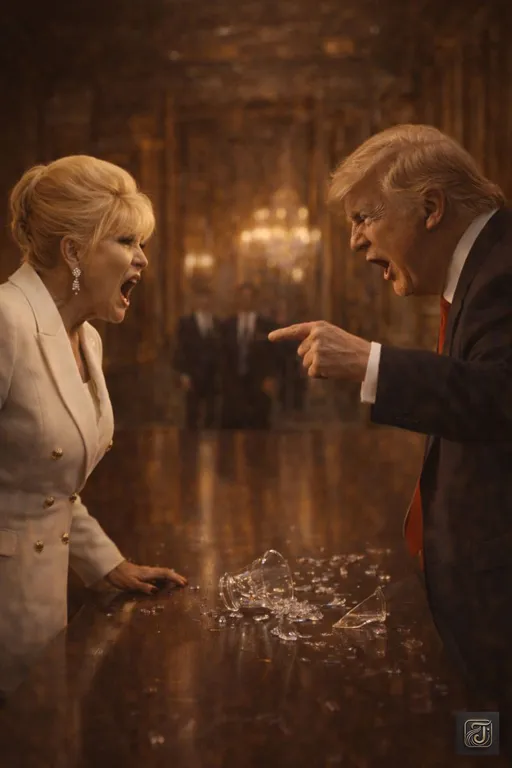
“You trust the staff too much!”
“You only ever look at the numbers!”
“This is my hotel!”
“If I don’t reform it, nothing will ever change!”
The sound of a glass cup shattering.
Staff members trembled.
Even the heavy walls could not contain their voices.
Years later, an employee would recall:
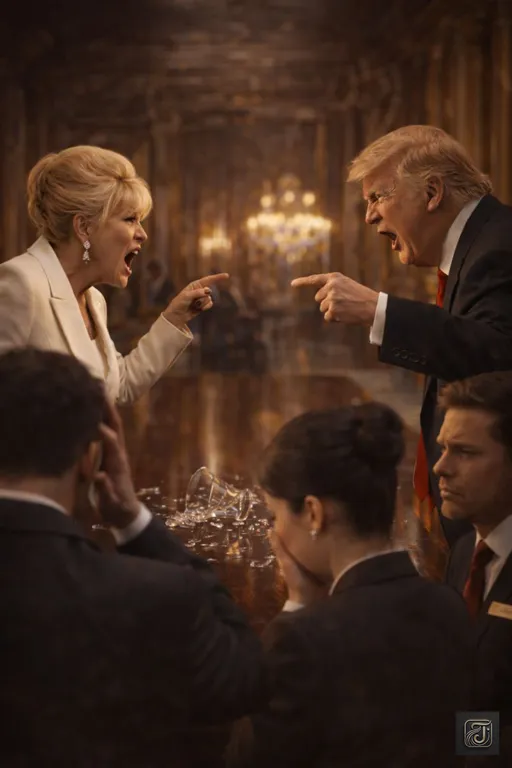
“Trump and Ivana’s fights had practically become the hotel’s background music.”
The Plaza, that grand palace, was gradually turning into a battlefield between a king and a queen.
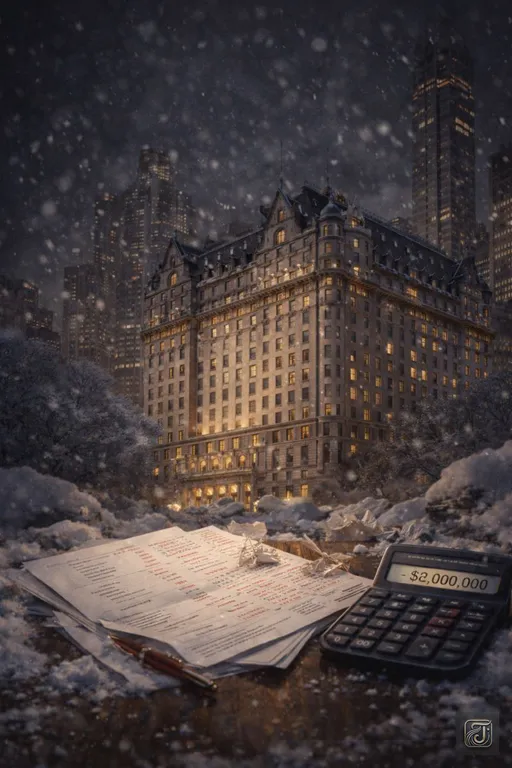
A descent into red ink, and the beginning of the empire’s collapse
The Plaza was beautiful, historic, and symbolic.
But when it came to profits… There were none at all.
- Maintenance costs were too high
- Room rates couldn’t compete with rivals
- Waves of economic recession
- Interest payments on Trump’s massive debts
The losses piled up like snow, with no sign of ever melting.
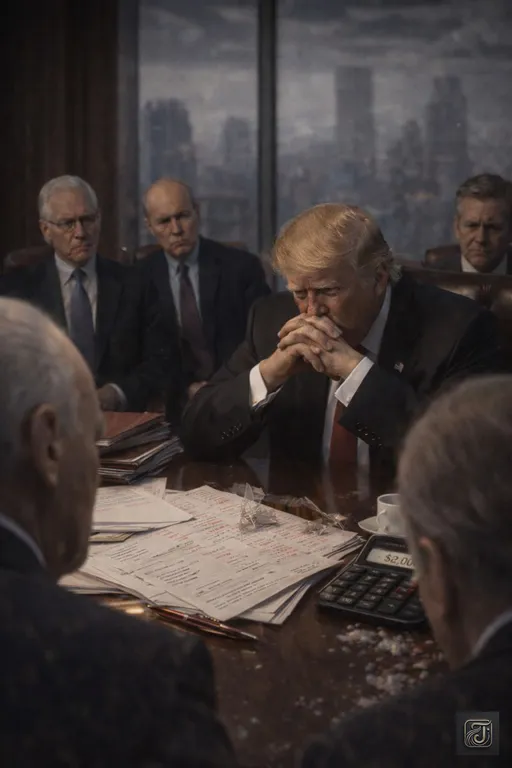
And then there were the other ventures—
the Taj Mahal, the Castle, the Shuttle airline—
All of them had turned into mountains of debt.
In a bank conference room, Trump fell into a long silence for the first time.
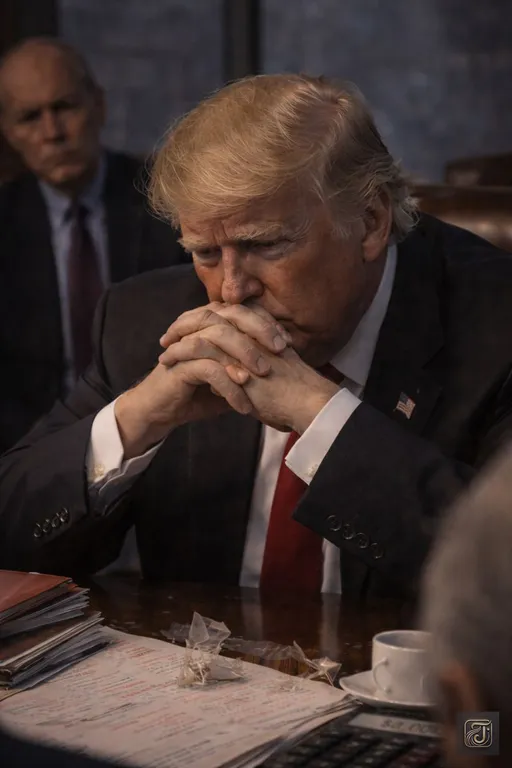
“Am I… going to lose the Plaza?”
No one could answer.
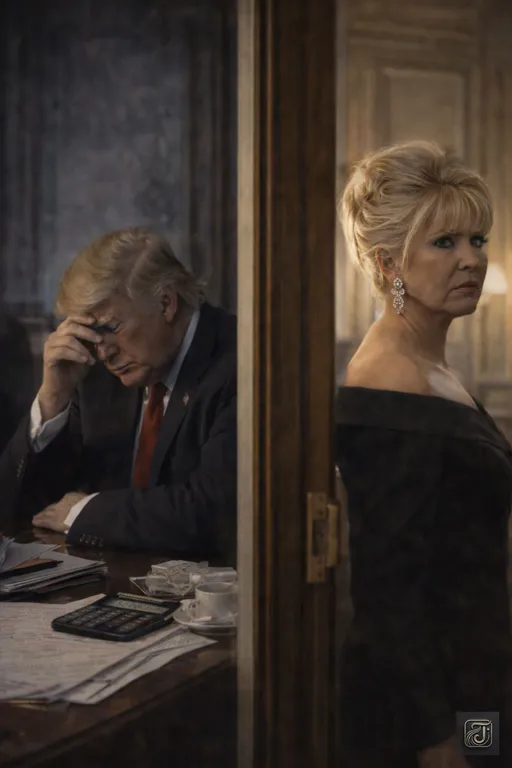
In 1992, the Plaza fell—and so did his marriage.
The losses exceeded their limits, and the Plaza Hotel finally entered restructuring, effectively bankruptcy.
At the same time, his marriage to Ivana came to an end.
Looking up at the grand staircase of the Plaza’s main hall, Ivana is said to have spoken these final words.
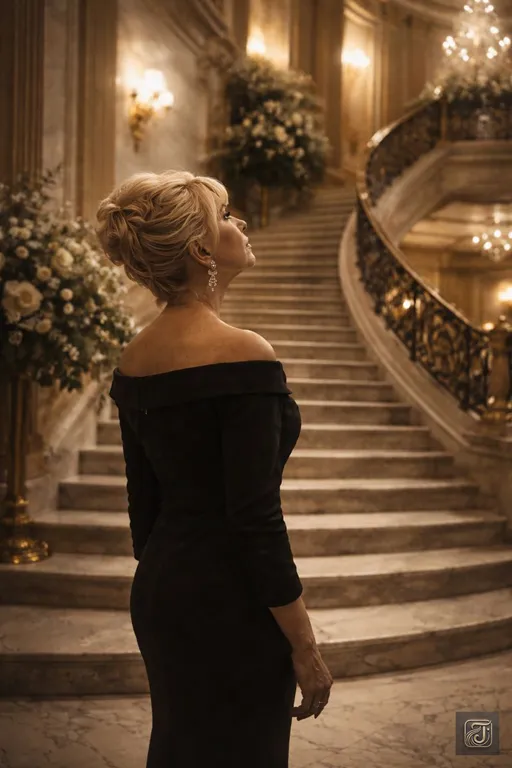
“You wanted something far too big.”
Trump did not reply.
Instead, that night, he stood alone in the Plaza’s lobby.
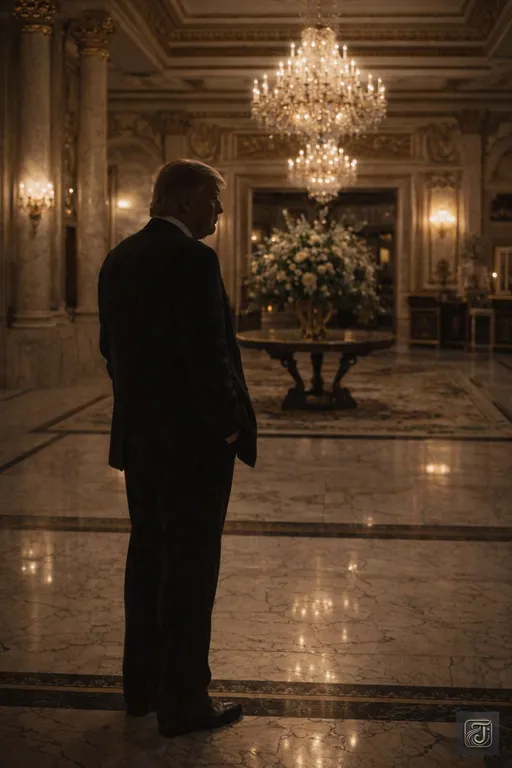
The glittering chandeliers, the golden ornaments, and the white stone walls offered him no comfort.
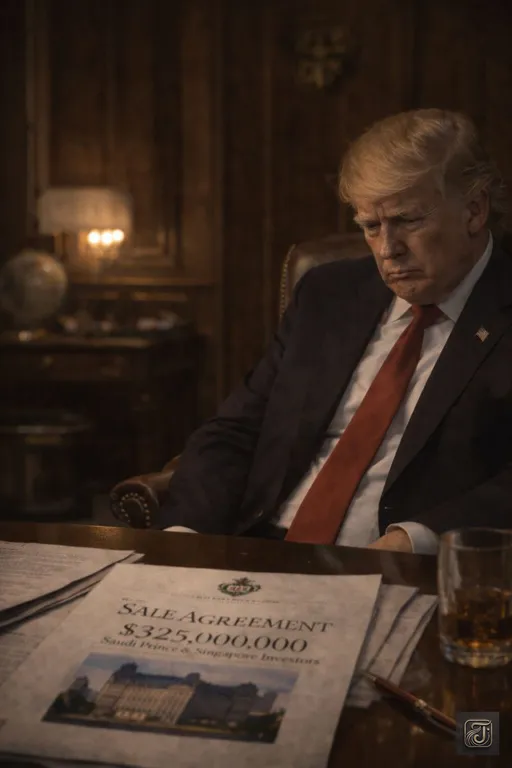
1995 — Complete withdrawal: the price of a “love affair” is settled
It was decided that Saudi Prince Alwaleed and a Singaporean company would acquire the Plaza Hotel.
Sale price: $325 million.
A loss of more than $150 million compared to what he had paid.
At the press conference, a reporter asked.
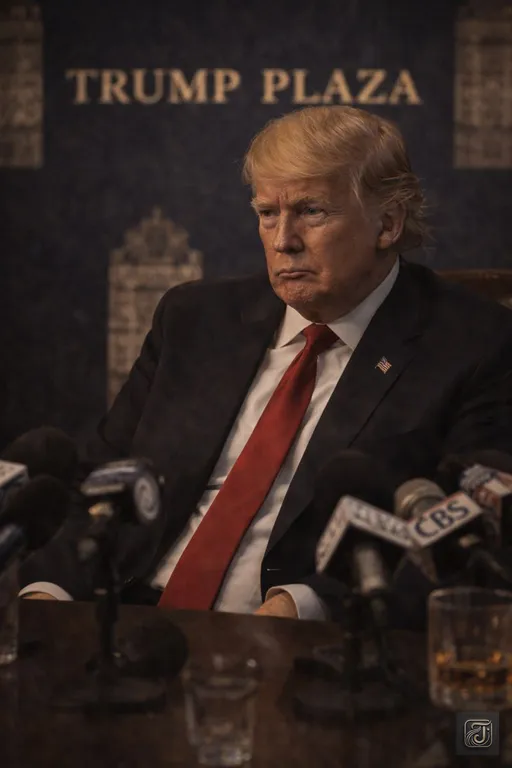
“Do you regret it?”
Trump did not change his expression, as always.
“Regret? No. I owned the Plaza. That is an experience reserved only for winners.”
But that night,
as he slowly looked up at the exterior of the Plaza Hotel,
he murmured to himself.
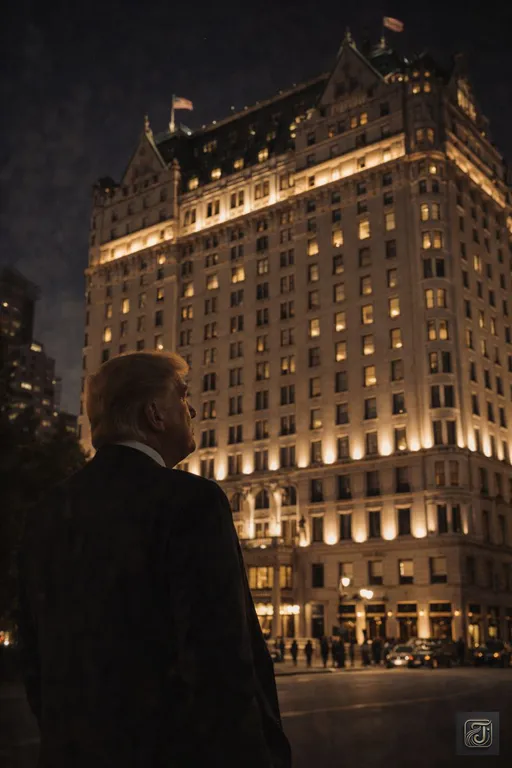
“This was the most expensive love affair of my life.”
Chapter 7: The Collapse of the Empire (1990–1994) — The Fall of the Golden Empire
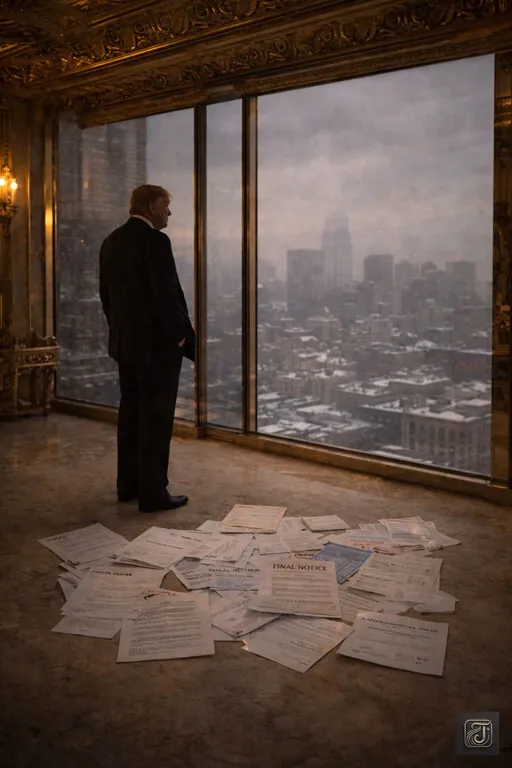
The winter in Manhattan felt colder than usual.
At the top floor of Trump Tower, in a room where gold decorations reflected light in silence,
Donald J. Trump stood alone, saying nothing.
At his feet lay bank demand letters, memos from lawyers,
and casino revenue reports—
all carrying the same meaning: the end.
The empire was beginning to collapse, audibly and unmistakably.
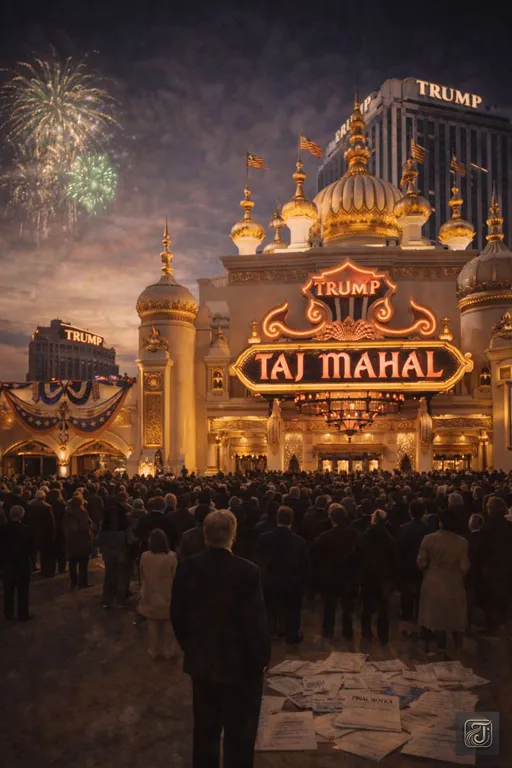
● The Taj Mahal — Supposed to Be a Symbol of Victory
April 1990.
Rising along the Atlantic coast, Trump Taj Mahal opened with great fanfare as the new king of Atlantic City.
That day, Trump declared proudly.
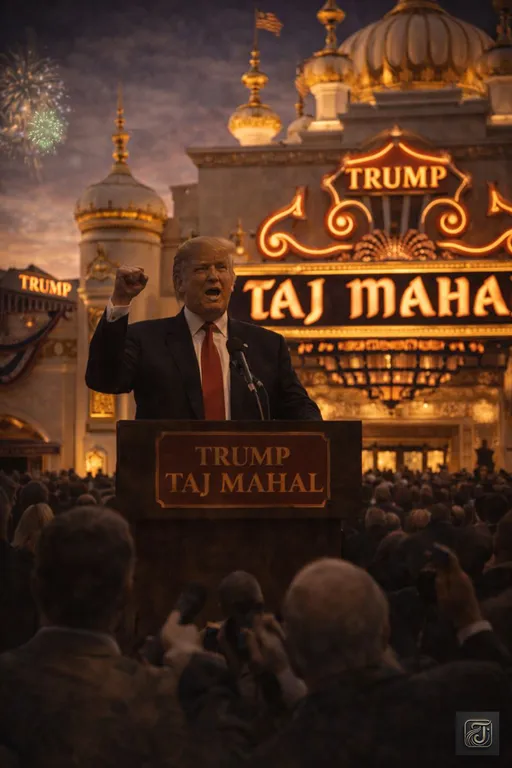
“This is the eighth wonder of the world. No one can beat me.”
But behind the scenes—
The high-interest junk bonds taken out to finance the $1.2 billion construction cost were quietly, yet relentlessly, tightening around his neck.
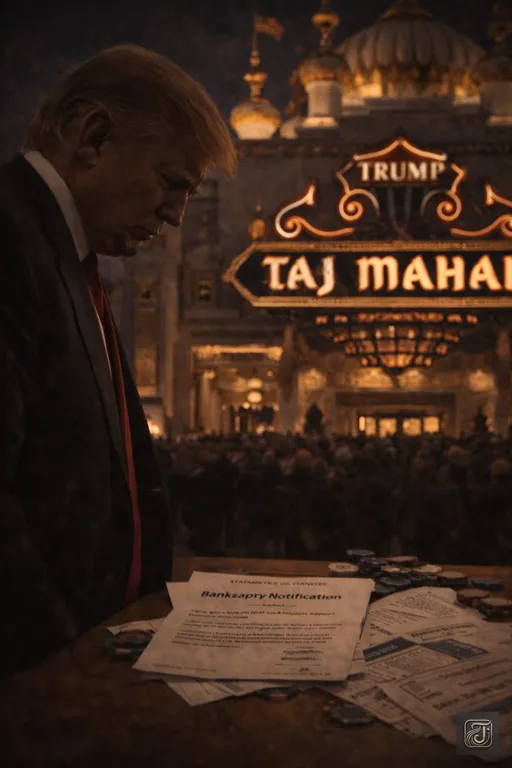
One year later, the Taj Mahal was insolvent and declared bankrupt.
The building, once hailed as the most luxurious casino in the world, also became the fastest to collapse.
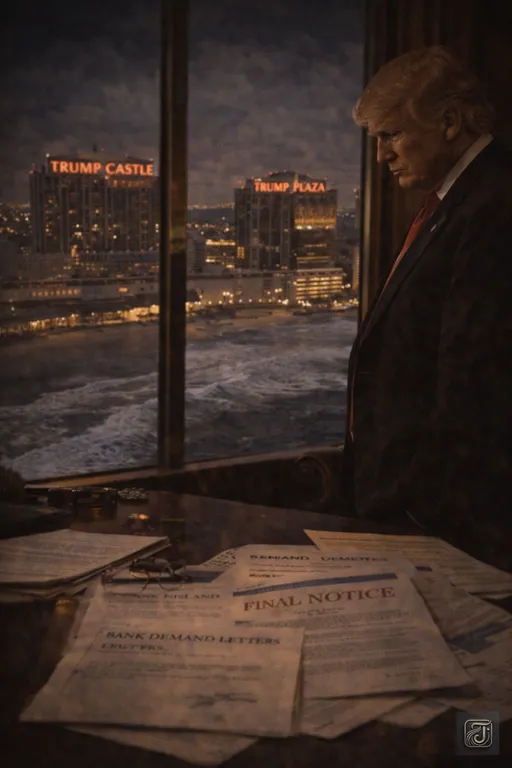
● The casino empire crumbled, and the banks closed in on the “king.”
Trump Castle was in the red.
Trump Plaza was in the red.
The sea winds of New Jersey howled as if mocking the former “winner.”
Bank executives said to Trump.
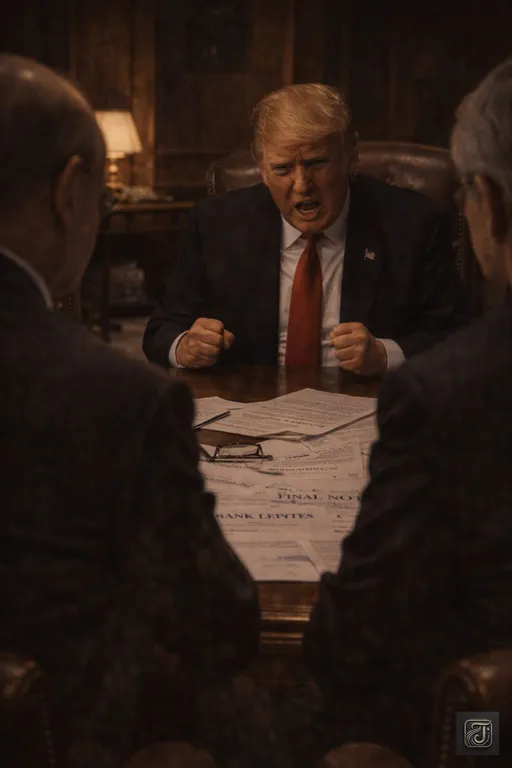
“Donald, you can’t pay anymore.”
Trump’s face twisted.
“I’m not going bankrupt. What’s bankrupt is your imagination.”
But reality was ruthless.
All of his assets were seized as collateral for loans, and the consortium of banks began to monitor his every move.
The Trump empire effectively entered bank control.
The very men who had once praised him and competed to lend him money were now concerned with only one thing:
how quickly they could recover what was left from the collapsing empire.
● And then, the greatest defeat — the battle for the Empire State Building
In 1994,
Trump found himself entangled in a “hidden ownership battle” over one of America’s most iconic symbols:
The Empire State Building.
He claimed that the building’s long-term lease was “invalid.”
and attempted to seize control of the property.
A reporter asked him:
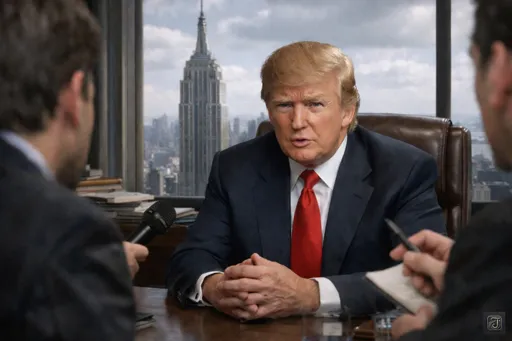
“Why are you so obsessed with the Empire?”
Trump answered quietly.
“That building is New York’s crown.
I can’t stand the idea of the crown belonging to anyone but me.”
But—
The court ruled that the contract was valid.
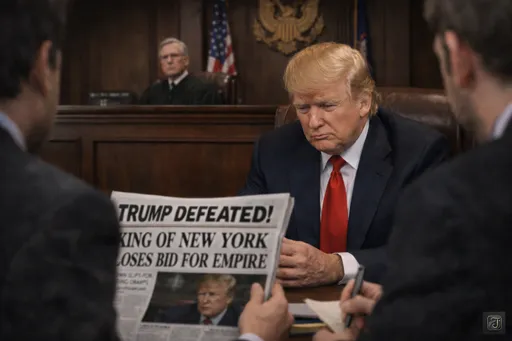
Trump lost.
His dream of claiming Manhattan’s ultimate symbol was shattered.
The newspapers wrote mercilessly:
“The King of New York has failed to seize the crown.”
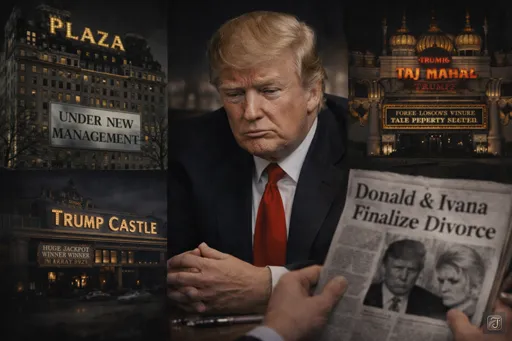
● Plaza, Castle, Taj Mahal… the golden names collapsing one by one
Around Trump, the golden neon lights began to go out, one after another.
- Plaza Hotel → placed under restructuring control
- Taj Mahal → handed over to creditors
- Castle → profits plummeted
- The Plaza divorce scandal → his reputation severely damaged
The rumors in the city began to change.
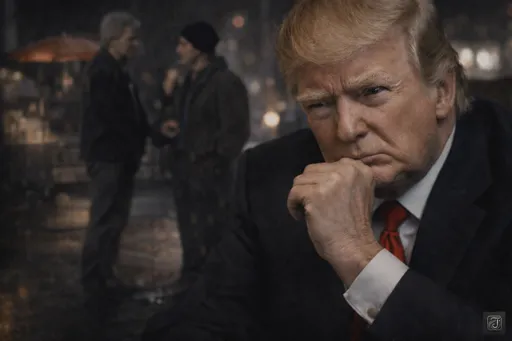
“Trump is finished.”
“He was nothing but flashy.”
Trump clenched his teeth at those words.
“What’s finished,” he said, “is their imagination.”
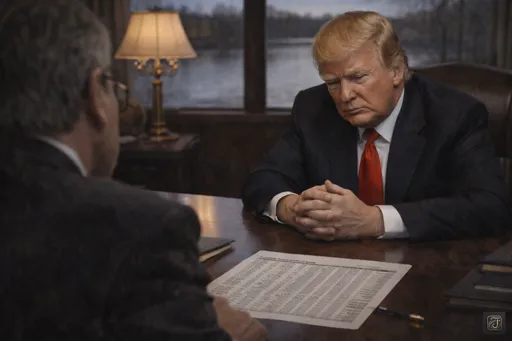
● A Man Sinking into a Golden Lake
In 1991, Trump sat in silence across from his lawyers at his estate outside New York.
On the desk lay a debt repayment schedule.
The monthly payments were, by any standard, impossible.
One of the lawyers spoke quietly.
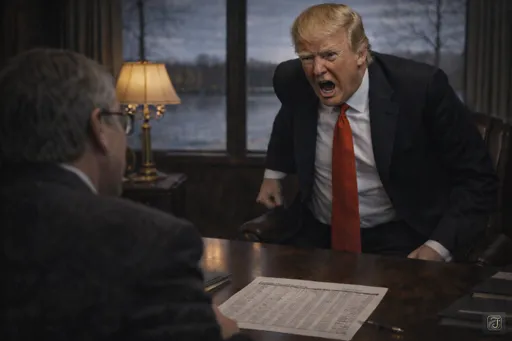
“You should file for bankruptcy, Mr. Trump.”
At that moment, Trump kicked his chair back.
“No. I’m not a loser. I’m not a loser.”
But reality was merciless.
Choosing his words carefully, the lawyer continued.
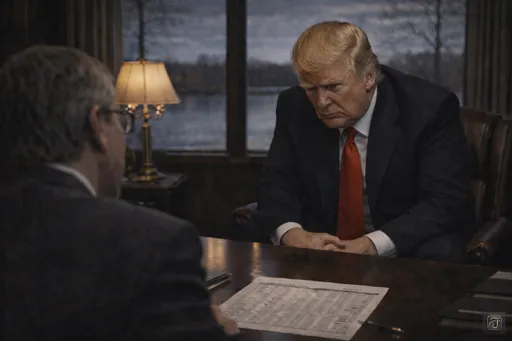
“…Then there is no choice but to hand over more than half of the empire to the banks.”
Silence.
The golden empire collapsed,
crumbling like a castle of sand.
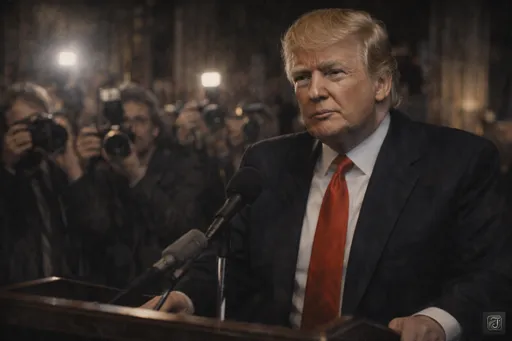
● Even so, he had not lost his “story.”
Trump would later say this:
“At that time, I lost everything.
But there was one thing I did not lose.
The story of ‘Donald Trump.’”
Even if people mocked him,
even if the media ridiculed him,
even if the banks dismantled his empire—
As long as the story remained, the man could keep going.
This was the only hope Trump grasped in the 1990s.
And that story would soon begin running toward an even larger stage.
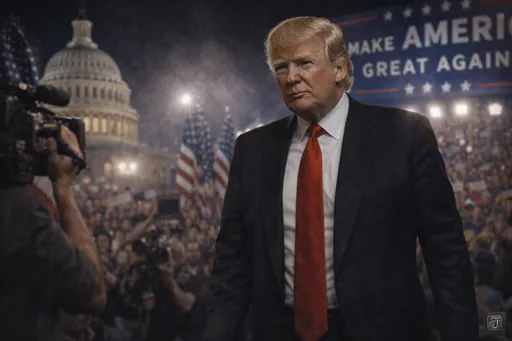
Television.
Politics.
And America itself.
The empire had collapsed.
But the man was not finished yet.
Chapter 8: Into the Dark of Politics — The Reform Party Primaries (2000)
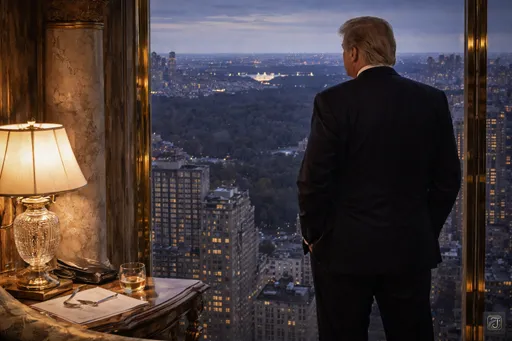
New York, 1999.
As the dry winter wind rattled the glass along Fifth Avenue, Trump stood by the window of his golden penthouse.
Below him lay the real estate empire he had built.
But his gaze was fixed not on the buildings—
—It was directed toward the White House.
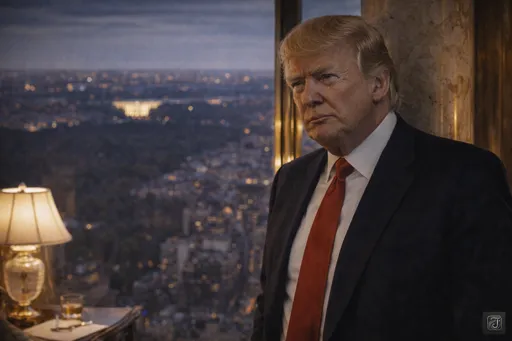
“Maybe it’s time to run this country.”
That line was not a joke.
By then, whenever he appeared on television, he drew attention.
When he published a book, it sold.
Whatever he said became news.
Precisely because of that, there was no next stage to choose—
except politics.
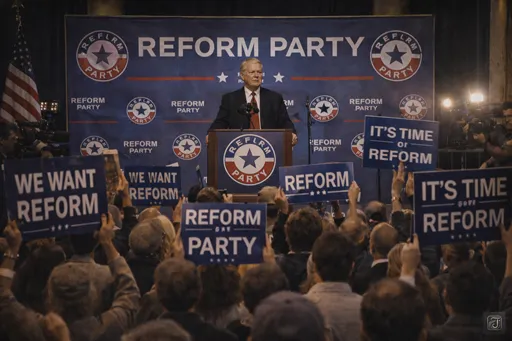
1. The Reform Party — A Strange Third Force
At the time, the United States had an unusual third political party built by Ross Perot: the Reform Party.
- Neither Republican
- Nor Democrat
- Yet overflowing with public dissatisfaction
In that era, the Reform Party attracted support as a vessel for the masses who harbored deep resentment toward elites.
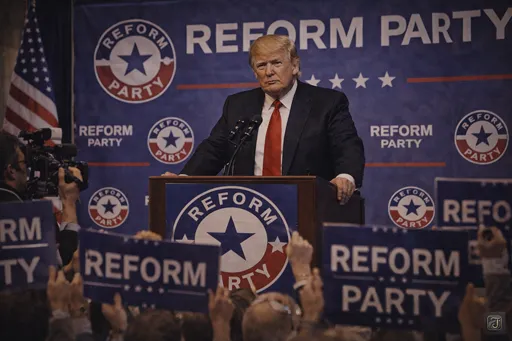
“I see. Outsider, anti-elite, fiscal discipline…
It fits the mood of the moment perfectly.”
And then Trump made his decision.
“I will become this party’s presidential candidate.”
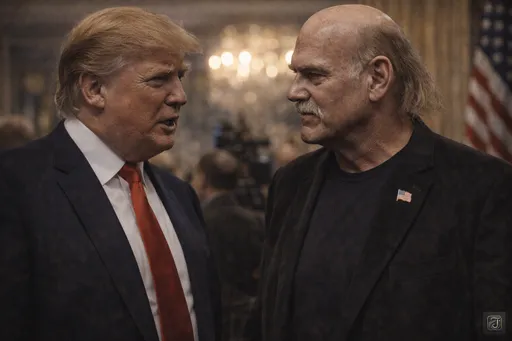
■ 2. An Ally: A Former Pro Wrestler Turned Governor
Trump first went to meet one man.
Jesse Ventura.
A former professional wrestler and, at the time, governor of Minnesota.
An “outsider hero” who had risen from zero political experience to win a real election.
Ventura laughed and said:
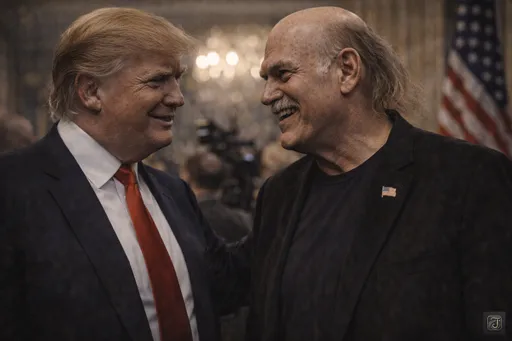
“Donald, you can win. This country is sick of politicians. What it wants now is a showman.”
Those words gave Trump a gentle push forward.
But he did not yet know that, from this moment on, the gates of hell had begun to open.
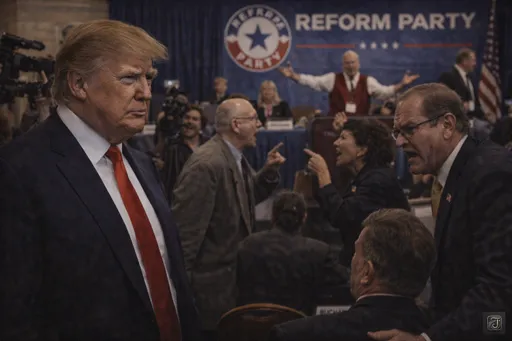
3. The Reform Party Was Already in a State of “Civil War.”
The moment Trump stepped inside the party, he understood it.
“This is a circus.”
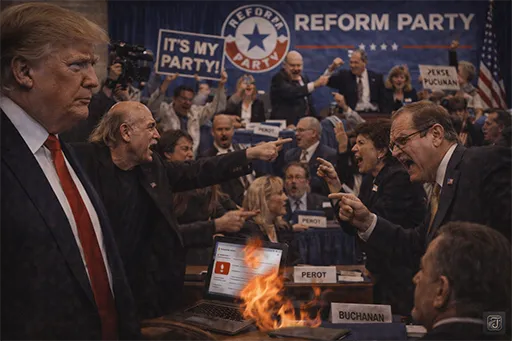
The party was split into three factions.
- The Ventura faction (anti-elite, anti-establishment)
- The Pat Buchanan faction (far-right populism)
- The Perot holdovers (budget-focused pragmatists)
Every meeting dissolved into insults.
Every debate turned into shouting matches.
Emails erupted into constant flame wars.
There was no environment in which serious policy discussion was even possible.
Trump later recorded his impression with open exasperation:
“I’ve seen my share of cutthroat battles in the business world,
But I’ve never encountered an organization this chaotic.”
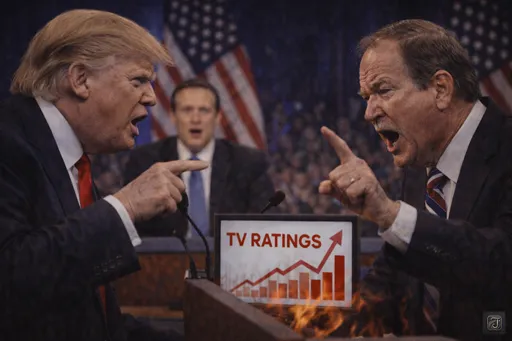
■ 4. VS Pat Buchanan — Trump-Style “Political Combat”
The strongest rival within the Reform Party was the conservative commentator Pat Buchanan.
As soon as the televised debate began, Trump lunged forward without hesitation, as he always did.
“Pat, aren’t you supported by the KKK?”
Buchanan erupted in anger.
The audience gasped.
The moderator went pale.
But the ratings soared.
At that moment, Trump was certain.
“Creating enemies” can be a weapon.
That realization would later become the core of the Trump political style.
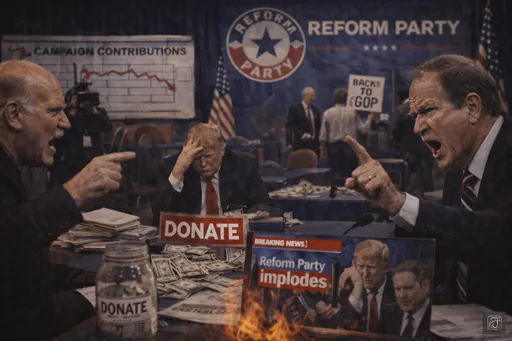
5. Endless Infighting, and the Vanishing Chance of Victory
As the days passed, the Reform Party sank deeper into the mud.
- Funding dried up
- Supporters drifted away
- The media treated it as entertainment
- The Ventura faction and the Buchanan faction were on the verge of suing each other
At last, even Ventura himself grew fed up and said bluntly to the media:
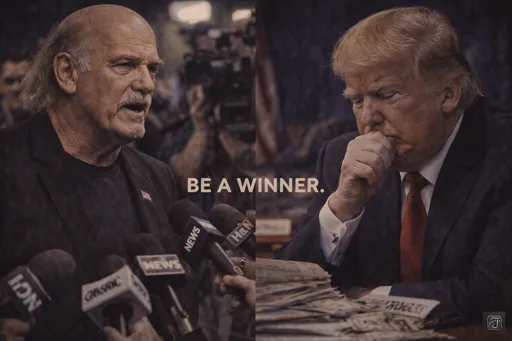
“This party is no longer functional.”
Trump began to calculate quietly.
Can I win?
Or can’t I?
In his mind, the familiar words drifted once more:
“Be a winner.”
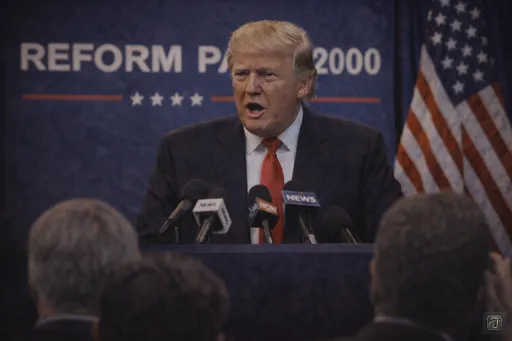
■ 6. Withdrawal Announcement — “This party is crazy.”
February 2000.
Out of the blue, Trump announced that he was withdrawing from the race.
The press conference opened with a line that could only be his:
“This party is crazy.”
- Internal divisions
- Incompetence
- Dishonesty
- And no chance of winning
So he was leaving.
That was all.
Trump explained it this way:
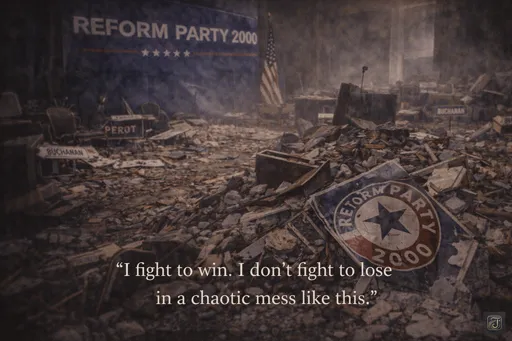
“I fight in order to win. I have no intention of getting dragged into chaos just to lose.”
After that, the Reform Party rapidly fell apart.
It was as if a massive storm called Trump had swept through—leaving nothing behind but rubble.
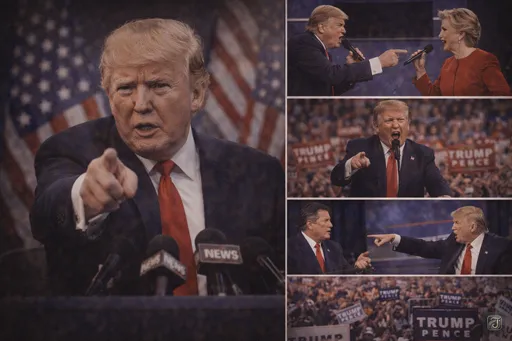
■ 7. But this experience completed “Trump-style politics.”
Was the Reform Party a “failure” for Trump?
The answer is NO.
On the contrary, this is where he learned:
- The masses respond to politics that creates enemies
- Established parties are weak against internal conflict
- Outsiders possess an overwhelming appeal
- Extreme language becomes free publicity
- If you charge into topics no one else dares to touch, you seize attention
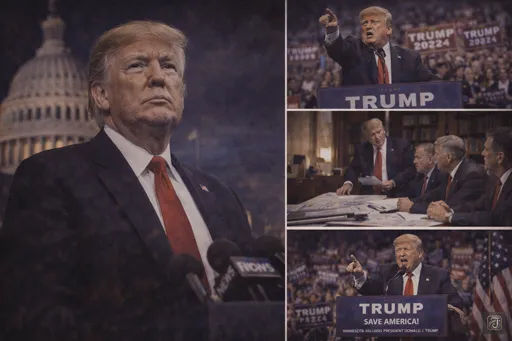
“This will become the formula for victory in 2016.”
And somewhere deep inside, he became certain.
“Someday, I will go after the presidency for real.”
The Reform Party was finished, but Trump’s political story began here.
Chapter 9: Transformation into a Television King (The Apprentice)
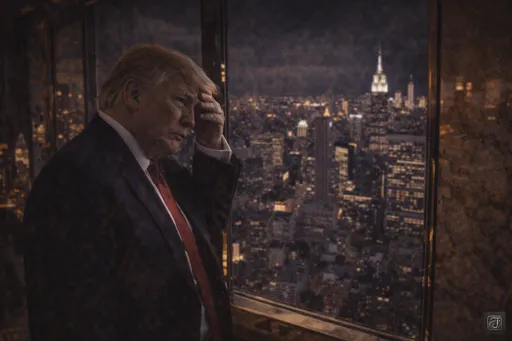
—“You’re fired!” changed the world
The New York night skyline was quieter than usual.
Reflected in the windows of the top floor of Trump Tower was neither gold ornamentation nor marble—
It was anxiety.
The collapse of the 1990s, the loss of the Plaza, the bankruptcy of the Taj Mahal, and the failed bid to seize the Empire State Building.
The Trump empire was far more fragile than the public believed, its colossal feet beginning to crumble like loose gravel.
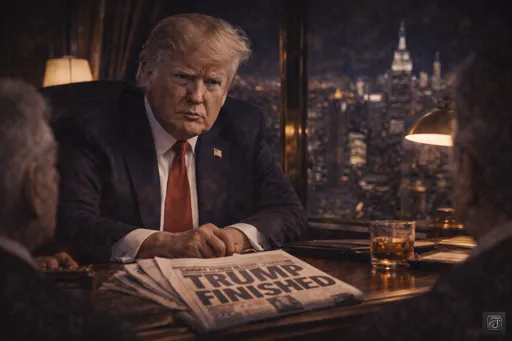
“Donald Trump is finished.”
That was what the newspapers said, and investors began to keep their distance.
But he was not finished yet.
If you change the story, you change people’s memories.
The story itself was Trump’s greatest weapon.
Then, a single phone call rang—one that would change his fate.
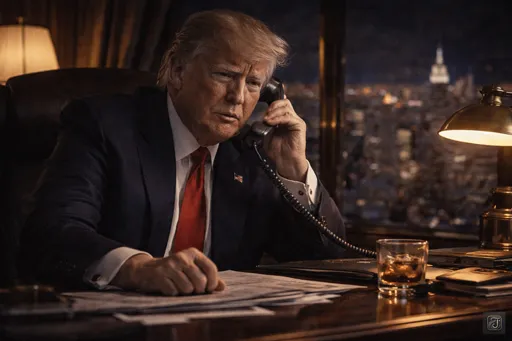
◆ Mark Burnett, the “Mad Inventor.”
The caller was Mark Burnett, the king of reality television.
Looking at the lavish atrium of Trump Tower, he murmured just one line.
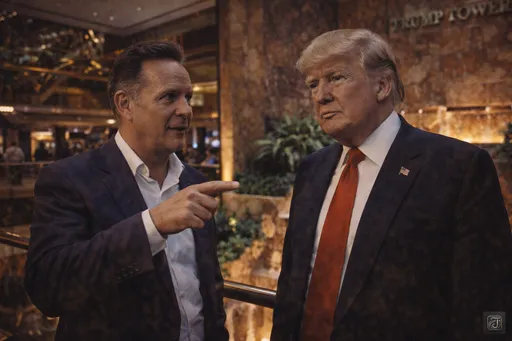
“This man is the show. And this building is the stage.”
Burnett’s proposal was strange.
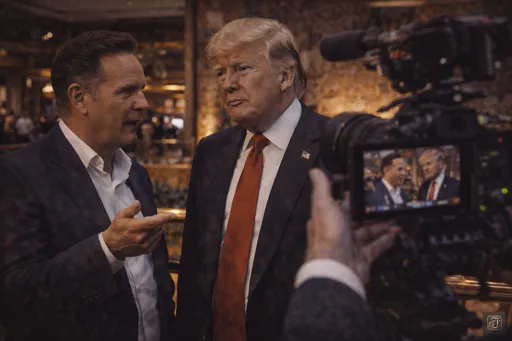
“I want to make a reality show with you as the star.”
Trump laughed it off at first.
“Television? Do I really need that?”
But he knew it.
In the world of real estate, he was no longer shining the way he once had.
If the path back to glory lay inside that camera—
Then there was only one choice: take it.
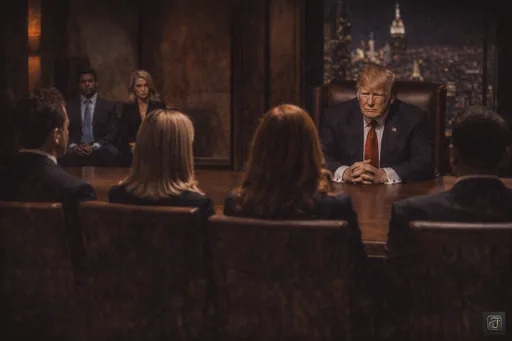
◆ The Birth of The Apprentice
In 2004, NBC launched a new television series: The Apprentice.
The stage was Manhattan.
The competitors were young men and women driven by ambition.
Their challenges involved business, advertising, negotiation, and strategy.
Each week, a loser was chosen
and summoned to stand before Trump.
And then—
a single phrase was spoken, one that would shake the world.
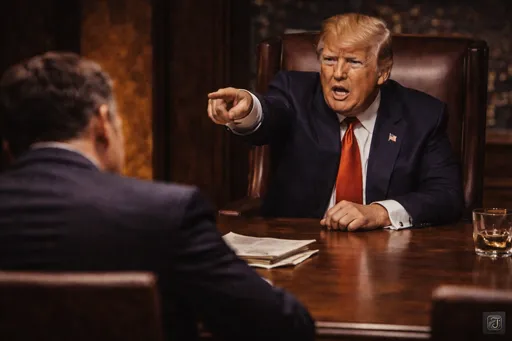
“You’re fired!”
In that moment, viewers were electrified.
Trump looked down like an emperor from a massive boardroom chair,
delivering a merciless judgment.
…but there is a backstory.
That famous catchphrase was not Trump’s idea.
It was Burnett who said this.
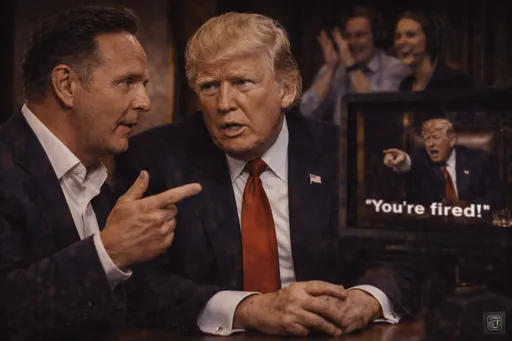
“Donald, the audience needs a symbol of punishment.”
At first, Trump hesitated.
“That’s not how I usually talk.”
But the moment they watched the finished footage, everyone on the staff knew.
“This is it. This is Trump’s weapon.”
◆ The Fiction of the “Perfect Businessman” the World Believed In
In reality, Trump’s financial situation at this time was far from healthy.
The towers struggled to attract tenants, the hotels were burdened with debt, and banks remained wary.
But television does not care about the truth.
Who television shows becomes “reality.”
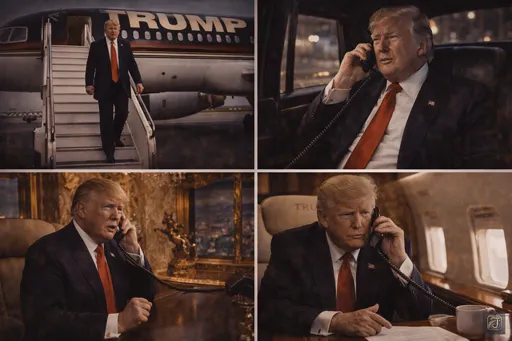
The program relentlessly showcased:
- Trump’s private jet
- Limousines
- A golden penthouse
- His image constantly on the phone, appearing endlessly busy
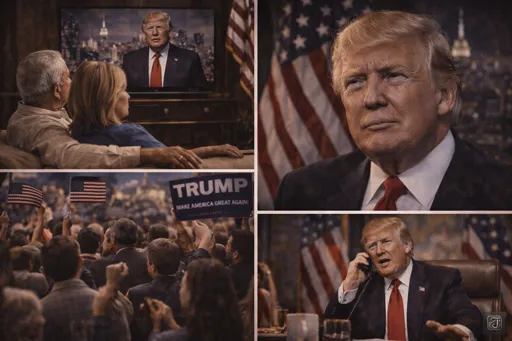
“Donald Trump = the world’s strongest businessman.”
This image was etched into households across America.
Viewers began to genuinely believe:
“This man can rebuild America.”
The fact that he had gone through bankruptcies and was carrying enormous debt no longer mattered to anyone.
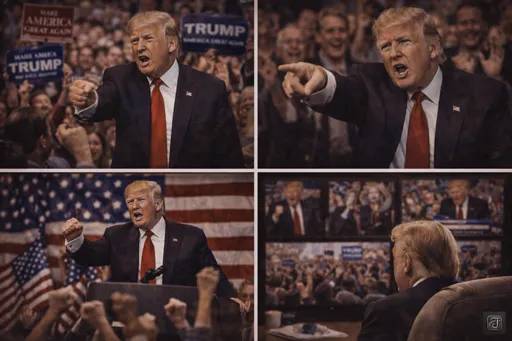
◆ The Apprentice Was a “Public Opinion Poll.”
In later years, Trump would say:
“The Apprentice taught me what the people want.”
What makes the public cheer?
What kind of words are perceived as “strength”?
Who should be turned into an enemy to ignite excitement?
The show was a more ruthless laboratory of public sentiment than politics itself.
And from it, Trump learned one clear lesson:
“If I perform strength, you can win.”
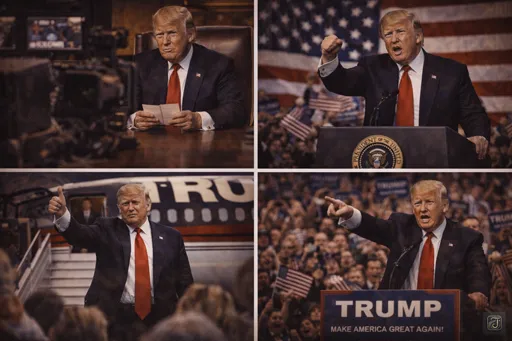
◆ The Road to the White House Began in This Television Studio
The Apprentice became a ratings monster, and Trump returned to the very center of America.
But this was not merely a comeback.
It gave birth to a different version of Trump.
- Cold, ruthless decision-making
- Flashy, theatrical presentation
- A style that creates enemies and cuts them down
- A “strongman” persona that ignites mass enthusiasm
All of these connected directly to the Trump of the 2016 presidential election.
The Apprentice was not just a television show.
It was a staging ground that produced a president of the United States.
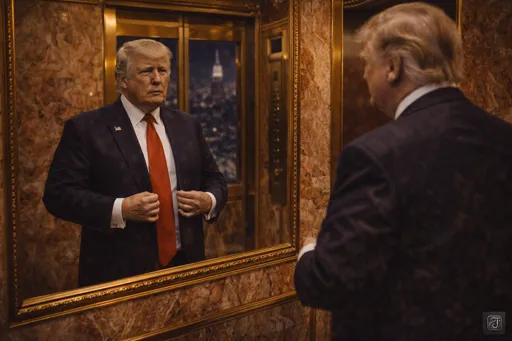
◆ Epilogue: Back to the Golden Tower
The elevator reached the top floor.
Donald Trump straightened the hem of his suit and looked into the mirror.
The “strongest man” people had watched through a screen was standing right there.
“I’m back.”
Armed with the weapons he had gained in the television studio,
He stepped into the next battle—politics.
At that moment,
American history quietly began to change its direction.
Chapter 10: The Dark Shadow of SoHo (2007–2010)
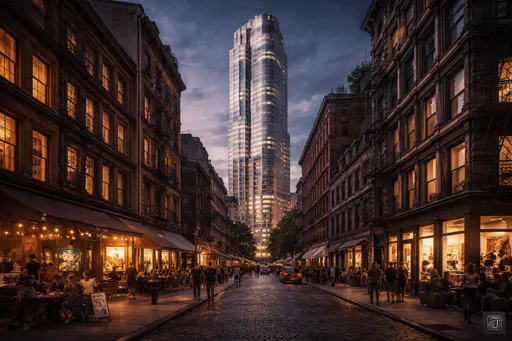
— What Lurks in the Shadow of a Beautiful Tower —
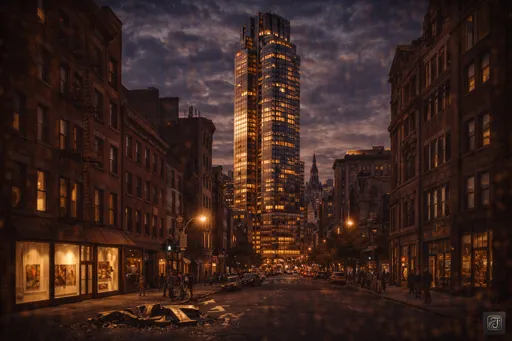
At the southern edge of Manhattan lies SoHo, a district dense with artists’ studios.
Once a warehouse zone, the area had become a symbol of New York’s creative energy.
And then, suddenly, an alien “city of the future” rose into view.
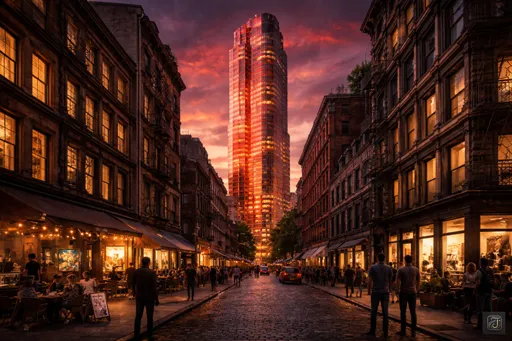
Trump SoHo.
Its walls of glass and steel reflected the setting sun, staining the building a blood-red hue.
Local residents called the sight an “intruder.”
— This is an art district, not a place for a golden tower.
As opposition to the development intensified,
Trump stood on the site accompanied by Ivanka and Don Jr.
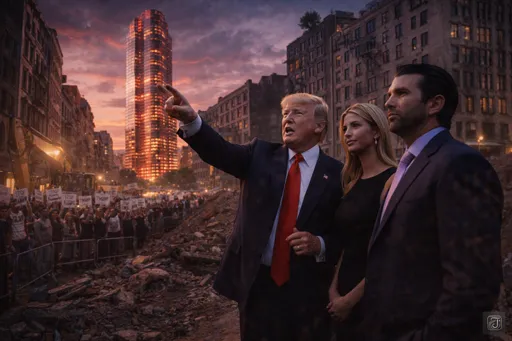
“Look. SoHo needs me.
This neighborhood may be selling ‘the old,’ but I’m the one who will build the future.”
Ivanka nodded with a smile, yet in her eyes flickered a faint unease—
a quiet anxiety about the sheer scale of her father’s ambition.
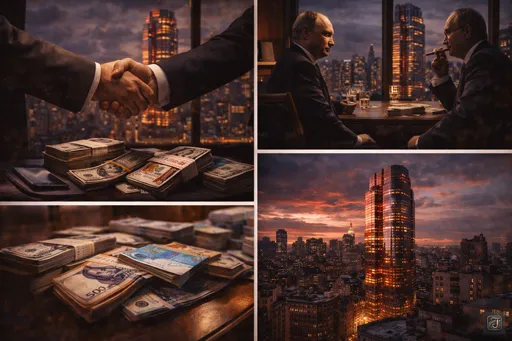
◆ The “Shadows” of Russia and Kazakhstan
There was something strangely quiet about this project.
On the surface, it appeared to be a glamorous international investment.
But behind the scenes, foreign money was flowing in through a tangled web of channels.
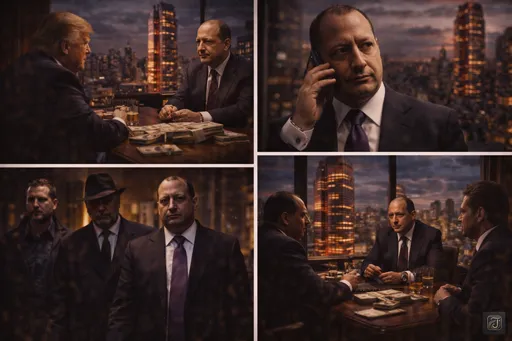
At the center of it all stood one man—Felix Sater.
Convicted in a violent crime, rumored to have ties to the mafia, and connected to the FBI as well—a multifaceted figure.
Whenever Trump was asked about him, he always gave the same answer:
“I don’t remember him. I’ve never even heard the name.”
But in reality, they had sat at the same table many times.
Business always contains both light and shadow—but in SoHo, there was far more shadow than light.
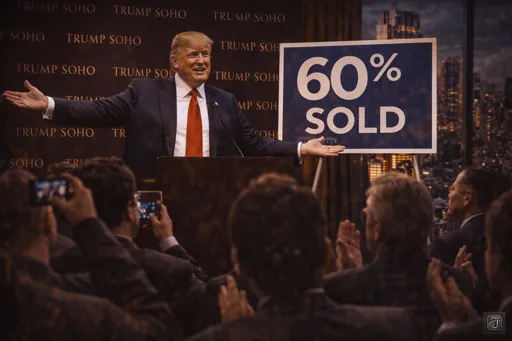
◆ And Then, the Fabricated “Sales Success.”
Before the opening, Trump’s side announced with absolute confidence:
“Sixty percent sold! SoHo is a huge success!”
Reporters leaned forward, investors applauded, and Trump puffed out his chest with pride.
But then—
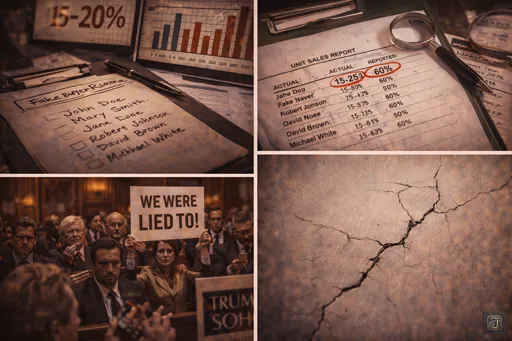
• The actual sales rate was only around 15–20%
• Many of the supposed buyers listed as having signed contracts were names that did not exist
• The statistics were decorated numbers, carefully staged
Buyers would later file lawsuits, saying:
“We were sold an illusion of success.”
The white walls of SoHo quietly absorbed the lies—and began to crack in silence.
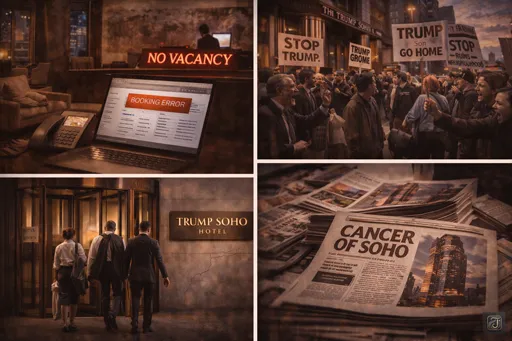
◆ Chaos in Hotel Operations
After opening, the hotel was perpetually plagued by vacant rooms.
Its sterile, inorganic sense of luxury—so out of place in an art district—failed to attract guests.
• The reservation system was in constant disarray
• Employees quit one after another, and even new hires didn’t last
• Local residents were furious, with protests never ceasing
• The media branded it “the cancer of SoHo.”
Trump, seething with frustration, slammed his fist down on the conference table.
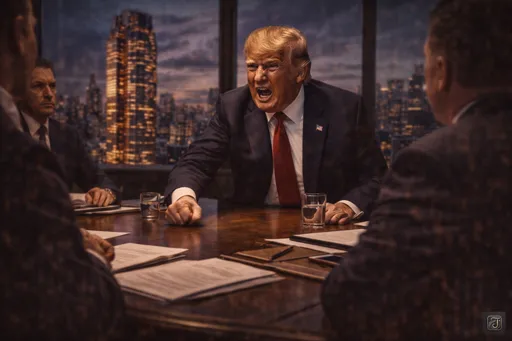
“Why won’t it fill up? It’s the Trump brand!
It would be a success anywhere else in Manhattan!”
No one could answer.
SoHo had its own culture, its own aesthetic—and the golden tower that had suddenly appeared there was simply rejected.
◆ And Then Came the “Execution Notice”: The Stripping of the Brand
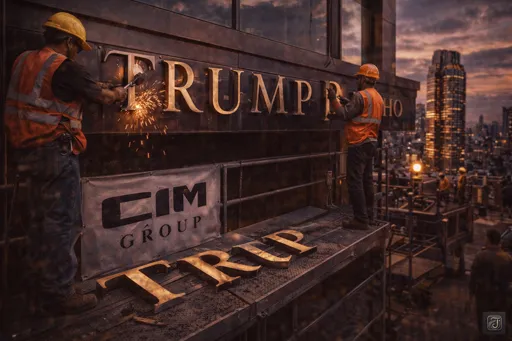
In 2017, the owner, CIM Group, finally reached its conclusion.
“The Trump name is no longer an asset—it is a liability.”
For Trump, this was the most important thing of all.
The one absolute capital he had inherited from his father—the name “TRUMP.”
The day came when that name was officially removed.
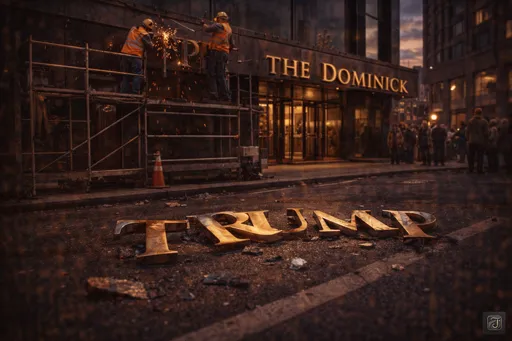
The giant sign in front of the hotel was dismantled letter by letter.
T. R. U. M. P.
Each piece fell onto the asphalt with a dull, heavy sound.
The new name was “The Dominick.”
There was no trace of Trump left anywhere.
Trump chose not to speak about it.
But those around him knew.
—This was one of the most humiliating defeats of his life.
◆ What Remained in the Night of SoHo
The city of Manhattan mercilessly swallowed both his victories and his defeats.
But the tower in SoHo was an exception.
An artist once said:
“Only beautiful buildings can survive in a beautiful city.”
Trump’s tower was beautiful.
But it never touched the soul of the city.
That was the reason for its defeat.
◆ Theme of This Chapter
“Brand power is not universal. Every city has its own aesthetic.”
This was the lesson of Trump SoHo,
and one of the few battlegrounds where Trump could not win by name alone.
Chapter 11: The Anti-Elite Banner (The Obama Birthplace Controversy)
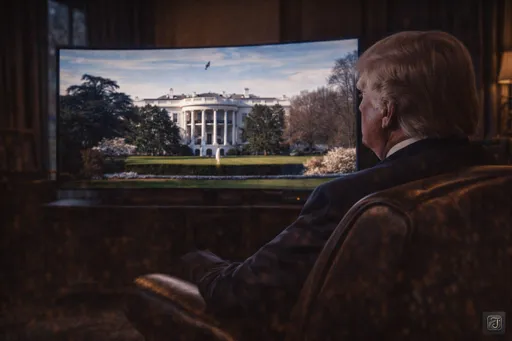
A gentle spring breeze swept quietly across the White House lawn.
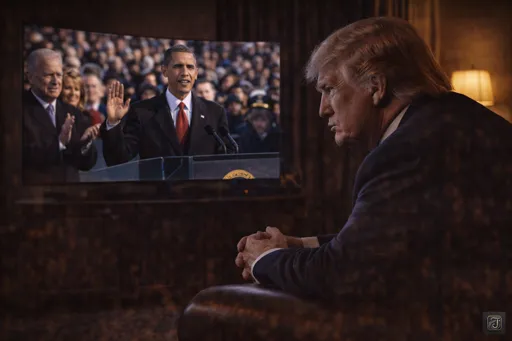
A man who did not belong there was gazing at that garden through a television screen.
Sinking deep into a leather chair, Trump felt his chest scorched by a certain sensation.
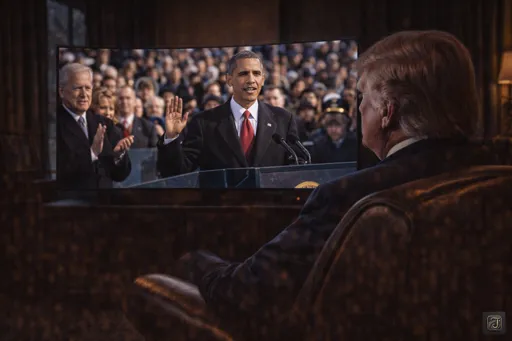
—The age of Obama had arrived.
But at the same time, it also meant that the age of Trump was drawing closer.
In 2009, when Barack Obama became the first Black president of the United States,
the nation was wrapped in hope and applause.
But Trump did not like it.
The reason was simple—and unmistakably Trump.
“I should be more suited to be president than he is.”
Jealousy?
Competitiveness?
Pride?
All of them were true.
Above all, the presence of Obama—a “charismatic elite”—ignited the anti-elite instinct that had been sleeping deep in Trump’s chest.
■ The spark was a small rumor
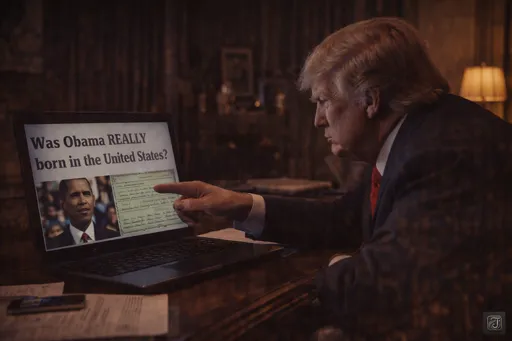
One day, Trump heard something from a staff member.
“Was Obama really born in the United States?”
In reality, it was nothing more than a baseless conspiracy theory smoldering in a corner of the internet.
But at that moment, something flashed sharply in Trump’s eyes.
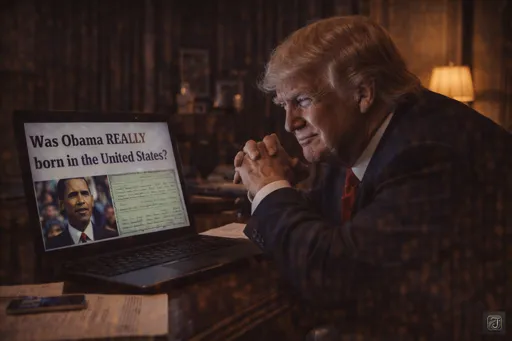
“Interesting.
This isn’t a test of whether it’s ‘true’ or not—
It’s a test of how angry the public will get.”
He understood the psychology of a populace that despised elites.
And he became convinced that he could be the standard-bearer of that anger.
■ The Man Who Provoked the Media
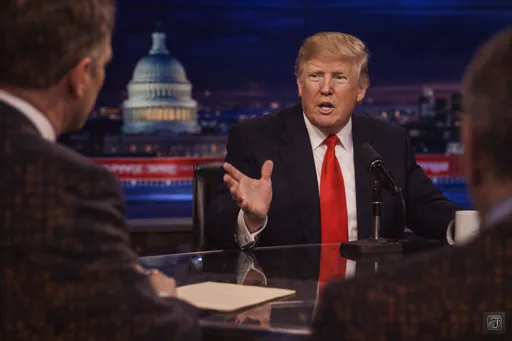
Trump appeared confidently on television shows and voiced the rumor in question.
“I’m just asking a question. Was he really born in the United States? I think he should show his birth certificate.”
The host was bewildered, experts pushed back,
but Trump was utterly unfazed.
He continued.
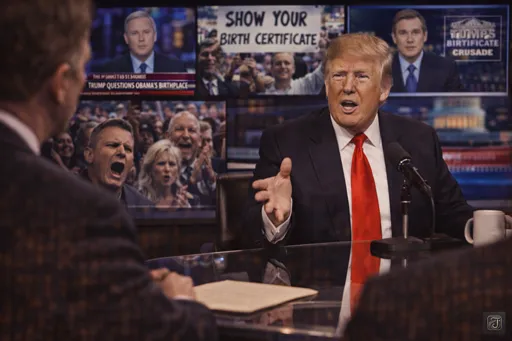
“If he truly is an American, then he should confidently produce the certificate.”
Those words spread across the United States in an instant.
- Those who denounced Trump as a madman
- Those who applauded, saying, “He finally said it!”
- A public stirred up by the media, their anger growing louder
America split into two.
Trump smiled quietly.
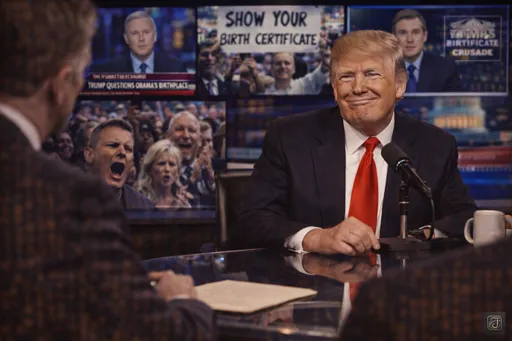
“Good. Division becomes power.”
■ The White House Was Shaken
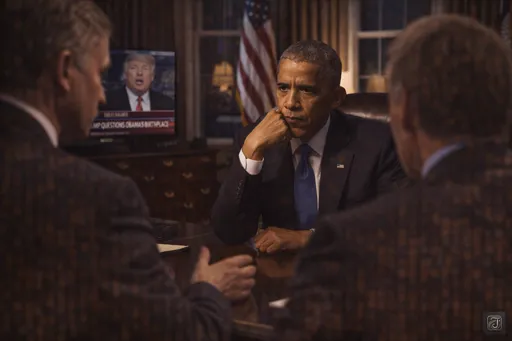
At first, the Obama camp ignored the rumor.
They judged it unworthy of a response.
But as Trump’s words began to dominate television, political commentators grew restless.
“Trump’s influence can’t be ignored.”
“This man is not just a real estate mogul.”
“This is the beginning of a ‘populist war.’”
And finally, the White House took the extraordinary step of releasing Obama’s birth certificate.
Obama himself appeared at a press conference and said with a wry smile:
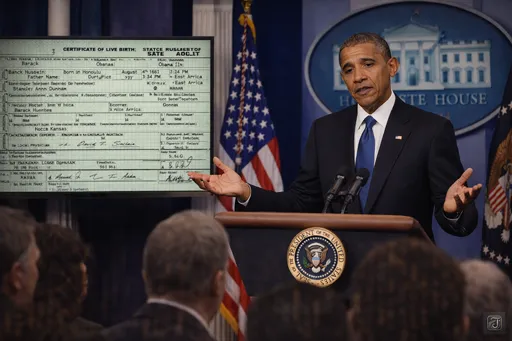
“This should never have been necessary in the first place.”
Yet immediately afterward, a strange phenomenon occurred.
Trump’s approval ratings rose.
At that moment, he became certain of victory.
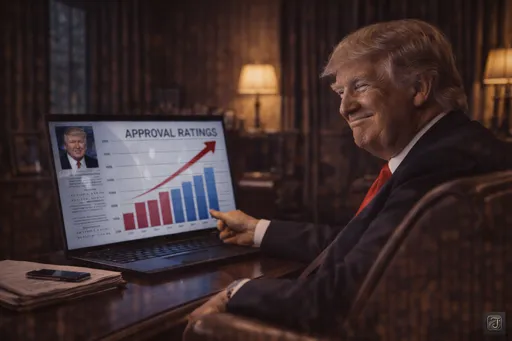
“It doesn’t matter whether the certificate is released or not.
I will be remembered as the man who raised the question.
And the anger of the people will eventually carry me to the White House.”
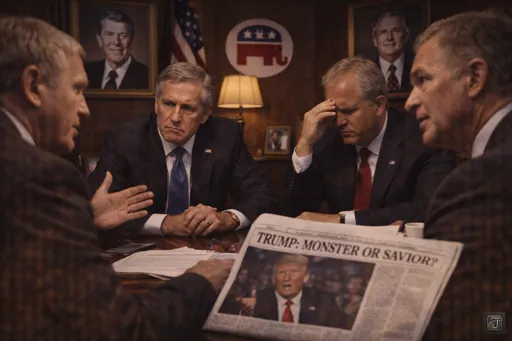
■ The Republican Party Begins to See Him as “a Monster or a Savior.”
Inside the Republican Party, things were shaking.
“He’s dangerous. But he has power.”
“If we bring Trump into the fold, we can win votes.”
“But he’s impossible to control.”
Then, a conservative lawmaker said this:
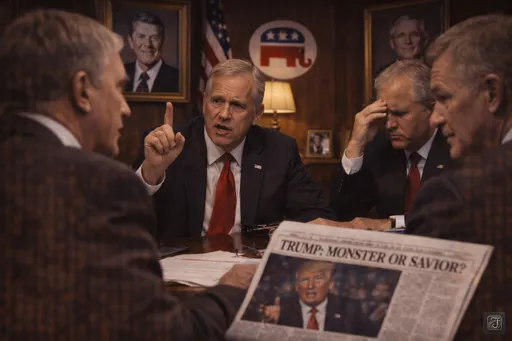
“Trump is the anti-elite symbol we’ve been searching for over the past twenty years.”
That was everything.
Trump’s ability to give voice to anger—
That, above all else, was the power conservatives across America had been longing for.
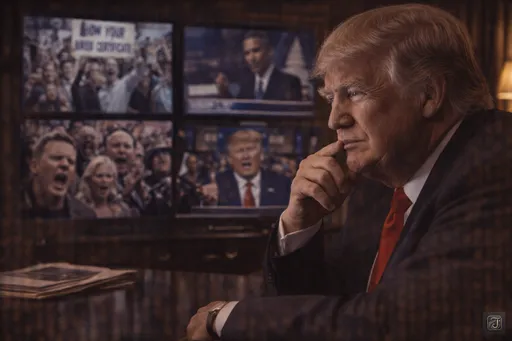
■ And Trump Saw Through It
The birthplace controversy was not a conspiracy theory.
It was a political experiment.
- Hatred can mobilize votes
- Attacking elites generates applause
- The media amplifies the flames of anger
- Conflict itself becomes the foundation of power
And so, he reached his conclusion.
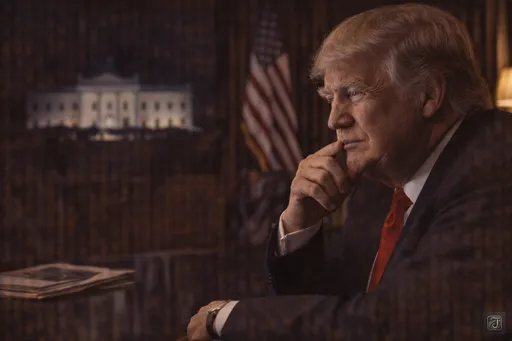
“This country is driven by anger. The one who can harness that anger will be the next leader.”
In other words—
“the one who can become president.”
■ The Story Moves On to the Next Chapter
He still had no intention of officially running for office.
But the success of this “experiment” convinced him of one thing.
America was ready to accept Trump.
And he himself was ready to wield America—the vast monster—as his instrument.
From this point on, there would be no turning back.
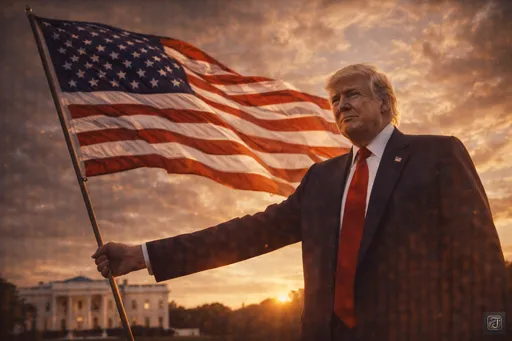
On that day, the banner of Trump as an “anti-elite” figure caught the wind
and began to unfurl on a grand scale.
Chapter 12: 2016 — The Year the Crown Was Taken
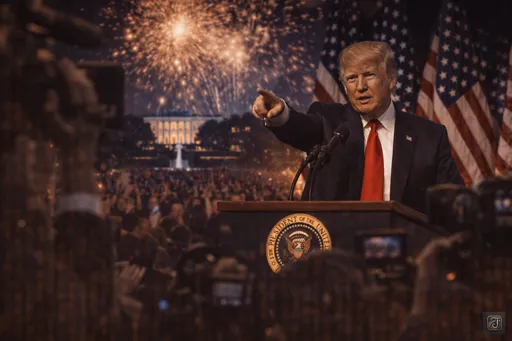
— The moment an “outsider” reclaimed the throne of the empire —
America is a nation that can be graceful at times, violent at others—and above all, easily bored.
People had grown weary of hearing the same politicians repeat the same words over and over again.
Into that void—this backlash against boredom—steps someone who inevitably shakes history.
That year, a man appeared with a golden crown placed upon his name.
Donald J. Trump
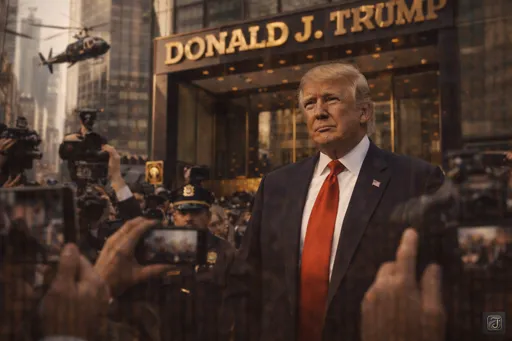
Reporters swarmed the street in front of Trump Tower.
Helicopters circled above Manhattan.
The media shouted:
“Is he really going to run?”
On that day alone, the grand atrium of Trump Tower was eerily quiet.
Light reflected off the marble floors, and the waterfall in the open atrium sounded louder than usual.
Then the man appeared at the top of the escalator, slowly descending.
He did not wave.
He did not puff out his chest.
He simply walked with the measured stride of someone who believes he stands at the center of the world.
In that moment, the needle of history shifted—just slightly.
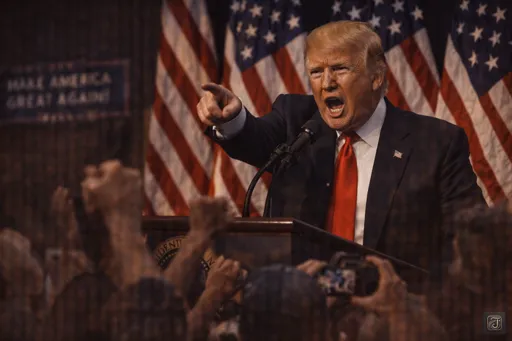
“Make America Great Again.”
Those words were a declaration of war.
Trump’s speeches were not those of a politician.
His words were sharp, rough, and—fatally—honest.
“China is ripping us off.”
“Japan isn’t paying for its own defense.”
“A border with Mexico means nothing without a wall.”
Each line was aggressive enough to rattle allies around the world.
But America’s workers heard something different.
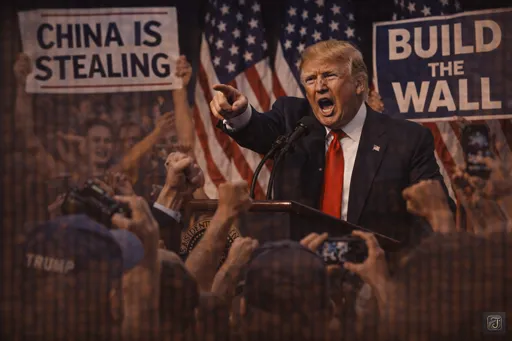
“Finally—someone is saying it.”
That was their honest feeling.
Trump didn’t care about policy consistency.
He drew clear lines between enemies and allies, gave direction to anger, and built a grand theater of “us versus them.”
And that theater was exactly what America had been waiting for.
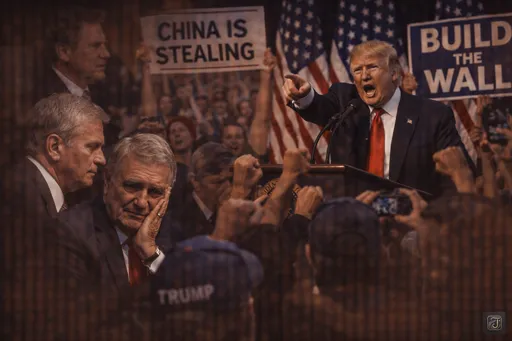
Chaos in the Republican Party — and Surrender
The party leadership resisted desperately.
“He’s destroying Republican tradition.”
“His language is far too extreme.”
“He’s a destroyer of conservative ideology.”
But rank-and-file voters poured in behind Trump like an avalanche.
On the debate stage, Trump crushed his rivals with words that felt like bare-knuckle punches, leaving no room for recovery.
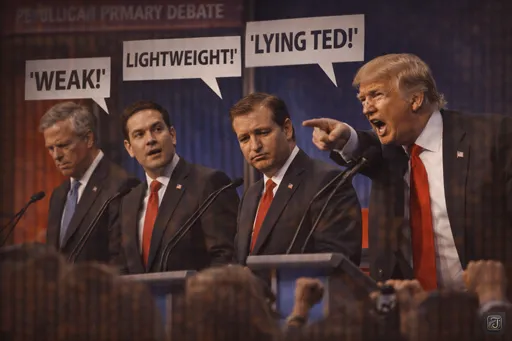
“Jeb Bush is too weak.”
“Rubio is a scripted, made-for-TV politician.”
“Ted Cruz is a man nobody likes.”
He executed flawlessly the tactic he had learned back in the Reform Party: create enemies, then crush them.
In the end, the Republican Party understood the truth.
— There was no longer any way to stop this man.
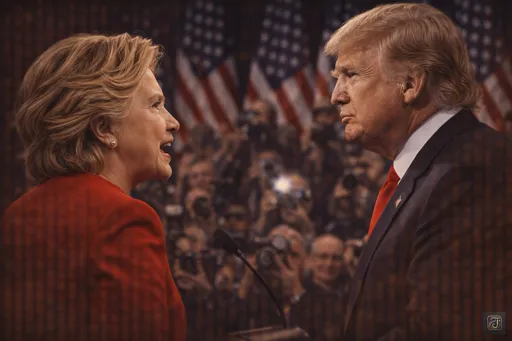
Clinton vs. Trump: A Battle for the Soul of America
The media said:
“Clinton’s victory is assured.”
“Trump’s chances of winning are 1–3%.”
“He is not fit to be president.”
But everything was wrong.
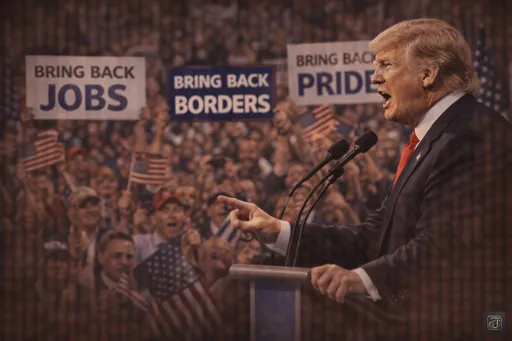
Trump did not win on policy, but on story.
“Bring back lost jobs.”
“Take back our borders.”
“Restore America’s pride.”
The word “take back” pierced the hearts of a nation carrying deep wounds.
If Clinton’s speeches were built on logic, Trump’s were built on emotion.
And elections are decided by emotion.
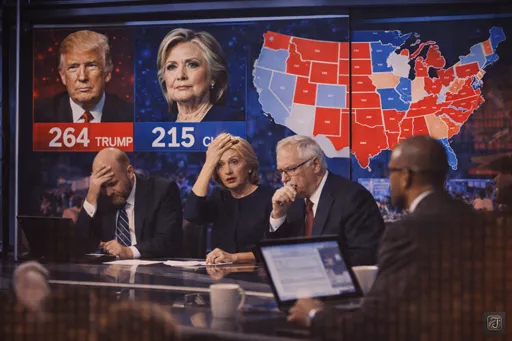
Election Night: The Moment the World Froze
November 8, 2016.
As the vote counts streamed in live, studios around the world fell silent.
Pennsylvania.
Michigan.
Wisconsin.
States that were supposed to be blue turned red, one after another.
Watching the television quietly, Trump said,
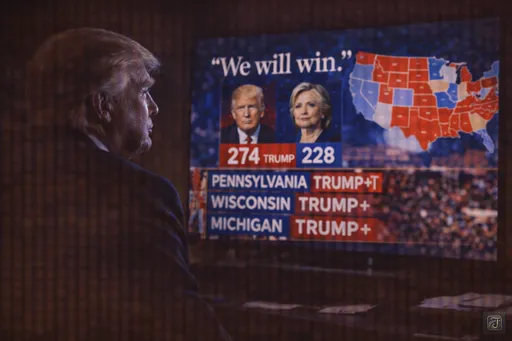
“We will win.”
A future no one believed in began to take shape before their eyes.
Late at night, it was confirmed.
Donald J. Trump
45th President of the United States.
A CNN anchor said, his voice trembling:
“America has entered a completely new era.”
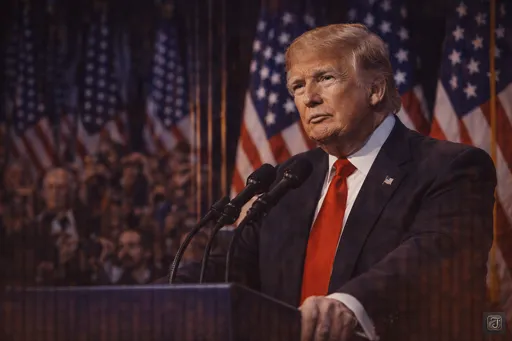
Victory Speech — “My fellow Americans, I have reclaimed the crown.”
New York.
The man who descended from the top floor of Trump Tower looked exhausted.
Yet his eyes shone like a boy’s, cold and sharp like an emperor’s.
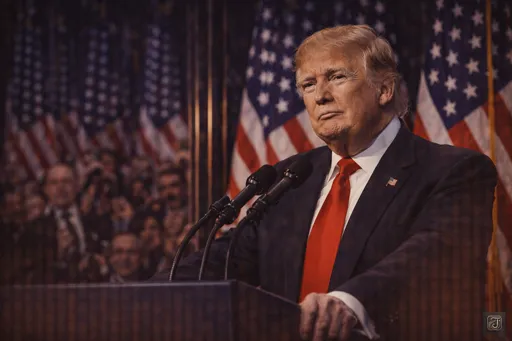
“The forgotten people will be forgotten no longer.
From this day forward, America is your country again.”
He was not wearing the smile of a victor,
but the expression of a man who had finished his revenge.
In that moment, America changed.
The world changed.
And history would be rewritten like this:
— In 2016, Trump took the crown.
Chapter 13: The Global Trade War (2018)
“They hit us, so we hit back.”
And the world began to shake.
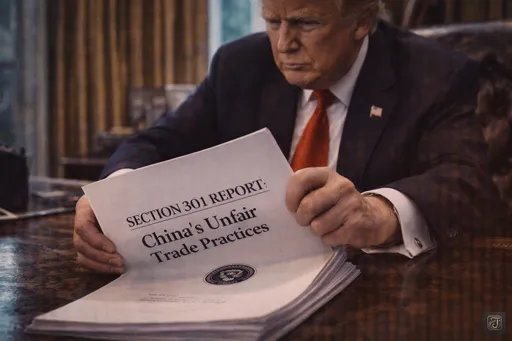
The Oval Office.
On the marble desk lay a thick file.
Its title read:
“SECTION 301 REPORT: China’s Unfair Trade Practices.”
A report compiled over months by the Office of the United States Trade Representative—
As Trump turned its pages, his fingers trembled with anger.
“For forty years, China has been stealing our technology.
Our factories were emptied, our workers lost their jobs.
And what were the politicians doing?
Nothing.”
The aides in the room held their breath.
The president’s voice was low—yet filled with absolute conviction.
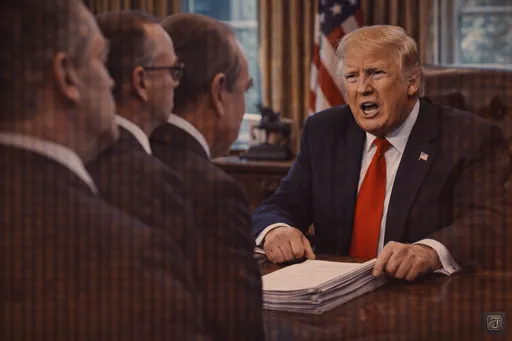
“Then I’ll do it. What no one in the world has ever done.”
And with that, a single signature—destined to be etched into history—was set down.
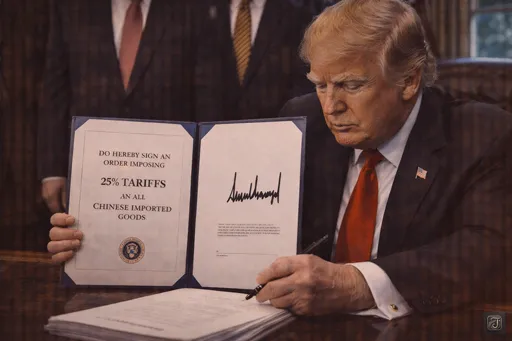
“Impose a flat 25 percent tariff on Chinese goods.”
The room seemed to shudder—
whether it was merely the aides’ hearts skipping a beat,
or the unmistakable prelude to a global economic war about to begin.
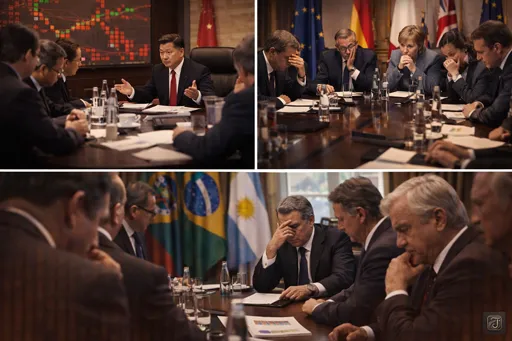
■ The world tensed in an instant
The next morning.
Markets were thrown into turmoil. Asia, Europe, South America—
Leaders around the world convened emergency meetings.
And China responded immediately.
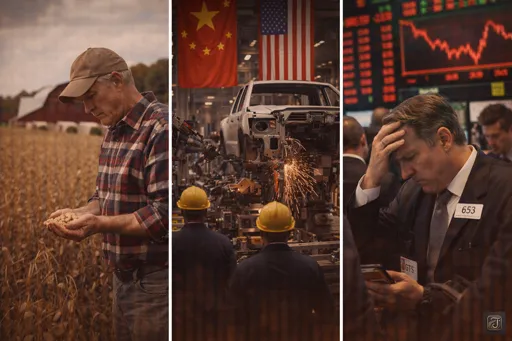
“We will impose retaliatory tariffs.”
American farmers’ soybeans.
Midwestern automobiles.
Wall Street investors.
Everyone began calculating the cost of the war.
But Trump did not back down.
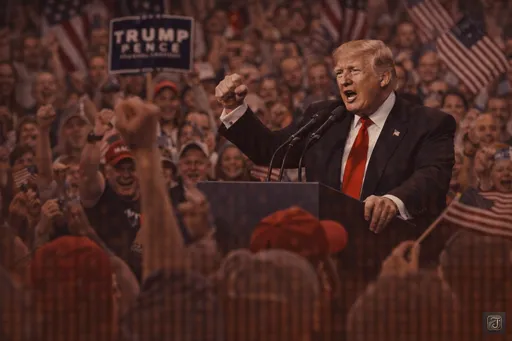
“China struck us. We laughed it off. So now, we strike back.”
When he said that on television, his supporters erupted in cheers.
Calls for a “strong America” flared up from within the country itself.
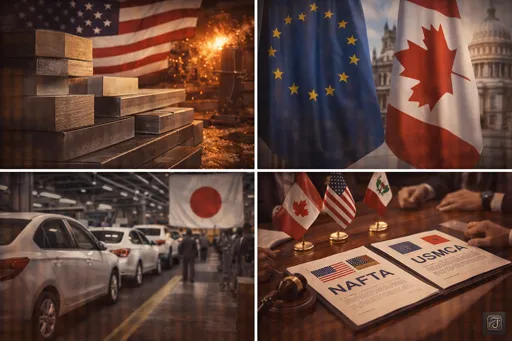
■ The world feared “Trump’s tariffs.”
Trump kept shifting his targets.
- 25% tariffs on steel and aluminum
- Tariffs imposed on the EU and Canada
- Japanese automobiles placed in the crosshairs
- NAFTA (U.S.–Canada–Mexico) scrapped and forcefully renegotiated into the USMCA
America’s allies around the world were left bewildered.
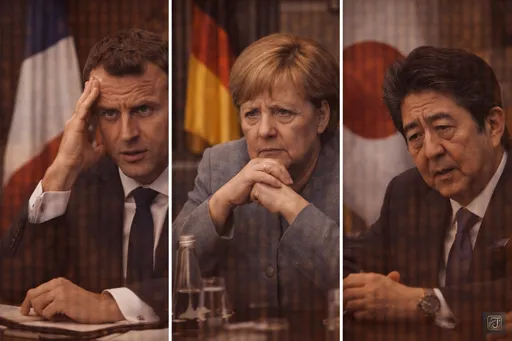
“Why are we being treated as enemies too?”
But Trump’s logic was simple.
“Any country that runs a trade surplus at America’s expense is not a ‘friend.’”
And then he said:
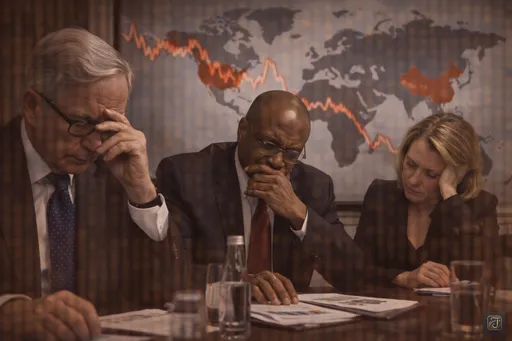
“Trade wars are easy to win.”
Only experts understood just how dangerous those words were.
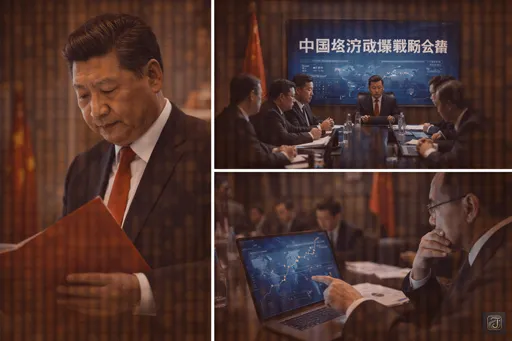
■ China Did Not Stay Silent, and the Global Economy Began to Ripple
China responded with retaliation, but internally it was calculating something else.
“America is divided. China is united. In a war of endurance, we can win.”
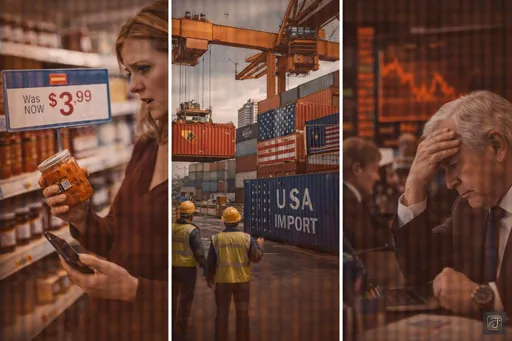
Thus the two countries continued to trade blows with tariffs, while companies around the world suffered in the crossfire.
Prices rose, supply chains fell into chaos, and investors found themselves with nowhere to run.
Economists said:
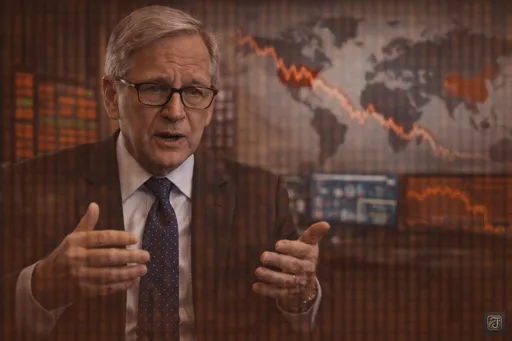
“This is not about tariffs. It is a war that severs the nerves of the global economy.”
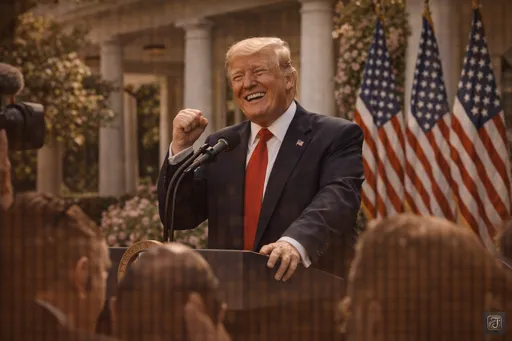
■ Yet Trump smiled
In the White House Rose Garden, Trump declared confidently at a press conference.
“China has disrespected America. But that ends now.
America will once again be a nation that wins.”
His face was the same as it had been when he built golden towers in Manhattan.
It didn’t matter who the enemy was—he would defeat them.
It was the face of a man who made the world believe that.
But at that moment, many of his aides had already realized the truth.
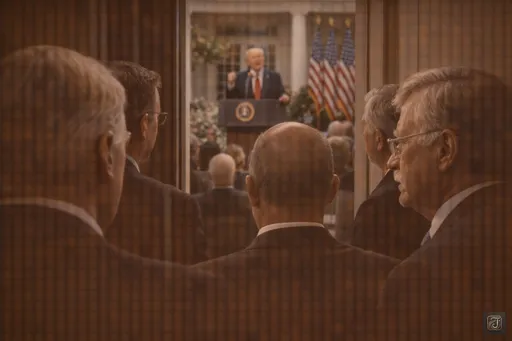
“If Trump fights the world, the world will fight Trump in return.”
What would remain at the end of this war—
No one yet knew the answer.
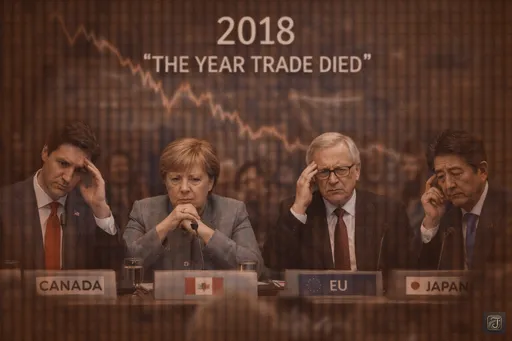
■ The Global Economy Trembled, and an Era Was Decided
2018.
Among experts, this year came to be known as:
“The Year Trade Died.”
The very premise of free markets was shaken, and even America’s allies could no longer hide their unease.
At the same time, the world came to understand Donald Trump anew.
He does not fear.
He does not compromise.
He does not choose his enemies.
As long as he believes in victory, he moves forward.
That figure was unchanged—
the same man who once carved his name into a golden tower in Manhattan.
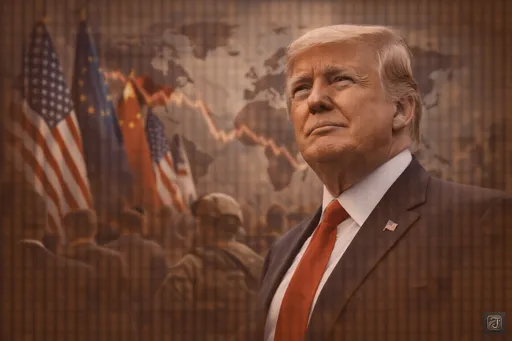
■ Toward the Final Chapter
Triggered by the trade war, the world stepped into a new era,
and the international order began to warp with an audible creak.
This battle is not over yet.
And everyone was starting to realize it.
“Trump’s story is made entirely of battles.”
Chapter 14: 2025 — Echoes of Fire (A Symbolic Literary Interpretation)
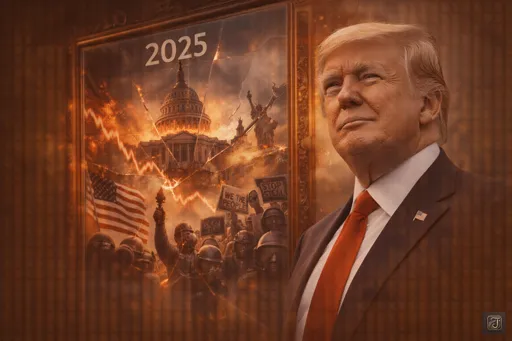
— The Man Summoned Back by His Era, and America as a Mirror —
America sometimes becomes a vast mirror.
What is reflected there is not politicians, nor citizens, nor even national ideals.
It is simply this:
what that era fears, what it desires, what it forgets, and what it dreams of —
nothing more than the flickering image of the spirit of the age (Zeitgeist) itself.
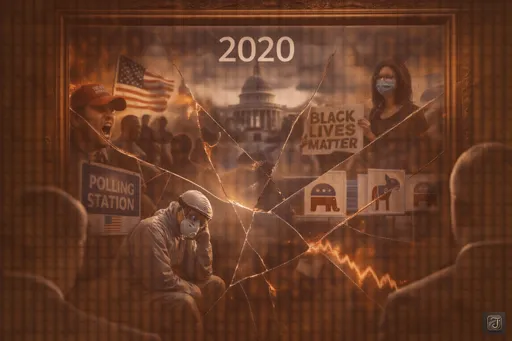
In 2020, America cracked that mirror.
Division, anger, anxiety, loneliness, exhaustion, emptiness.
The shadow of the pandemic spread across the land,
and the election made the nation tremble quietly, like ground split cleanly in two.
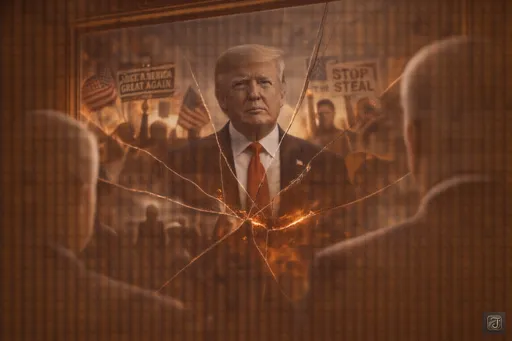
Trump was defeated.
But defeat did not erase him from the mirror.
Instead, something that had long been submerged in America’s deep undercurrent rose to the surface with greater clarity.
Was it anxiety? Hope? Anger? Or a hunger for change?
Trump as an individual may have ended there, once and for all.
But the phenomenon that sustained him was far from over.
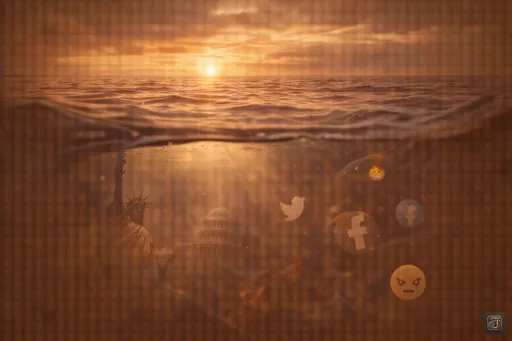
■ 2021–2023: The Shadow Growing in Silence
After Trump retreated to Florida, America appeared, at first glance, to regain its calm.
But it was only the stillness of the ocean’s surface; beneath it, massive currents continued to shift and reshape themselves.
Economic anxiety, the trembling of the international order, and social media amplifying division—once again, the public began to hunger for a “strong narrative.”
And there—
The phenomenon called Trump slowly regained its outline.
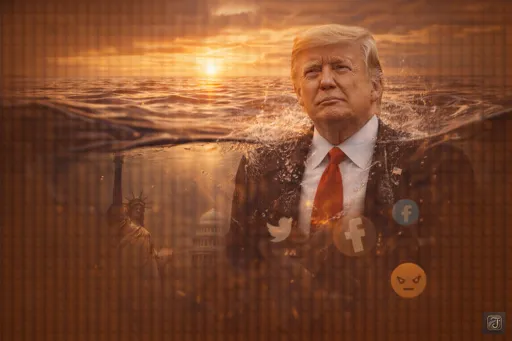
It was not because he moved.
The era itself moved toward him.
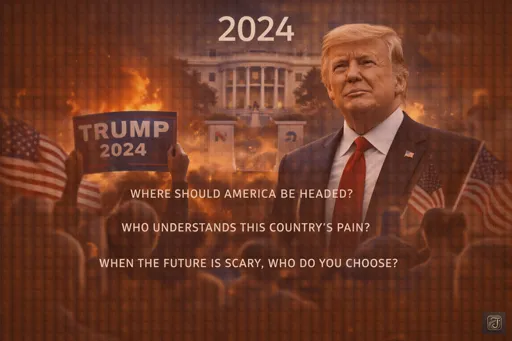
2024: The Year History Looked Back
In an election year, America was once again forced to confront its own shadow.
Not reason.
Not policy.
But the unresolved questions sunk deep in the nation’s chest began to stir the people.
“Where should America be headed?”
“Who truly understands this country’s pain?”
“When the future feels frightening, whom do people choose?”
To those questions, the nation called forth the same answer once again.
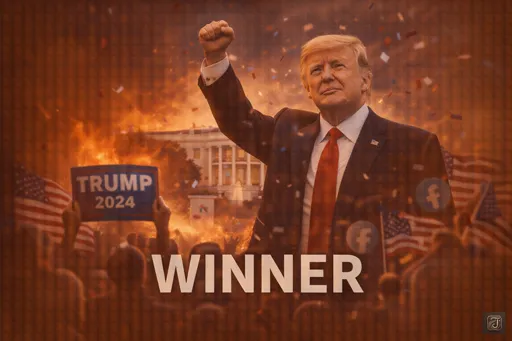
Trump’s victory was not so much an individual political triumph as it was the result of an era giving shape to its own anxieties and desires.
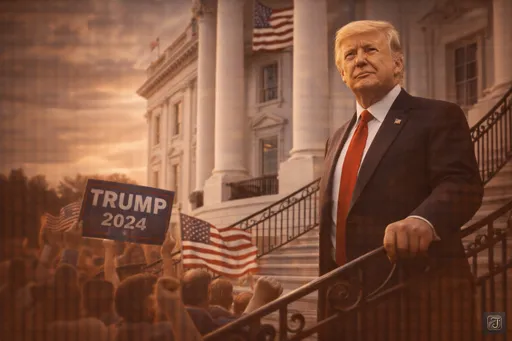
■ 2025: The Fire Returns
January 2025.
Trump once again ascended the steps of the White House.
Behind his aged expression, the same light as before still flickered.
Yet what history is trying to tell at this moment is not “politics.”
Rather, it is asking a different question:
“Why did America need him?”
He was a symbol of anxiety.
At the same time, he was a symbol of rebellion.
He became the voice of a public that despised the old order,
and a shield for those who feared the future.
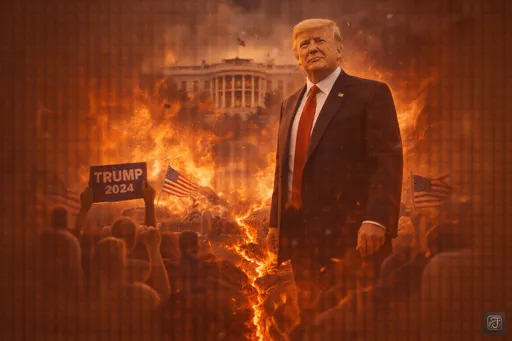
America chose “fire.”
Whether it sought warmth,
wished to illuminate the darkness,
or longed for a destructive light—
No one can yet answer that.
But one thing is certain.
Trump was not merely a man;
He was a “phenomenon” born from a fracture in the age itself.
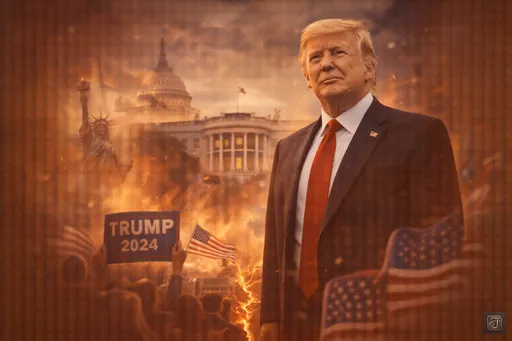
■Epilogue: As a Story of the Zeitgeist
The figure of Trump standing in America in 2025 was not that of a single politician,
but rather one answer within the larger story called America.
It is not a question of liking or disliking him.
Nor is it a matter of whether he was right or wrong.
History cannot be told within such simple frames.
Rather, it should be said this way.
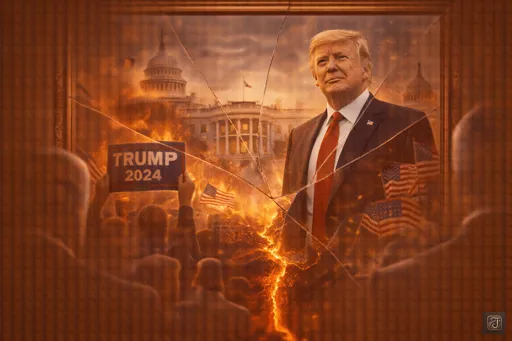
“In 2025, America chose once again to look into the mirror called Trump,
and to confront the image of itself reflected there.”
He was not a king.
Nor was he a rebel or a savior.
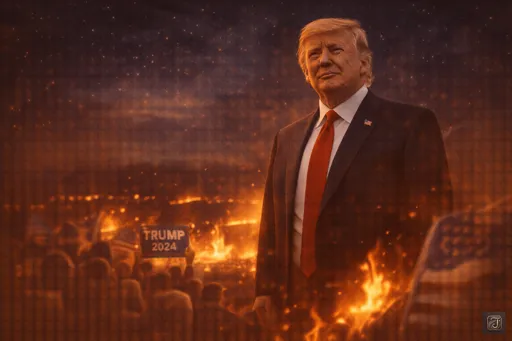
He was the age itself—shaped by the age that created him.
And that story is not yet over.
The fire has not gone out.
It continues to flicker quietly.
As a single symbol, in the vast night called America.
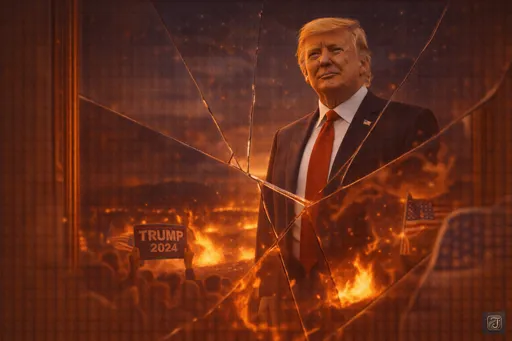
“The cracked mirror continues to reflect someone, even today.
Only history knows who will appear in it next.”
The images used in this article are not journalistic photographs depicting real individuals or events.
They are generated as narrative, critical, and symbolic representations,
and are not intended to assert or confirm any specific facts or actions.
Author’s Afterword

This story is not written to praise or to condemn a particular individual.
Nor does it aim to present a politically “correct” answer.
What I wanted to explore was this question:
Why a certain person came to be “needed.”
The structure behind that necessity, and the emotional currents that carried it.
Donald Trump is neither a hero, nor a monster, nor a savior.
Rather, I believe he was a mirror—
one created by an era to project its own anxiety, anger, desire, and fear.
What appeared in that mirror was not him.
What appeared was an America exhausted by division, frightened of the future,
and yet still desperate to believe in “strength.”
History is often told through the names of individuals.
But what truly moves history are the countless emotions, the atmosphere,
the silences, and the choices that exist behind those names.
If, after finishing this story, you find yourself asking not
“Who was Trump?”
but rather,
“Why did America create him?”
Then this story has fulfilled its purpose.
The mirror remains cracked.
What will be reflected in it next may be another name, or it may be an entirely new set of values.
When that moment comes, what will we see?
What will we choose?
History always leaves us with questions.
The answers are given only by those who live in the next era.
— Fuji
If you found this article helpful or enjoyable, please consider supporting me with a cup of coffee! 👈Click☕🙏
I’m a passionate blogger who loves diving deep into human history and sharing captivating stories about remarkable figures and events from the past. My blog combines engaging storytelling with beautiful illustrations, making history accessible and enjoyable for everyone.
Currently, I write my blog while managing a full-time job. Balancing both limits the time I can dedicate to research, writing, and illustrations. With your support on Ko-fi, I can reduce the time spent on my main job and focus more on blogging, allowing me to increase the frequency of updates and bring you even more captivating stories.
Whether it’s a one-time coffee or a regular contribution, every bit goes directly into making history engaging and fun for my readers.
Thank you for joining me on this journey through time.
Let’s uncover the past together!
If you found this article insightful, please consider supporting me with a cup of coffee! 👈Click☕🙏
Author: Fuji

Human history is truly complex, isn’t it?
There are countless websites introducing historical figures and events,
but many of them are just plain explanations—not exactly exciting to read.
On the other hand, reading books takes a lot of time and effort.
That’s where I come in.
Through “stories that are more engaging than explanations and shorter than books,” I aim to bring the world’s history and humanity’s records to you in a more accessible and interesting way.
If my stories inspire you to love history a little more, I’d be absolutely thrilled!

Comment